
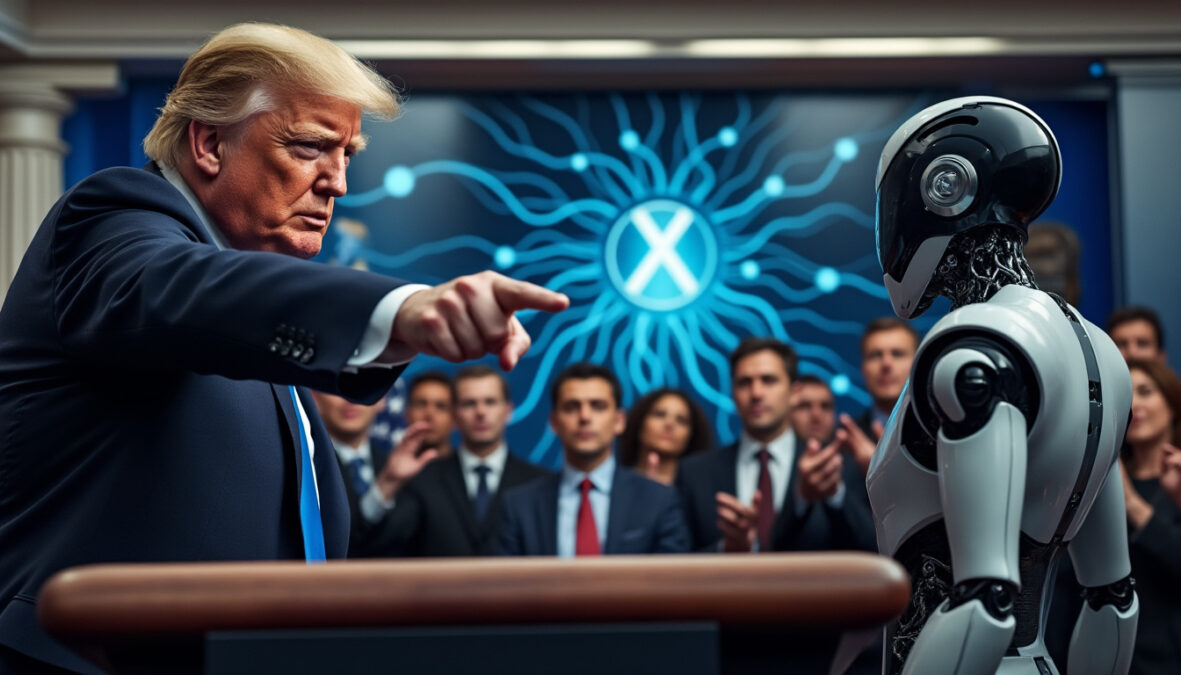
Donald Trump wants to replace the expression “artificial intelligence” with “superintelligence” in communications from the U.S. federal administration. The president has even called those who continue to use the old term “enemies.” But this new label, already adopted by some tech companies, could heighten public concerns rather than make AI more appealing.
New terminology imposed on the federal administration
Donald Trump’s determination to rename artificial intelligence has taken the form of a directive for communications from the U.S. government. The administration must now favor “superintelligence” in place of the usual expression, a term the president considers more positive and more precise.
On Thursday evening, Donald Trump struck a tougher tone on his social media platform Truth Social. He wrote that the White House considered anyone who used the expression “artificial intelligence” rather than the one he favors an “enemy.” The president did not, however, explain what concrete consequences this designation might entail.
The change had already been raised in September before the United Nations General Assembly. Donald Trump said then that “superintelligence” sounded better and that the word “artificial” might suggest that it was fake intelligence. He later signed an executive order requiring the new terminology in communications from the federal administration.
The measure applies to U.S. government agencies, but does not require private companies to abandon the term “artificial intelligence.” Companies and organizations therefore remain free to keep the established term, even though some have chosen to adopt the one promoted by the White House.
A change in vocabulary amid public concerns
For Jean-Pierre Dubé, a marketing professor at the University of Chicago, the initiative reveals a political concern: reservations about AI could hinder a sector considered a major driver of growth. In the context of economic and technological competition with China, the administration is seeking to encourage public support for the industry.
The researcher remains skeptical, however, that a name change can alter perceptions. In his view, hoping to sway public opinion through a simple change in vocabulary is more wishful thinking than a strategy likely to persuade people over the long term. Concerns associated with this technology relate to its uses and effects, and do not necessarily disappear with a new label.
Opinion data illustrate this distrust. In a recent Quinnipiac University poll, only 25% of voters said they were satisfied with the way Donald Trump was handling artificial intelligence, compared with 58% who said they were dissatisfied. Many Americans already use AI-powered tools while expressing concerns about safety, jobs, and the growth of very large data centers.
This tension between AI’s potential benefits and the risks it raises emerges in a wide range of debates. One discussion centered on technology and human nature is explored in this article about a day of discussions at Solan Monastery on how artificial intelligence is redefining human nature.
“Superintelligence”: an expression that could be even more alarming
The term chosen by Donald Trump does not necessarily seem more reassuring than the one he wants to replace. Jean-Pierre Dubé points out that treating the word “artificial” as alarming risks making the expression “superintelligence” even more frightening. The idea of superiority suggested by the prefix “super” can indeed evoke a technology that surpasses human capabilities.
Ronald Kline, a historian at Cornell University, observes that the expression goes beyond imitating human intelligence: it implies that technological intelligence could surpass it. This semantic shift resonates with concerns already present in public debate, particularly those about loss of control, the autonomy of systems, or the replacement of certain human tasks.
These concerns are not limited to scenarios in which technology surpasses human intelligence. They also relate to systems that influence real-world decisions and can shift power toward automated tools. This issue is explored in an article about the growing role of algorithms, where decision-making power is described as shifting from humans to algorithms.
A historic term Donald Trump wants to replace
From academic research to everyday use
The expression “artificial intelligence” dates back to 1956, when it was used at a summer workshop held at Dartmouth College in the United States. The choice of a broad term was intended to bring together researchers from a range of disciplines, including mathematics, psychology, and engineering, under a single label.
The project at the time was to teach computers, which were large calculating machines, to perform tasks associated with human thought. The phrase has sometimes been criticized for grouping together very different technologies and methods. Despite these reservations, it gradually became established in scientific, economic, and public vocabulary.
The acronym helped spread the term. In French, “IA,” and in English, “AI,” became familiar terms, propelled by the growth of specialized companies and the popularity of tools accessible to the general public. The rapid growth of companies such as OpenAI further reinforced the use of the label.
Donald Trump has previously challenged certain names and designations in other contexts. His White House notably criticized the Associated Press for continuing to use “Gulf of Mexico” rather than the name “Gulf of America” favored by the president. The episode surrounding artificial intelligence is therefore part of a broader policy of focusing on the words used by institutions and the media.
Tech companies adopt the expression
Meta and Elon Musk adopt “superintelligence”
Several major players in the sector have started using the new expression in their communications. Meta, led by Mark Zuckerberg, has adopted it in some messages. Elon Musk, a close ally of Donald Trump, also uses it on X and actively supports this change in vocabulary.
For companies that deal with the government, adopting the president’s terminology may be a pragmatic choice. One industry lobbyist believes that publicly pitting “AI” against “superintelligence” is not a priority for tech companies. This stance does not necessarily mean that companies share the president’s analysis; it may also reflect their desire to avoid a dispute with federal authorities.
The executive order does not require OpenAI to rename its products or abandon the expression “artificial intelligence.” The measure’s scope remains limited to government communications. Nevertheless, the repeated use of “superintelligence” by influential companies could help the expression spread beyond public institutions.
Controversies that go beyond the name of the technology
The battle over words is unfolding as AI companies face questions about their data, models, and practices. In the United States, the use of data originating in China has fueled controversy involving several players in the sector, as discussed in this article about U.S. companies and the use of Chinese data.
Digital security is another source of concern. Advances in AI tools can make certain tasks easier, but they also raise questions about protecting systems and the ability to prevent cyberattacks. This topic is explored in an article about how artificial intelligence is putting cybersecurity to the test.
The risks associated with the spread of misleading content are also part of the debate. An unfounded rumor attributed to artificial intelligence concerning Sadio Mané was examined in an article that points out that the information circulated about him had no basis. This example illustrates the importance of verifying content, whether it is generated or simply shared by digital tools.
In this context, the choice between “artificial intelligence” and “superintelligence” is not merely a matter of stylistic preference. The terms used shape how the public views the technology: one refers to a broad category of techniques, while the other more directly suggests a system capable of surpassing human faculties. The debate initiated by Donald Trump thus places terminology at the heart of a broader discussion about trust, regulation, and AI’s place in society.


