
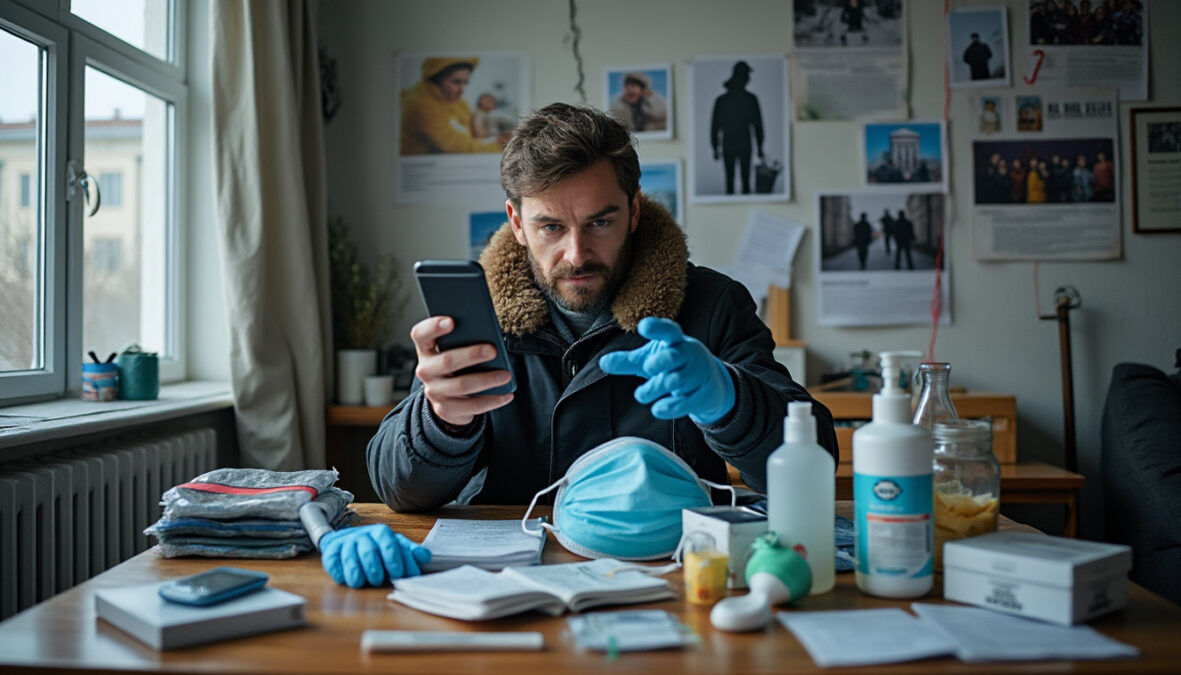
Following the death of a laboratory employee in Siberia, initially linked in early reports to possible exposure to plague, promotional videos quickly encouraged American and Canadian internet users to buy a $300 care kit. Presented as a way to prepare for a potential crisis, the product is raising concerns: specialists point out that plague is treated with appropriate medications and that, in their view, the incident reported in Russia does not amount to a pandemic scenario.
Suspected plague in Russia: conspiracy theorists wasted no time selling their $300 care kit
The circulation of information about a possible case of plague in Russia was followed by the spread of commercial content on social media. In the United States and Canada, posts are urging internet users to get a kit presented as useful in a health emergency. Its listed price of $300 and the urgent messages accompanying it have helped attract attention online.
One of these promotional videos, posted on Facebook, has surpassed 161,000 views. Its caption urges users to buy the supplies before others rush to do so. This kind of wording turns uncertain medical information into a sales pitch, playing on the idea that people need to act immediately to avoid being caught unprepared.
Health concerns turned into a sales pitch
Media coverage of the death of a laboratory employee working with plague in Siberia provided a favorable backdrop for these messages. In the first reports, attention focused on the possibility of a link to the disease. However, the available information is not enough to establish that the incident signals wider spread, and Russian authorities attributed the death to pneumonia.
Despite these uncertainties, some videos present buying the kit as an essential precaution. They link the fear of infection to a commercial recommendation, without always clearly explaining the level of risk, the product’s limitations, or the difference between a first-aid kit and medical treatment. The message is simple: it would be better to pay now than regret not doing so later.
A $300 kit promoted on social media
The product featured in these posts is marketed as a set of supplies for preparing for an emergency. Its high price is justified to the public by the advertised inclusion of various items, including doxycycline, an antibiotic used in certain medical situations. Highlighting this medication gives the kit the appearance of being a direct response to plague, even though antibiotics should be taken under the supervision of healthcare professionals.
An American influencer known by the pseudonym DC Draino also promoted the product to his approximately 2.9 million followers. The visibility of a personality like this can amplify a claim, especially when it is posted at a time when a worrying event is widely circulating. But a recommendation shared by a popular account does not, by itself, constitute medical validation of the kit’s contents or usefulness.
The presence of an antibiotic does not guarantee protection
Doxycycline is one of the antibiotics that may be used to treat plague in affected countries, depending on the circumstances and medical protocols. This does not mean that a kit containing this medication can be considered a universal remedy or insurance against infection. The choice of treatment depends in particular on the diagnosis, the patient’s condition, and an assessment by a professional.
Buying and taking antibiotics without medical advice carries risks. A medication may not be suitable for someone, may cause side effects, or may delay necessary care. In addition, a kit sold online is no substitute for a medical examination or instructions from health authorities. The presence of a medication’s name on a label is therefore not enough on its own to determine whether the product is appropriate for a given situation.
Misinformation thrives in times of uncertainty
Misinformation specialists observe that health crises create fertile ground for dubious commercial offers. When information is incomplete and the public is looking for quick answers, some sellers exploit fear and uncertainty to present products as essential. The promise of being prepared in advance can then take precedence over examining the evidence and medical recommendations.
This pattern is not new. During previous health emergencies, products have been promoted as ways to prevent or treat disease before their effectiveness was proven. Social media accelerates the spread of these messages: an alarming video can be shared much faster than a detailed explanation of the actual risks, symptoms, or available care.
The brand offering the kit is run by an American cardiologist who has shared conspiracy theories, particularly about the Covid-19 pandemic. This fact alone does not make it possible to determine the product’s exact composition or assess every commercial claim. It does, however, underscore the importance of distinguishing a person’s professional credentials, their public statements, and independent evidence regarding a product’s effectiveness.
What specialists say about the risk of plague
Infectious disease specialists cited in the available reports point out that plague is a known disease and that treatments are available. For Isaac Bogoch, an infectious disease specialist, the case reported in Russia is not the kind of infection that could, on its own, cause a pandemic. This assessment contrasts with promotional messages that portray an imminent threat to drive sales.
Plague can be serious and requires prompt care when diagnosed. But the existence of a serious disease does not automatically mean that a widespread outbreak is underway. Assessing a situation requires taking into account confirmed medical information, the mode of transmission, the number of cases, and public health measures, rather than relying on commercial videos or alarmist messages.
A reported case does not mean a pandemic is imminent
Caution is still important when the first details of a health incident are reported. The circumstances of a death, the stated medical cause, and possible exposure to an infectious agent may be clarified over time. In this context, claims presented as certain by sellers or influencers should be scrutinized carefully.
According to the reports, Moscow attributed the death to pneumonia. The available information does not describe a plague outbreak or international spread. The experts cited therefore highlight the gap between the case in question and the pandemic scenarios alluded to in some posts to create a sense of urgency.
How to spot alarmist marketing
Several signs can help identify communications that exploit a health crisis. A message that demands an immediate decision, emphasizes shortages, or claims that a product is the only way to protect yourself warrants verification. It is also useful to check whether the claimed benefits are supported by independent medical data and whether the risks associated with using the product are explained.
Caution is also warranted when a recommendation is based mainly on the popularity of the person sharing it. A high number of followers or views is no substitute for scientific evaluation. It is important to distinguish between an advertisement, a personal testimonial, and a recommendation made by authorities or healthcare professionals as part of their work.
In the case of the $300 kit, the promotion’s emphasis on doxycycline and the context of the death in Siberia make it seem highly urgent. Yet the specialists cited point out that plague is treatable and that, based on the information reported so far, the suspected case in Russia does not indicate a risk of a pandemic. This gap between the alarmist tone of an advertisement and the experts’ assessment lies at the heart of the questions raised by the product’s sale.


