
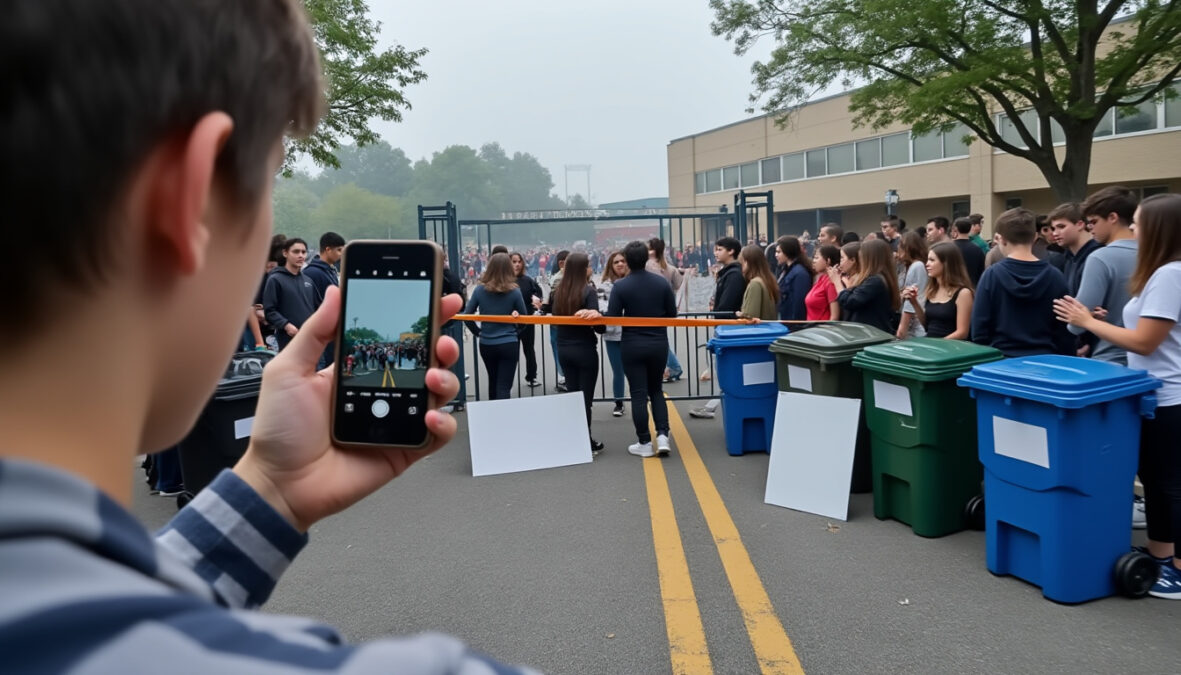
High school blockades are continuing as authorities report more than 5,000 people taken into police custody since the start of the protests. In this context, social media is rapidly spreading videos of vandalism and calls to join demonstrations, making violence more visible and sometimes more glorified. However, its role is not limited to relaying events: recommendation systems can also expose more young people to this content and influence how the protests are perceived.
Videos of vandalism widely shared
As the blockades continue, videos showing bins set on fire or police vehicles being targeted are circulating on several platforms. Some are accompanied by comments celebrating the unrest or encouraging people to continue the action. Phrases such as “things have to blow up” or calls to attack law enforcement can thus be seen, shared, and commented on far beyond the places where the incidents occur.
The repeated appearance of these images gives prominence to the most spectacular scenes. A peaceful blockade or a discussion about the protesters’ demands is less likely to go viral than a confrontation. The most striking content can therefore take up a disproportionate amount of space in news feeds, risking the impression that violence sums up the entire protest movement.
This rapid circulation also blurs the facts. A video may be posted without precise context, shared by other accounts, or accompanied by a caption that shapes how it is interpreted. Users do not always know where or when the footage was shot, or what happened before or after the clip. Sharing can then amplify an emotion—anger, outrage, or enthusiasm—before the facts can be verified.
When calls for vandalism become intertwined with demands
Some posts present vandalism as an accepted part of the movement and reject the distinction between protesters and perpetrators of violence. Others go further, explicitly urging people to target property or issuing challenges designed to provoke reactions and “Likes.” Near a high school in Compiègne, a call to “cut everything off” was reportedly accompanied by a provocation involving setting a car on fire.
This kind of post can put pressure on young people who come across the videos or are considering joining a demonstration. The staging of confrontations can sometimes create the impression that radicalism is proof of commitment and that violence can make a cause more visible. On TikTok, one young user in particular defended the idea that violence had played a role in the history of rights, citing the French Revolution as an example.
These historical claims, often condensed into a few seconds, oversimplify complex events and can be used to justify contemporary acts without considering their consequences. The spread of an argument does not make it an established fact: rather, it shows how political or historical references can be used to legitimize an action to a young audience.
Do platform mechanisms encourage escalation?
Visibility rewards content that provokes reactions
Platforms rely on user interactions to organize the content they recommend. Videos that hold people’s attention, prompt comments, or are frequently shared can gain greater visibility. This does not mean that every social network directly encourages violence, but it can help circulate intense scenes, especially when they provoke immediate reactions.
Ethical hacker Clément Domingo believes the protests would not be as large in scale without social media. He points out that platforms are fueled by the content users post, and that young people who did not previously share this kind of footage may gradually start doing so. The dynamic is cumulative: a video is reposted, reactions inspire new posts, and other accounts then imitate the styles that seem to attract the largest audiences.
As this content multiplies, it can create the impression that unrest is more widespread than it actually is. Algorithms do not simply transmit information: they organize a succession of posts according to recommendation criteria that often remain difficult for users to understand. This selection influences what each person sees and how much prominence is given to different forms of protest.
The effects of social networks on well-being and behavior also raise broader concerns. An article on the lasting impact of social media on distress sheds light on this concern, without establishing that these platforms alone are the cause of the violence observed during the blockades.
Virality turns protest into a spectacle
The ability to film and post in real time changes how events are experienced. Some participants may know they are being watched by an online audience and try to create footage likely to be shared. The scene then becomes both an action on the ground and content intended to circulate, with the risk that the pursuit of attention will intensify the staging of confrontations.
This dynamic also affects how the movement is perceived from the outside. The most spectacular images can attract more attention than the demands behind the demonstrations. People following the protests from a distance may first see fires, clashes, or provocative slogans, without necessarily seeing the discussions, peaceful actions, or diversity of participants.
Yet platforms are also used to share information, coordinate demonstrations, and publicize demands. Their role depends on how they are used: the same tools can circulate a call for calm, share verified information, or help spread a message inciting vandalism. Broader analyses of digital formats and practices are also available in this podcast analysis of social media.
Teenagers confronted with violent content
Exposure that extends beyond the school gates
For teenagers, social media extends the protests beyond the streets and schools. Videos can continue to appear after a demonstration has ended, be sent in private conversations, or resurface in compilations. This repeated exposure sustains attention to the incidents and can make images of violence seem familiar when they might otherwise be less accessible.
However, exposure and endorsement should be distinguished. Watching a video does not necessarily mean approving of the acts it depicts or wanting to take part in them. But when content is presented in a positive light, without context or perspective, it can help normalize unrest or create the impression that it is a normal response to political conflict.
Several countries are debating ways to better protect minors in their digital environments. Debates over teenagers’ access to social media in Australia and measures adopted in Malaysia to limit minors’ access to these platforms illustrate the challenges authorities face: protecting young people while taking into account their habits and the role these tools play in everyday life.
Content moderation, responsibility, and image verification
Content moderation is a central issue during periods of tension. Platforms must handle posts that may contain explicit calls for violence, as well as images of events that are in the public interest. The line between removing dangerous content and preserving freedom of information can be difficult to draw, especially when posts are numerous and spread rapidly.
Users also have a role to play before sharing a video. Checking its source, looking for contextual information, and avoiding giving additional reach to calls for violence are actions that can limit the spread of misleading or provocative content. Schools, families, and the media can help reinforce the distinction between sharing information and amplifying an unverified message.
Political protest shaped by digital practices
From demands to online staging
Social media has profoundly changed how political causes gain visibility. It facilitates the circulation of slogans, allows people to comment on events in real time, and provides access to firsthand accounts that traditional media may not necessarily broadcast. At the same time, the speed of exchanges encourages immediate reactions, sometimes without verification or in-depth discussion.
This transformation also affects traditional forms of political life. The place of rallies and public speeches in the age of platforms is explored in this article on the role of political rallies in the age of social media. High school blockades are part of this landscape, where a local action can quickly become a national issue, sometimes through a handful of videos that represent only part of what happened.
The protests are thus unfolding simultaneously in the streets, outside schools, and on screens. Social media can facilitate coordination and make demands visible, but the way it works can also give particular prominence to calls for vandalism and images of confrontation. This tension between political expression, the accelerated circulation of content, and teenagers’ exposure remains at the heart of debates about platform responsibility and ways to prevent violence.


