
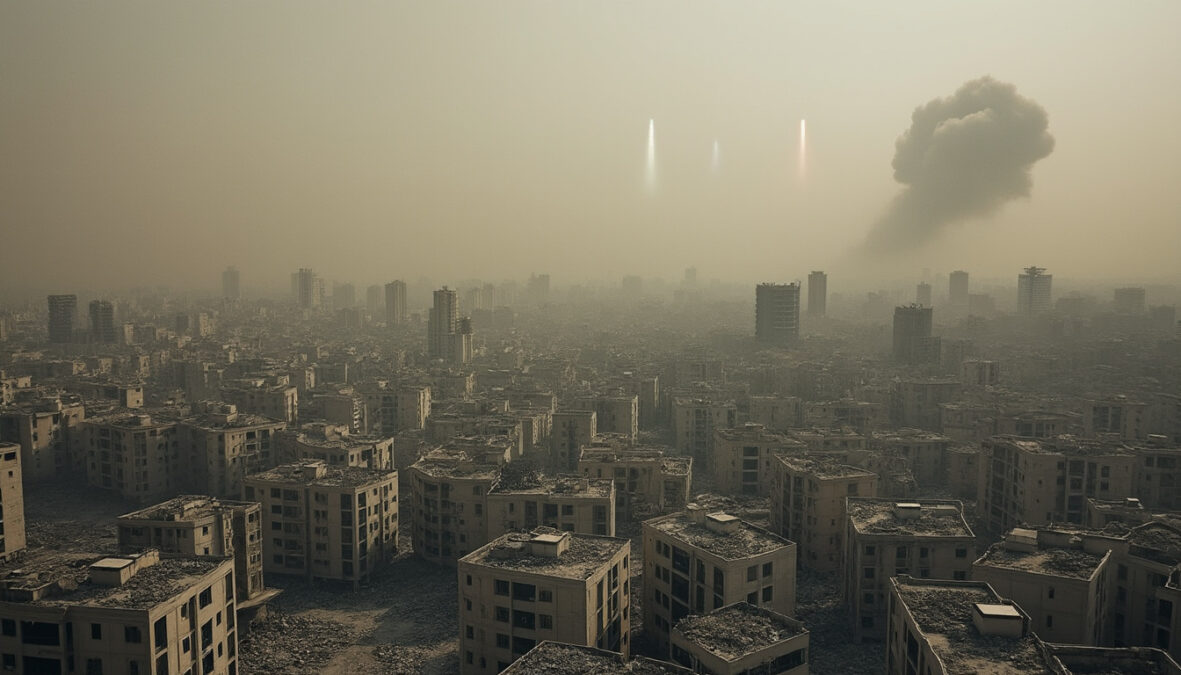
Satellite images of Gaza shared online show the scale of destruction that has accumulated since the war began in October 2023. One figure is circulating to measure the intensity of the bombardments: nearly 223,000 tonnes of munitions are said to have been dropped on the territory, an amount presented as equivalent to fifteen times the power of the atomic bomb used in Hiroshima. However, this comparison is based on estimates and should be interpreted with caution, since the weight of conventional munitions cannot be directly compared with the energy released by a nuclear weapon.
Satellite images make the destruction visible
For several days, internet users have been sharing satellite images of Gaza, including those available through Google’s mapping services. Compared with images taken before the war, they show extensive areas of damage: buildings destroyed or damaged, heavily affected neighborhoods, and urban landscapes profoundly transformed by the bombardments.
These images make it possible to observe changes across a city, but on their own they are not enough to precisely measure the damage or establish all of its causes. The images may have been taken on different dates and under varying conditions, and the appearance of an area does not always reveal the condition of buildings’ interiors. Nevertheless, they offer a striking glimpse of the extent of the destruction.
According to a United Nations estimate cited in publications on the subject, around 80% of Gaza’s buildings are believed to have been destroyed or damaged as a result of the Israeli bombardments launched after the October 7, 2023 attacks. The figure therefore encompasses different situations: buildings completely razed, as well as structures hit and rendered uninhabitable or in need of major repairs.
An estimate of several hundred thousand tonnes
The figure of 223,000 tonnes of bombs is attributed to the Gaza Government Media Office, an organization administered by Hamas. This source calls for caution: the number is not an independent measurement that has been exhaustively verified, and the methods used to calculate it do not allow it to be treated as indisputable data.
Michel Goya, a former colonel in the French Marine Troops and a historian, nevertheless considers the order of magnitude plausible. The estimates he cites range from 150,000 to 220,000 tonnes of munitions dropped. The difference between this range and the 223,000 tonnes put forward by the media office illustrates the difficulty of establishing an exact tally in the midst of a war, in a territory experiencing massive destruction where available information may be incomplete.
Figures for the mass of bombs should not be confused with a direct measure of explosive power. The total weight depends on the type and size of the munition and the proportion of explosives it contains. Two bombs of the same mass can therefore release different amounts of energy, while their effects on the ground also vary according to how they are used and where they impact.
What does the comparison with Hiroshima mean?
An equivalence that depends on the units used
Viral posts compare the tonnes of bombs dropped on Gaza with the power of the nuclear weapons used against Hiroshima and Nagasaki in 1945. They cite an amount equivalent to fifteen times “Little Boy,” the American bomb dropped on Hiroshima, or twelve times “Fat Man,” used three days later against Nagasaki.
This formula is intended to convey a striking sense of scale, but it can be misleading. The total mass of conventional munitions dropped over several years is not the same as the explosive power of a single nuclear bomb. To make a rigorous physical comparison, one would need to know the amount and type of explosive contained in each munition, as well as the energy actually released. It is also necessary to distinguish an accumulation of strikes spread across time and space from a single nuclear explosion.
The comparison therefore does not mean that Gaza experienced an explosion comparable to Hiroshima, or that the effects were identical. It relates estimates of quantities of explosives using a method that needs to be explained. The human, urban, and environmental consequences of a nuclear weapon also involve specific phenomena, particularly radiation, which are not the same as those associated with conventional bombardments.
Figures can nevertheless help make the scale of military operations more tangible, provided it is clear what they measure. An estimate of tonnage can indicate the volume of munitions used; on its own, it does not describe the distribution of strikes, the intensity of each explosion, or the full extent of the damage caused to infrastructure and the population.
Massive destruction, but difficult comparisons
The number of bombs does not sum up the impact on the city
The destruction of a neighborhood depends on many factors: the power and type of weapons, the frequency of strikes, building density, the strength of structures, and the proximity of explosions. The effects are therefore not uniform. The same quantity of munitions can cause very different damage depending on how it is used and on the characteristics of the areas affected.
The war in Gaza has also hit essential networks and facilities. Residential buildings are only part of the toll: health services, roads, water and electricity networks, and other infrastructure have also been affected. This damage can prolong the consequences of the bombardments long after the strikes end, making rescue efforts, travel, and a return to normal daily life more difficult.
Satellite images document the transformation of the territory, but they need to be considered alongside other sources: assessments by international organizations, field surveys, infrastructure data, and testimony. A summary of information published about the Israeli bombardments in Gaza is also available in this article on the strikes and their consequences.
The role of sources and estimates
During a conflict, casualty and damage figures change as new information is gathered. Some data comes from local authorities, while other figures come from international organizations or military experts. They do not always use the same methods, and limited access to the area can hinder verification. It is therefore useful to distinguish figures established by multiple sources from estimates put forward by a single organization.
The figure of 223,000 tonnes should therefore be presented as an estimate attributed to the Gaza Government Media Office, rather than as a definitively confirmed tally. The range of 150,000 to 220,000 tonnes cited by Michel Goya provides context, without eliminating the uncertainties involved in the calculation. The similarity in orders of magnitude does not, on its own, fully validate the method used.
The destruction of Gaza City has also been the subject of descriptions and analyses of changes to the urban landscape. Another perspective on this evolution is presented in this overview of Gaza City and the destruction affecting the city. These accounts complement satellite views by placing the damage in the context of successive offensives and showing how it has unfolded over time.
A historical comparison to be treated with caution
References to Hiroshima and Nagasaki often arise when describing destruction on an exceptional scale. They carry great symbolic weight, but can also reduce different realities to a single measure. Hiroshima and Nagasaki were each struck by a nuclear weapon, while the destruction in Gaza has resulted from a succession of conventional bombardments spread over time.
Some Japanese officials have themselves responded to these comparisons. The mayor of Nagasaki, in particular, has spoken about the scale of the destruction in Gaza, a statement that reflects the issue’s international significance. However, this does not mean that the two historical situations are identical: their military contexts, the weapons used, and their immediate consequences are not the same.
The phrase “fifteen times Hiroshima” can therefore serve as shorthand for an estimate of cumulative explosive energy, but it should not be read as a comprehensive equivalence between the two events. Nor does it automatically make it possible to infer the number of casualties or the exact level of damage. These aspects require separate data and appropriate comparison methods.
What the figures can—and cannot—establish
Available estimates point to a very large volume of munitions used in Gaza, even if the exact figure remains disputed. They are consistent with reports of massive destruction by the United Nations and with what can be seen in satellite images. To understand the scale of the disaster, these elements must be considered together, while keeping observations, numerical data, and historical comparisons distinct.
The number of tonnes cited does not, on its own, describe the full extent of the war. It does not provide precise information about the location of each strike, the nature of the targets, the damage caused by each munition, or the long-term effects on the population. These limitations do not diminish the scale of the reported destruction, but they do underscore the need to present figures alongside their sources, their degree of uncertainty, and the precise meaning of the comparison being made.


