
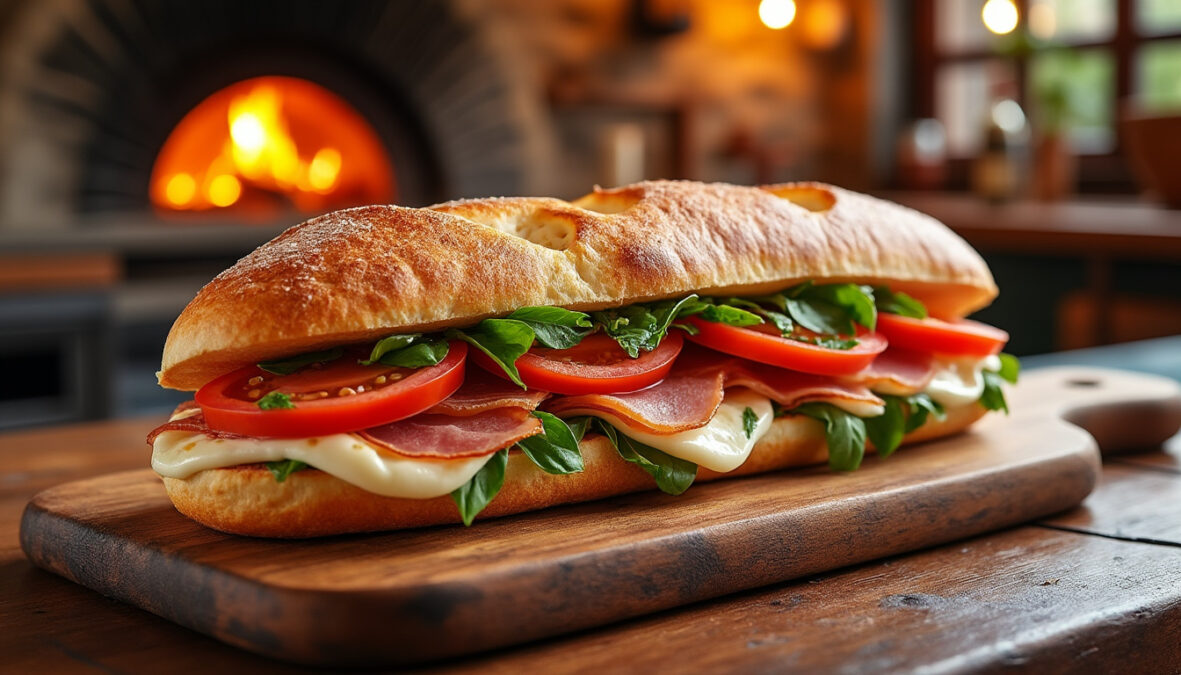
Halfway between Neapolitan pizza and a sandwich, the panuozzo draws attention with its golden dough, generous fillings, and easy-to-carry format. Long known mainly in Italy, this filled bread is gaining visibility on TikTok and Instagram, while specialist restaurants are opening in France. But is its online popularity enough to make it a new fast-food staple?
A sandwich made with pizza dough
Originating in the Naples region, the panuozzo stands apart from a classic sandwich because of its bread. It is made with dough similar to pizza dough, baked before being opened and filled. Baking gives it a lightly golden crust and a softer interior that can hold a generous filling.
Recipes often bring together ingredients emblematic of Italian cuisine: cured meats, cheeses, grilled vegetables, or salad leaves. The combinations vary depending on the establishment and personal tastes. The panuozzo can therefore be served in a traditional version or adapted with more original fillings, allowing restaurateurs to refresh their menus.
Once filled, the bread is generally served warm. The cheese may melt against the dough and other ingredients, while the vegetables add a different texture or flavor. The result is eaten by hand, like a sandwich, but calls pizza to mind through its dough and aromas.
An old specialty gaining visibility online
The panuozzo is not a recent invention. It has long been one of Italy’s specialties, but remains less familiar to the general public than pizza or focaccia. Its profile is now growing thanks to videos showcasing its preparation: dough being worked in front of customers, generous fillings, melting cheese, and the finished sandwich cut in half.
These images are particularly well suited to the short-form content on social platforms. The product is visually distinctive, its preparation lends itself to video, and the ingredients can be shown in detail. Posts shared by customers, content creators, or the restaurants themselves are helping introduce this sandwich to online audiences who may never have tried it before.
Why is the panuozzo attracting so much attention?
A tempting and customizable product
Its appeal stems first and foremost from its generous appearance. The dough wraps around visible, abundant ingredients, making the sandwich instantly recognizable in a shop window or in a video. This tempting quality meets strong demand in fast food, where consumers look for products that are as appealing to look at as they are to eat.
The recipe also lends itself to customization. Restaurateurs can offer different combinations of cheeses, cured meats, and vegetables, or prepare the sandwich to order. This flexibility makes it possible to vary the options without changing the product’s basic concept. It also lets customers choose a combination that matches their preferences.
The panuozzo thus brings together several qualities sought in a meal on the go: a portable format, a preparation method that is easy to understand, and customizable fillings. It can be eaten on-site or taken away, making it well suited to on-the-go dining.
Images that encourage sharing
On social media, food trends often take off around products that are easy to film and talk about. The panuozzo has several visual strengths: dough coming out of the oven, the act of filling it, ingredients spilling out, and the cut that reveals the inside. These clips can spark curiosity and encourage viewers to look for a nearby place to try one.
This visibility can lead to lines outside certain establishments or prompt customers to travel from other cities to visit a place they discovered online. In several towns, specialist businesses are beginning to make a name for themselves by tapping into Instagram and TikTok’s video conventions. The phenomenon illustrates how quickly a product that was once little known can reach a wide audience when it is widely shared.
Social media does not necessarily create the product itself, but it can speed up its discovery and give businesses that know how to use these formats significant exposure. A traditional recipe can thus be presented as something new and then grow in popularity beyond its region of origin.
The panuozzo, somewhere between pizza and a sandwich
An intriguing hybrid format
The panuozzo borrows from two great classics: pizza dough and the convenient format of a sandwich. This combination is part of what defines it, but it also raises a question: does the public see this pairing as something genuinely new, or as a blend of two already familiar products?
Pizza and sandwiches are both firmly established in French eating habits. For some consumers, bringing them together in a single product may seem natural and appealing. For others, the panuozzo’s hybrid nature could make it harder to categorize or choose than a more familiar option. Its success therefore depends as much on the quality of its preparation as on how clearly it is presented.
Past food trends show that initial curiosity does not guarantee lasting popularity. Some products built around an unusual combination have enjoyed a rapid surge in interest before fading from people’s habits. Online visibility can attract the first customers, but it cannot replace a convincing recipe or a consistently good experience.
Pricier than a classic sandwich
A panuozzo generally costs around ten euros, though prices can vary depending on the recipe and location. It is therefore often more expensive than a sandwich bought at a bakery, while remaining within an affordable range for a fast-food meal.
This pricing can support its image as a generous product made to order. However, it presents a challenge for businesses: customers must see enough of a difference in the dough, filling, and portion size to justify the higher price. The balance between cost, ingredient quality, and how filling it is can influence whether they decide to come back.
Compared with street-food options that are particularly competitive on portion size and price, the panuozzo occupies a slightly higher-priced segment. Its growth will depend in particular on its ability to win people over beyond the first visit prompted by curiosity or a popular video.
A lasting trend or a passing phenomenon?
Online popularity is not enough
Views, comments, and shares indicate online interest, but they do not directly measure the number of regular customers. A video can go viral without bringing a steady stream of people to the restaurant. For food-service professionals, the distinction between social media success and commercial success is therefore essential.
The trend’s staying power will be measured instead by repeat purchases, restaurant attendance, and the product’s ability to find a place in different eating occasions. A sandwich that initially attracts customers with its spectacular appearance must then win them over with its taste, convenience, and price.
Restaurateurs also have an important role to play. They need to maintain consistent preparation, manage busy periods, and provide an experience that remains satisfying as the novelty wears off. An overly complex menu or excessively long wait times can make it harder for a viral trend to become a stable business.
More openings are in the works
Specialist businesses are opening in several French cities, including Dijon, Mâcon, Lyon, and Grenoble. This expansion shows that the concept interests entrepreneurs and customers, but it is not yet as firmly established as the major fast-food categories.
The pace of new openings is an indicator to watch. An increase in restaurants accompanied by a loyal customer base could signal that the panuozzo is moving beyond the discovery phase. Conversely, if visits are concentrated mainly around a few highly publicized locations, the trend may remain limited to local hubs.
For now, the panuozzo is caught between two forces: the power of videos, which accelerate its rise in profile, and consumer habits, which take longer to develop. Its customizable, portable format gives it a case for becoming part of everyday life, while its hybrid nature and price still need to be validated by regular customer traffic.


