
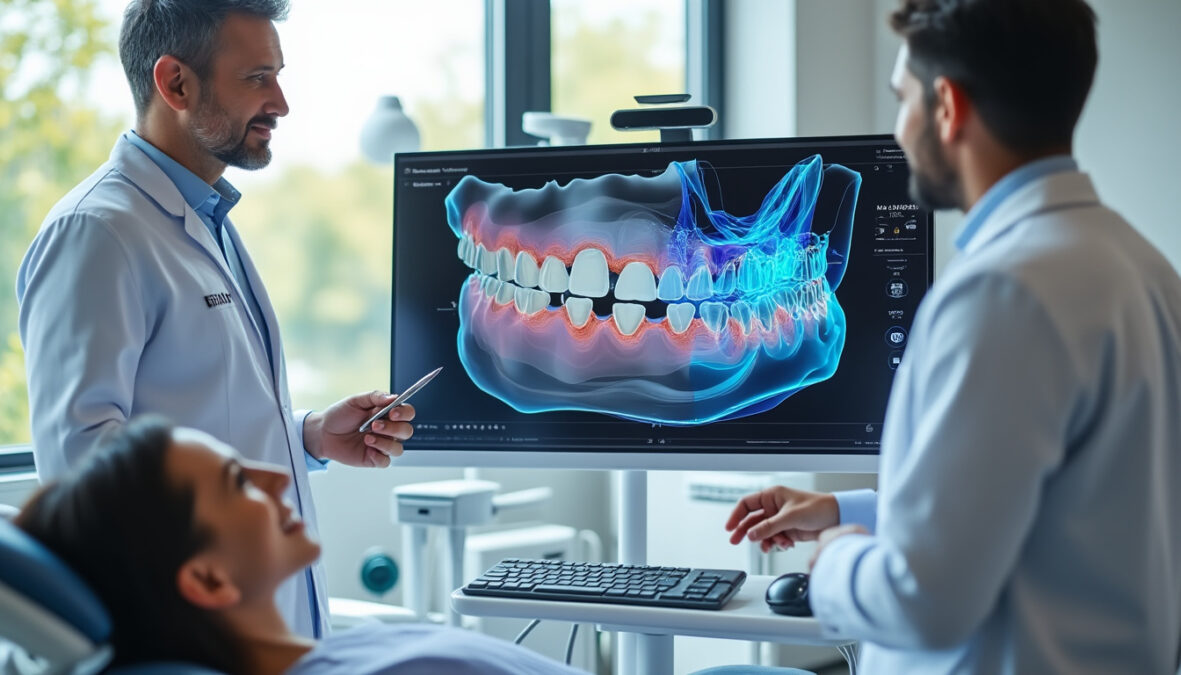
According to the president of Biotech, artificial intelligence could expand dentists’ skills by giving them new tools to analyze examinations, prepare treatments and monitor their patients. This development does not mean that software replaces the practitioner; rather, it points to a form of dental medicine in which clinical expertise relies more heavily on data, automation and decision support.
Artificial intelligence is gradually becoming part of discussions about the future of healthcare. In dentistry, it is attracting particular interest because diagnosis and treatment planning already rely on the careful observation of images, measurements and medical histories. For the president of Biotech, these technologies offer an opportunity to complement dentists’ expertise and expand their scope of practice.
This outlook rests on an essential distinction: AI can help process and organize information, while the dentist remains responsible for the examination, clinical interpretation and relationship with the patient. Digital tools can therefore support professional judgment, but they do not replace the training or experience needed to make a treatment decision.
Analysis tools supporting diagnosis
AI-assisted imaging software can help identify certain features in X-rays or scans, compare examinations and draw attention to areas that warrant further review. One key benefit is the ability to provide a complementary reading, which may help practitioners examine images systematically and better document their reasoning.
These results should nevertheless be treated as indications, not as autonomous diagnoses. An anomaly flagged by an algorithm must be considered alongside symptoms, an oral examination, medical history and other available data. Dentists must also take the model’s limitations into account, particularly when an image is of poor quality or the patient’s situation differs from the cases on which the tool was trained.
More personalized treatment planning
By combining different sources of information, decision-support systems could make it easier to prepare certain treatments. They can help organize images and measurements, simulate options or make the potential stages of a course of care clearer. The professional nevertheless retains the choice of strategy, based on the clinical situation and the priorities expressed by the person receiving care.
This assistance can also encourage more precise communication among members of a dental team. Better-structured data and clearly presented treatment plans facilitate coordination among practitioners, specialists and care staff. AI could thus expand dentists’ skills by strengthening their role as coordinators and interpreters of clinical information.
A transformation in dentists’ skills
Integrating these tools involves more than learning how to use new software. It requires understanding how systems produce their results, what data they use and in which situations they may make mistakes. Digital skills are becoming a complement to medical knowledge, technical expertise and listening to patients.
Dentists may need to become more adept at reading data, checking automated recommendations and explaining results. They must also know how to assess whether a tool is appropriate for a specific task, rather than treating AI as a universal solution. This shift gives greater importance to ongoing training and collaboration between healthcare professionals and technology specialists.
Advances in AI in other fields illustrate the scale of this transformation. The developments presented in the article about breakthroughs in artificial intelligence in mathematics are a reminder that systems are becoming capable of tackling complex problems. In dental medicine, this computing power can be useful, but its value still depends on data quality and the practitioner’s ability to interpret results in context.
The human relationship remains central
A dental consultation is not just about analyzing an image. It involves understanding the patient’s concerns, explaining the available options and taking into account their overall health, constraints and preferences. AI can help prepare certain information or simplify administrative tasks, but it cannot replace the trust built through interaction with a care provider.
By clarifying data that are difficult to interpret or helping to illustrate a treatment plan, digital tools can even support dialogue. Their use must, however, remain understandable to patients: practitioners must be able to explain the role of the algorithm, its limitations and how the final decision was made.
The conditions for responsible adoption
The quality of systems depends heavily on the data used to design and evaluate them. If certain patient groups or clinical situations are underrepresented, results may be less reliable for them. Dental teams must therefore consider how tools have been validated, their intended scope and their performance in the contexts where they plan to use them.
Protecting medical information is another major concern. Images, records and health data are particularly sensitive. Their collection and processing must comply with applicable rules, limit unnecessary access and ensure appropriate security. Practices also need clear procedures to determine what data are transmitted, where they are stored and who can access them.
Caution about technological promises is central to discussions about AI. The interview addressing the idea that “we’re rushing in headfirst without thinking” highlights the importance of thoughtful deployment: professionals must be able to examine expected benefits, risks and practical effects on their work before adopting a system. In a dental practice, this means, in particular, testing tools, training teams and maintaining effective clinical oversight.
Economic and organizational challenges
Integrating AI can change how working time is allocated. Some repetitive tasks could be completed more quickly, while other responsibilities would become more important: checking results, explaining them to patients and coordinating care. The impact will nevertheless depend on the tools selected, their cost, their compatibility with existing software and the way each practice is organized.
These technologies will not necessarily be equally available to everyone. Organizations with substantial financial and technical resources may adopt them more quickly than smaller practices. For innovation to benefit a broad range of patients, it will therefore be necessary to assess its accessibility, total cost and ability to fit into different care settings.
Debates about the infrastructure needed for artificial intelligence also show that this transformation has a collective dimension. The article on public opposition to data centers highlights questions about the resources, locations and consequences of these facilities. Healthcare organizations must therefore consider not only clinical uses when adopting digital technologies, but also the infrastructure that makes them possible.
A rapidly evolving technology sector
The opportunities opened up by AI are part of a broader trend of investment and transformation among technology companies. These companies’ projects, business models and ambitions are regularly subject to revision. Anthropic’s postponed IPO, discussed in an article about the ambitions of the artificial intelligence company, is a reminder that the sector remains subject to uncertainty and strategic trade-offs.
For dental professionals, this dynamic is a reason to distinguish between capabilities that have already been evaluated and forward-looking claims. A tool may be presented as innovative without its usefulness having been demonstrated in every care situation. The decision to integrate it should be based on rigorous evaluations, verifiable results and a clear understanding of the conditions under which it can be used.
AI applications are also expanding into a wide range of fields, including areas far removed from medicine. The article on the rise of erotic artificial intelligence illustrates this diversity. It is a reminder that AI systems take different forms depending on the needs they address, and that their evaluation must always take into account the context of use, the people concerned and the associated ethical issues.
The quality of online information
Keeping up with technological and medical developments also depends on access to reliable sources. However, some pages may be temporarily inaccessible when a security system detects unusual activity or blocks a request. In such cases, enabling cookies may be requested; if the block persists, the relevant site can be contacted with details about the action taken and the incident ID. An inaccessible page, by itself, does not make it possible to verify the information it contains: claims should be cross-checked against other available sources.
For dental teams, this careful approach to information is just as important as choosing a tool. It helps distinguish established results from commercial promises, identify a technology’s limitations and decide whether its potential benefits match patients’ needs. It is through this combination of clinical skills, digital proficiency and critical evaluation that AI could help expand the role of dentists.


