
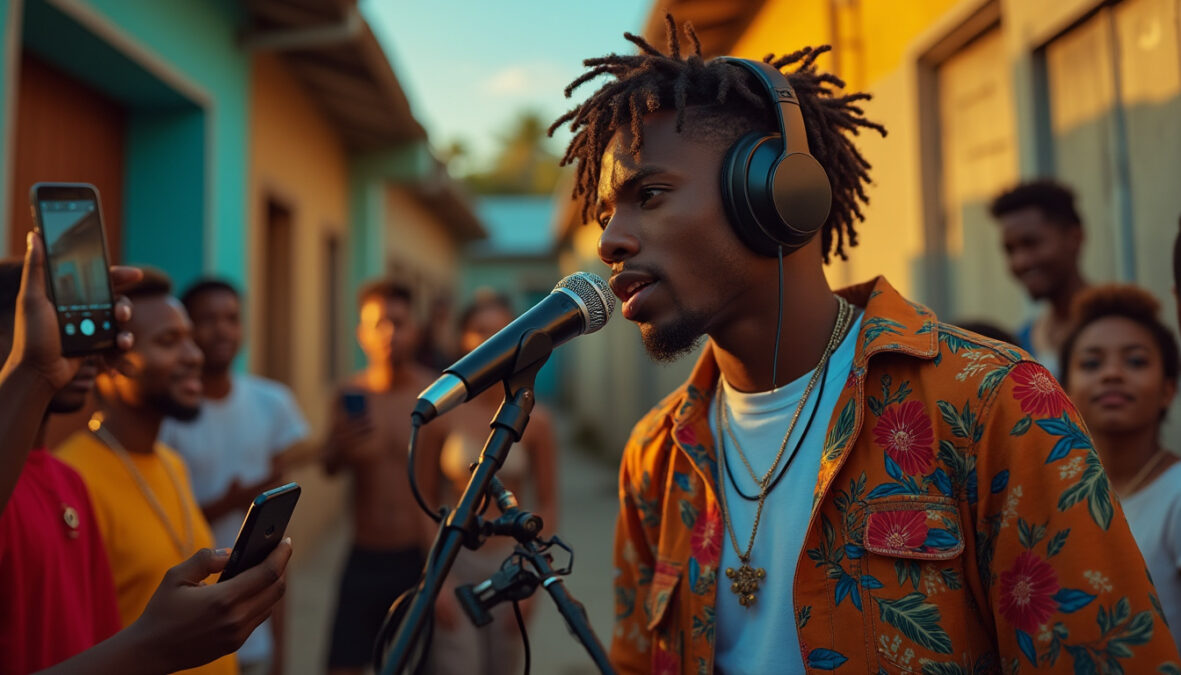
From digital platforms to rap stages, Creole now circulates in new forms, blending orality, writing, music, and everyday exchanges. These uses testify to a living language, capable of adapting to contemporary tools without losing its cultural roots. They also extend a movement for recognition to which linguists such as Jean Bernabé have contributed, working to secure a place for Creole in universities and institutions.
A living language, shaped by its uses
Creole is neither a single form nor a set of words passed down unchanged from one generation to the next. There is a diversity of practices, linked to territories, histories, and communication situations. Like any language, it evolves through contact with its speakers: words change, new expressions emerge, and ways of speaking vary according to context.
This evolution is particularly visible in exchanges among friends and family, in public conversations, and in artistic productions. Speakers may switch from Creole to French, or mix elements of both languages within the same sentence. These alternations do not necessarily indicate hesitation. They can help clarify an idea, create a comic effect, emphasize an emotion, or address different audiences.
Linguist Corinne Mencé-Caster, a professor at Sorbonne Université and author of Pour une linguistique de l’intime, is particularly interested in the links between language, personal experience, and identity. Observing Creole in contemporary practices therefore makes it possible to avoid reducing it to a question of grammar or vocabulary: it is also a way of understanding how people talk about their everyday lives and shape their relationships with others.
Social media, new spaces for writing
On social media, Creole is written as much as it is spoken. Posts, private messages, comments, and short videos make visible uses that were once less common in public written spaces. The language circulates through fast-paced, often informal formats, where people seek to convey a reaction, a joke, or a point of view in just a few words.
This digital presence gives inventiveness an important role. When writing a language whose spelling practices can vary, internet users often draw on habits shared within their circles or communities. The same word can therefore be transcribed in several ways, depending on the writer’s choices, the sounds they want to convey, or the conventions used by a particular group.
This diversity is not necessarily a sign of disorder. It shows that written practices develop through exchanges. Internet users experiment with spellings, adopt others, and help establish conventions, sometimes without any official decision. Platforms thus become places where Creole is written in context, at the pace of conversations and connections between users.
Digital tools also encourage the language to travel between territories. An expression shared in a video or post can be picked up, discussed, and adapted by people living elsewhere. Creole is thus at the heart of conversations that are both local and transnational. Online practices bring distant speakers closer together, while giving everyone the opportunity to reinterpret words in their own context.
Between orality, image, and text
Social media is not limited to writing. A video brings together voice, face, gestures, music, and subtitles. These elements make perceptible essential aspects of oral communication: intonation, rhythm, expressions, and audience reactions. Creole can then be understood and appreciated beyond the words alone.
Posts that combine text and sound also create new ways of transmitting the language. A sentence can appear on screen, be repeated aloud, and then be echoed in the comments. The content serves not only to inform or entertain: it can let familiar turns of phrase be heard, make local expressions visible, and encourage people to use them again.
However, the brevity of many formats calls for particular choices. Messages are condensed, words may be abbreviated, and visual symbols sometimes complete the sentence. These techniques do not replace more developed uses of Creole. Rather, they are a way of adapting to the constraints and conventions of digital communication.
Rap, a platform for expression and transmission
Making Creole heard through music
In rap, language is carried by a voice, a rhythm, and a performance. Creole becomes a sonic material: its sounds, accents, and cadences contribute directly to the composition. Artists can draw on its resources to tell stories about their experiences, evoke a place, or give a particular force to a phrase.
Choosing to rap in Creole can also assert a presence. A language sometimes devalued in certain public spaces can take center stage, carried by music that reaches a wide audience. Rap gives it a space where it is not merely spoken in everyday life, but crafted, performed, and addressed to a broad audience.
The lyrics address a range of subjects: family relationships, everyday life, aspirations, social tensions, or collective memory. Creole makes it possible to convey nuances and references that can be difficult to translate literally. The choice of words grounds the story in a particular experience, while the rhythm gives each line a presence unique to the performance.
Mixing languages as an artistic resource
Many artists bring Creole together with French or other languages. This mix can change from one track to another or occur within the same verse. It offers different ways of addressing listeners: some lyrics draw on reference points familiar to an audience that knows Creole, while other elements open the track up to listeners who do not speak it fluently.
This alternation is also an aesthetic choice. Switching languages can change the tone, speed up the story, or bring an idea to the fore. It can bring an expression closer to everyday speech and then turn it into a memorable refrain. Far from mechanically setting languages against each other, rap brings them into relation and reveals how artists use them in their real lives.
Refrains play an important role in this circulation. A repeated phrase can be remembered, sung, and repeated by listeners who do not necessarily have the same command of Creole. Music thus brings the language into new spaces while giving the lyrics a collective dimension. This sharing does not guarantee a full understanding of every text, but it can spark curiosity and encourage people to listen.
From recognition to contemporary uses
An ongoing effort to establish legitimacy
The visibility of Creole on platforms and in music is part of a broader history of recognition. The Martinican linguist Jean Bernabé devoted a significant part of his work to establishing Creole as a fully fledged subject of university study. His efforts helped challenge the idea that this language was less structured or less worthy of analysis than languages traditionally taught.
Linguistic research makes it possible to describe how Creole works, its variations, and its transformations without reducing it to a simplified version of another language. It also helps us better understand the perceptions surrounding it. For a long time, social judgments could lead some speakers to consider it a language reserved for the private sphere or unsuitable for school. The development of academic studies and cultural productions is helping to shift these perceptions.
Institutional recognition is an important step, but it does not, by itself, determine a language’s vitality. This also depends on the place it occupies in families, conversations, artistic creations, and digital spaces. Everyday practices show that Creole is transmitted and transformed in many different settings, sometimes far removed from school curricula or official debates.
Institutionalizing without freezing
Establishing written references, academic studies, or educational programs can support the transmission of Creole. It facilitates learning and makes it possible to produce shared resources. But institutionalizing a language does not necessarily mean erasing regional differences or imposing a single way of speaking. The challenge also lies in reflecting the diversity of uses and situations.
Social media and rap illustrate this tension between shared references and creative freedom. Internet users and artists draw inspiration from existing forms, but adapt them to their needs. They invent expressions, use different spellings, and develop different registers of language. This creativity can then influence everyday conversations, while everyday practices in turn feed into posts and song lyrics.
Creole is thus renewed through an ongoing relationship between transmission and invention. Institutions help document the language, artists bring it to life, and platform users circulate it through their exchanges. In these spaces, it is not merely preserved: it is used to communicate, create, recognize one another, and tell the story of the present.


