Toyota is planning a major modernization of its industrial operations starting in 2028, which could affect around 400,000 robots in its factories, across its group and at some suppliers. This development promises to transform production tasks, but the figure does not mean that 400,000 humanoids will replace employees: it also includes the replacement of robots already in service. For workers, the issue could therefore be as much about how jobs change as about the elimination of certain positions.
Toyota’s proposed project would bring a new scale to automation in the automotive industry. Starting in 2028, the automaker could devote nearly 1,000 billion yen each year to modernizing its facilities, an amount estimated at around six billion based on the conversions cited. However, this figure remains a projection, not a definitively confirmed budget.
The number of robots cited covers a broad scope: Toyota’s factories, those of its group and some of its main suppliers. It should also be understood as the number of machines affected by modernization, not as an announcement that 400,000 new robots will be installed on production lines all at once. Some of this equipment could replace existing industrial systems.
An impressive figure, but not 400,000 humanoids
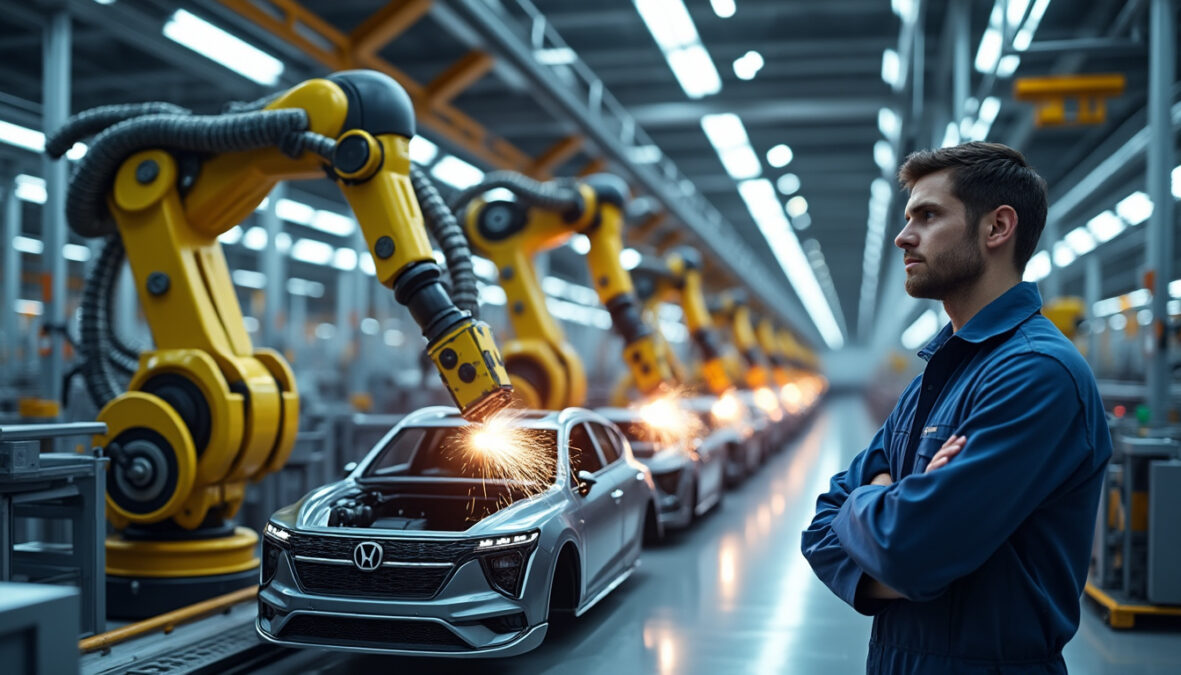
The image of thousands of humanoid robots installed at every workstation does not match the project as described. In industry, a robot can be a mechanical arm fixed to the floor, an automated device integrated into a machine or a mobile vehicle used to move parts. Many of these systems perform a specific, repetitive task without resembling a human being.
The planned modernization could therefore involve equipment from different generations, replacing some aging robots and adapting facilities to new production methods. The total would thus include machines already present in Toyota’s industrial ecosystem, as well as new equipment. On its own, it does not show how many human jobs would be eliminated.
Why Toyota wants to modernize its factories
Like other automakers, Toyota is seeking to improve the productivity and reliability of its industrial sites. Newer machines can help carry out certain operations more consistently, reduce interruptions and improve coordination between the various stages of manufacturing. Modernization can also make facilities more adaptable to changes in production.
Recruitment difficulties are another factor. In some sectors, it is hard to fill jobs that are physically demanding or involve repetitive movements. Automation can then take over some of these tasks, or help maintain production when companies struggle to find enough workers. This does not necessarily mean that every robot corresponds to a job eliminated: it may also meet a production need that the company would otherwise struggle to fulfill.
An annual investment on this scale could also involve much more than buying machines. Modernizing a factory often means reviewing equipment, software, safety systems and work organization. The timeline, the amounts ultimately invested and the sectors concerned will depend on decisions that Toyota and its partners have yet to make.
Robots that can learn by observing people
Beyond replacing conventional industrial robots, Toyota is exploring systems that can learn new tasks from human demonstrations. This approach departs from the model in which every movement must be programmed in detail before a machine can operate. Artificial intelligence analyzes how a person performs an operation and can use that observation to reproduce certain movements.
This method could speed up robots’ adaptation to tasks that change or are harder to define as a fixed sequence of instructions. It does not mean that the machine understands a situation exactly as a human does. Learning depends on the demonstrations, the environment and the system’s capabilities: a change in the object, its position or the working conditions may still require adjustments.
ELEY, a mobile robot in the exploratory phase
Among Toyota’s projects is ELEY, a robot designed with a wheeled base to move around workshops. Rather than walking like a humanoid, it rolls through its environment and can learn certain tasks by watching people perform them. This design focuses on practical use in a workspace, without necessarily trying to replicate the appearance or movements of an employee.
ELEY illustrates one avenue of research: teaching a robot operations from examples rather than prescribing each action through complex programming. But a technology demonstration should not be confused with widespread deployment. The available information does not support the conclusion that this robot is ready to independently carry out all of a car’s assembly operations.
Conditions in a factory often vary: parts may be positioned differently, tools change and workers must respond to unexpected events. To work reliably and safely, a robot must be able to perform its task under these conditions, communicate with other equipment and stop its actions if a problem occurs. These requirements explain why a promising technology may need to go through several testing stages before being used on a large scale.
Which jobs could be most affected?
Jobs most exposed to automation generally involve repetitive movements, clearly defined sequences or operations that can be performed in a controlled environment. Moving parts, certain handling tasks and specific production steps may be suitable for mechanical automation, provided the equipment is designed to perform them consistently and safely.
Robotics can change the number of workers needed for certain tasks, or even eliminate jobs when machines fully replace an operation. However, the impact depends on each factory’s circumstances, the production rate targeted, the cost of automation and the possibility of reassigning workers. The number of machines announced therefore does not automatically translate into an equivalent number of jobs lost.
Jobs that involve diagnosing a fault, managing an incident, adapting a procedure or coordinating several activities are harder to automate completely. Automotive production also relies on human skills to check quality, maintain equipment, organize workflows and intervene when the process does not go as planned. Even in highly automated workshops, these responsibilities do not necessarily disappear; they may change.
Jobs that evolve as equipment changes
A factory equipped with robots requires different skills from a production line where most operations are performed manually. Technicians may need to program, monitor or repair machines. Operators may have to work alongside automated systems, check their output or step in when an operation is interrupted.
This shift can create opportunities for training and career mobility, but it does not happen automatically. Not all workers have the same opportunities to acquire new skills, and changes can be difficult if jobs evolve quickly. Preparing teams and supporting people whose tasks are reduced or eliminated will be crucial to distributing the benefits and costs of the transformation.
Collaboration between workers and robots at the heart of factories
The most likely scenario is not necessarily a factory without people. Many processes already combine specialized machines with workers who handle supervision, supply, inspection or maintenance. Robots make it possible to automate certain operations, while people take on tasks requiring judgment, adaptability or intervention in response to an unexpected situation.
This coexistence requires appropriate safety measures. The movement of mobile robots must be managed to prevent collisions, work zones must be defined and shutdown procedures must be reliable. When machines learn from demonstrations, companies must also verify that the task being reproduced meets quality requirements and does not create risks for the people present.
Integrating robots can also intensify the pace of production or change how responsibilities are divided. A machine can reduce the physical effort involved in certain operations, but it can also impose a pace or require workers to monitor several systems at once. The impact on working conditions therefore depends on how the new equipment is introduced, not just on its technical capabilities.
Why the impact on employment remains difficult to predict
Several factors will determine the project’s impact on staffing levels: the number of robots actually installed, the tasks automated, the pace at which equipment is replaced and the number of vehicles to be produced. A machine that replaces an older robot does not have the same effect on employment as a system that automates an operation previously performed by several people.
Modernization may also shift demand toward other roles. Maintenance, programming, data management and supervision may become more important, while some manual tasks decline. But the creation of specialized jobs does not automatically offset jobs lost: these roles may require different qualifications and may be based at other sites or with suppliers.
Finally, an announcement about an industrial program spanning several years does not precisely describe the future day-to-day reality of every factory. The timeline, budgets and technical solutions may change as testing and investment decisions progress. The threat to human jobs therefore cannot be measured by the figure of 400,000 robots alone, but by the operations affected, organizational choices and measures taken to support workers.