
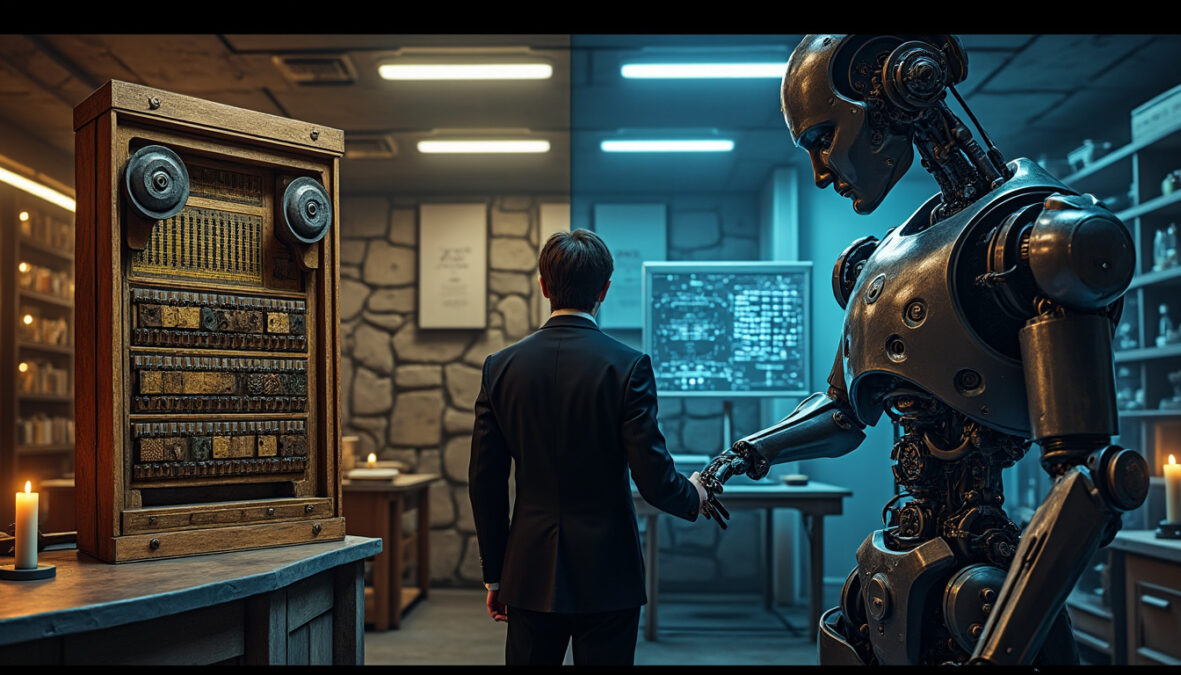
From the Pascaline to artificial intelligence systems capable of producing texts and images or taking actions on a computer, machines are transforming our relationship with work and creativity. But their effectiveness is not enough to attribute a will, understanding or genuine intention to them: the central question remains that of the place of human beings in the decisions and works they help bring into being.
In the seventeenth century, Blaise Pascal invented a machine that mechanically performed certain arithmetic operations. At the time, the Pascaline caused a sensation: it quickly carried out calculations that had previously been done by hand. Several centuries later, artificial intelligence inspires comparable fascination. It writes, translates, sorts information and assists users with a variety of tasks. Yet the difference between automating an operation and exercising a will remains fundamental.
Referring to Pascal in connection with artificial intelligence therefore means more than simply recalling that he designed a calculating machine. His work also invites us to reflect on the limits of automatism, the nature of thought and what distinguishes an effective operation from a truly human act. The comparison sheds light both on the promises of new technologies and on the questions raised by their use.
The Pascaline, a machine that makes calculation easier
A mechanical feat in the service of users
The machine designed by Pascal had a specific purpose: to help perform additions and subtractions. Thanks to a system of gears, certain operations could be carried out without the user having to master every step of the calculation. The machine thus reduced the effort required and made it quicker to work out accounts.
This ease of use is one of the invention’s most striking features. The instrument takes on part of the work and limits errors associated with repeated calculations. It allows users to obtain a result without constantly concentrating their attention or having extensive experience in arithmetic. The machine does not make its user more knowledgeable: it makes a task more accessible by taking on part of the operation.
This transfer of work to a mechanism could provoke mixed feelings. Admiration for a spectacular invention mingles with concern at seeing a human capability reproduced by an artifact. This reaction recalls some contemporary questions: when tools increasingly perform tasks once reserved for people, how should we redefine skill, effort and the value of human involvement?
Automation is not will
The Pascaline performs operations according to its mechanical design. It does not choose the purpose of the calculation, understand the data or represent the meaning of the result to itself. The user determines what needs to be calculated, enters the necessary information and interprets the result. The machine acts, but it does not act on its own initiative.
This distinction between execution and intention remains essential to understanding today’s technologies. An artificial intelligence system can produce a convincing response or carry out a sequence of actions without experiencing desire or setting itself an end in the human sense of the term. Its performance may give the impression of initiative, but that initiative depends on the objectives, instructions, data and parameters that govern its operation.
Recent models are presented as capable of using a computer autonomously, chaining together actions across different interfaces. This development broadens the scope of automation without making the question of where decisions originate disappear: who defined the task, the limits of action and the criteria for success? Autonomous systems that operate a computer make this question particularly concrete.
Human will in the face of automation
A machine can free up time without deciding how it is used
The value of an automated tool is often measured by its ability to take on lengthy, repetitive or complex tasks. By making it possible to spend less time on certain operations, it can open up new possibilities. But the time freed up does not, by itself, determine what happens next. The choice to make use of that availability, direct it toward a creative activity or pursue other goals still rests on a human decision.
Ease of use also carries a risk: that of confusing the fluency of a result with the quality of the judgment that produced it. A quick answer can be wrong, an operation can be carried out without its consequences being sufficiently assessed, and a recommendation can seem relevant while being based on inadequate information. Automation sometimes improves efficiency, but it does not remove the need to check, understand and take responsibility for decisions.
This vigilance now extends to fields far removed from simple calculation. In budget debates, for example, AI can change how data is processed, forecasts are made or options are compared. Its role in public policy choices nevertheless depends on the methods used and the people who interpret its results. How artificial intelligence is transforming the preparation of the budget illustrates how a tool can influence trade-offs without replacing political responsibility.
From assistance to delegation
Using artificial intelligence as an aid does not necessarily mean handing the entire task over to it. A user can use it to explore ideas, summarize a document or prepare a first draft, then review the result, correct it and decide what to keep. In this case, the machine provides working material, while the person retains responsibility for the choices and the final form.
The situation changes when the user delegates a decision without examining the result or understanding its consequences. The boundary between assistance and substitution then becomes harder to draw. The more a system is involved in important operations, the more necessary it becomes to know who controls its operation, who can challenge its recommendations and who is accountable for its effects.
This question of responsibility concerns not only individual choices. It also affects organizations that incorporate AI into their procedures, as well as institutions that use it to guide decisions. Technical effectiveness is not enough to establish the legitimacy of a use: it is also necessary to consider the objectives pursued, the people concerned and the means of verifying the results.
Literary creation put to the test by artificial intelligence
Producing a text does not necessarily make one its author
AI systems can generate texts that imitate the forms of conversation, storytelling or argument. This ability makes an old question more urgent: what makes a statement a work, and to whom should its creation be attributed? The mere presence of new sentences does not settle the question of authorship. We must also examine the role of choices, interpretation and responsibility in the creative process.
Pascal’s reflections on ideas already expressed by others can shed light on this problem. Two people can express a similar idea without giving it the same meaning or weighing its implications in the same way. Originality therefore does not always lie in the absolute novelty of the words. It also depends on how an author understands an idea, connects it to an experience and incorporates it into a statement whose implications they take responsibility for.
An artificial intelligence can assemble formulations and produce a coherent result based on the data and instructions provided to it. But this output does not, by itself, prove that the system understands what it says or believes its statements to be true. The appearance of intention in a text should not be confused with an intention experienced and embraced by a human subject.
Imagination, choice and responsibility
AI-assisted creation is not simply a matter of setting a machine against an artist. An author can use a tool to try out several approaches, explore a style or overcome a technical difficulty. They can then select, transform or reject the proposals they receive. In this process, human contribution does not necessarily disappear: it shifts toward framing, selection and rewriting.
The respective roles of humans and machines nevertheless vary according to how they are used. A work may be strongly guided by personal decisions, or result mainly from general instructions followed by few modifications. It then becomes important to distinguish the production of content, the direction of a process and the responsibility associated with its dissemination. The question of authorship cannot be resolved by looking only at the final result.
Debates about creation are part of a broader reflection on the political effects of artificial intelligence. Generative tools can change how images, texts and ideas circulate, as well as the conditions under which they are produced and received. The political stakes of creation in the age of AI show why the question of originality goes beyond the sphere of artistic practice alone.
The limits of comparing Pascal with AI
Technical continuity, but profound differences
The Pascaline and contemporary systems have in common that they delegate certain operations to technical devices. This continuity explains why Pascal is often associated with discussions of artificial intelligence. However, the capabilities and mechanisms of today’s technologies are much more complex, and the comparison should not obscure the differences between a calculating machine and a system that processes vast quantities of data to generate a range of responses.
The Pascaline followed a mechanism designed to perform a limited set of operations. Today’s AI tools can handle more varied situations and adapt to requests made in everyday language. This does not mean, however, that they possess consciousness or will. It remains necessary to distinguish observable performance from the inner experience sometimes wrongly attributed to machines.
New capabilities are regularly announced in the field of artificial intelligence. They can broaden the practical uses of these tools and make their operation harder for users to anticipate. Recent developments in AI in Europe are part of this evolution, in which technical advances go hand in hand with questions about control, evaluation and desirable uses.
Understanding what the machine does not understand
The results of an automated system are produced through technical processes, data and instructions. Even when they are convincing, they can contain errors, reproduce biases or omit essential elements. The ability to generate a response is therefore not equivalent to the ability to assess its truth, moral relevance or consequences in a particular context.
The difference between calculation and judgment is also apparent when a tool is used in a sensitive field. A system can identify patterns in data, but it is up to the people using it to determine whether those patterns are relevant and whether the resulting decision is acceptable. Human involvement does not consist merely of pressing a button: it means asking the right questions and evaluating the answers obtained.
This responsibility extends to system security. A tool capable of taking action or processing data can also become a target, be misused or produce unforeseen effects. The cybersecurity challenges associated with artificial intelligence remind us that a machine’s apparent autonomy requires safeguards, protection and monitoring. The challenges AI poses to cybersecurity underscore the importance of not separating innovation from risk prevention.
The place of humans in intelligent systems
Setting objectives and retaining control
Human will is expressed, in particular, in defining the purposes assigned to machines. A system can optimize a task, but humans must decide what should be optimized and what cannot be reduced to a performance metric. Speed, cost or output volume are not, on their own, sufficient criteria for determining the value of an action or a work.
Retaining control also means being able to understand the machine’s role in a decision. When a result is difficult to explain, it becomes harder to verify or challenge. Users and organizations therefore need to know when AI is involved, what limits govern its use and what human oversight procedures are in place.
The proliferation of systems capable of acting in multiple steps makes this requirement particularly important. The more operations a tool can perform without immediate intervention, the more important it is to define in advance the scope of its actions and the conditions under which a person can stop it. Technical autonomy can make certain tasks easier, but it must not obscure the origin of objectives or dilute the responsibility of those who set them.
A relationship to consider rather than a simple opposition
The machine is not necessarily the adversary of human intelligence. It can extend a person’s capabilities, simplify work or offer new ways to explore a question. The problem arises when we attribute to the tool an understanding it has not demonstrated, or when we completely relinquish the judgment its use requires.
The comparison between Pascal and AI thus invites us to distinguish what a mechanism can do from what a person chooses to make it do. The Pascaline performed calculations without understanding their significance; today’s systems produce more varied content, but their fluency is not enough to establish that they have intentions. For creators and decision-makers alike, the question remains how much human involvement there is in defining the goal, interpreting the result and accepting its consequences.


