
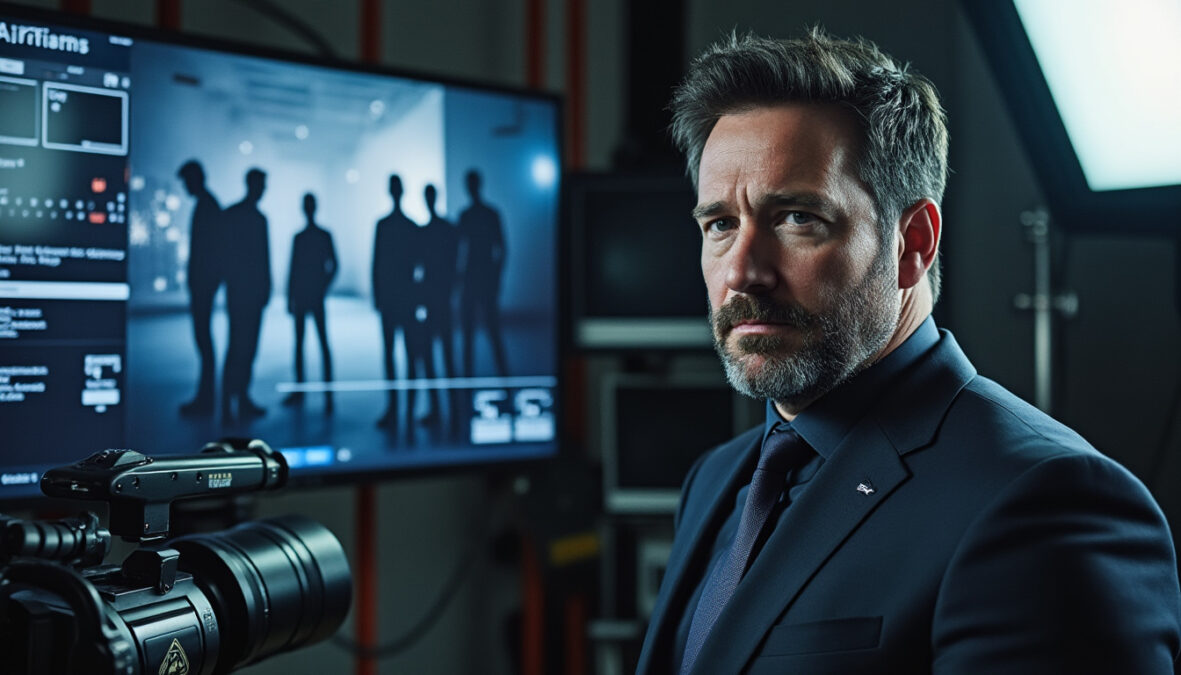
In Animals, the political thriller he directed and which is set to arrive on Netflix on October 9, 2026, Ben Affleck used artificial intelligence for several aspects of the production. The actor and filmmaker stands by this use, while clarifying that the technology alone cannot create a film capable of moving audiences. He likens its role to that of a creative tool integrated into the filmmaking process.
Ben Affleck confirmed that he used artificial intelligence while making Animals during a conversation hosted by Bloomberg. The film, which also stars Kerry Washington, Gillian Anderson and Steven Yeun, is expected to arrive on Netflix on October 9. However, the director did not detail the specific scenes or tasks to which these tools contributed.
He explained that AI had been used for several tasks, but that he was hesitant to discuss them in detail. In his view, filmmaking partly relies on creating an illusion of reality: revealing the mechanisms used to produce that illusion could change how it is perceived. He compared this kind of transparency to a magic show in which the magician reveals some of the secrets before it even begins.
This reluctance does not mean the filmmaker is trying to hide his use of the technology. Affleck acknowledges using it, but points out that revealing the details can distract from the film-going experience. He describes Animals as a deeply human story, for which AI served as a technical tool rather than a substitute for writing, directing or the performers’ work.
A production tool, not a machine that makes a film all by itself
Ben Affleck also sought to qualify the idea that advances in AI will soon allow anyone to describe a story to a machine and get a finished feature film in just a few moments. In his view, this prospect does not reflect the technology’s current capabilities, and he does not think filmmakers will soon be able to simply submit a prompt and produce a film audiences will want to watch.
This distinction matters in an industry where generative tools are prompting debate about the role of artists, the protection of their work and the future of many professions. The arrival of Tilly Norwood, presented as an actress generated entirely by AI, has in particular fueled concerns among some industry professionals. Affleck, for his part, advocates a more limited approach: AI can contribute to certain stages without replacing all the skills needed to make a film.
A technology the director places within the history of cinema
For Affleck, artificial intelligence is akin to a technological development among the many other technical changes that have shaped cinema and television. His perspective places these tools within a longer history in which new technologies change the ways films are shot, edited and brought through postproduction, without eliminating the human dimension of creation.
This view comes amid a broader context in which AI is also an economic and geopolitical issue, far beyond film sets. International rivalries over these technologies are explored in particular in this article about AI as a new battleground between major powers: international power dynamics surrounding artificial intelligence.
InterPositive, a project focused on postproduction tools
Ben Affleck’s position did not come out of nowhere. In 2022, he founded InterPositive, a startup developing tools to support technical teams during postproduction. The stated goal was to help film professionals with their work, rather than replace the creative process with fully automated production.
Netflix later acquired the company for a reported $587 million, or around 520 million euros. The deal lends particular significance to the director’s comments: his interest in the uses of AI in filmmaking stems both from his experience as a filmmaker and from his involvement in developing technical solutions for the industry.
Postproduction is one of the areas where digital tools can be used for a range of tasks, depending on a team’s needs. Affleck did not specify which InterPositive features were used for Animals, or explain how AI was incorporated into the film’s production. It is therefore difficult to assess the extent of its contribution based solely on his comments.
Investments that reveal the sector’s strategic importance
Companies specializing in artificial intelligence are attracting substantial investment, whether they serve the creative industries or the computing infrastructure sector. The industry’s financial ambitions are also evident in Cerebras’s announcement of a multibillion-dollar investment. Cerebras is an American competitor to Nvidia: Cerebras’s plans in the face of Nvidia’s dominance.
This technological race is not limited to the United States. Discussions also focus on how different regions can develop their own capabilities and integrate AI into their economies. Another perspective examines the relationship between artificial intelligence and India’s IT industry, presenting potential changes as an evolution rather than the simple disappearance of existing activities: AI and changes in India’s IT industry.
The human story at the heart of a political thriller
Animals is set in Los Angeles and revolves around the kidnapping of the son of a mayoral candidate, played by Ben Affleck. The character and his wife, played by Kerry Washington, try to find the child. The story is therefore built around a high-stakes family crisis set in a political and urban environment.
The cast also includes Gillian Anderson and Steven Yeun. By describing the film as a deeply human work, Affleck highlights the contrast between the feature’s dramatic subject matter and the technical processes used to make it. According to his explanation, AI contributes to certain stages of production, while the story remains centered on characters, relationships and human choices.
The filmmaker has not revealed exactly where artificial intelligence is used in the film. This lack of detail leaves open several questions about the nature of the work carried out with these tools. It also avoids reducing the discussion to a single scene or visual effect, given that AI can be used for various behind-the-scenes tasks.
A debate that extends beyond film sets
The use of AI by studios and production teams is part of a broader discussion about its consequences. Concerns include working conditions, the role of creators and control over the resources needed to develop these technologies. In the United States, public opposition to the construction of data centers illustrates another facet of the debate: the movement against data centers.
Questions of regulation and public-sector capabilities also arise at the European level, where new initiatives aim to strengthen the resources available in the field of artificial intelligence. This context helps explain why the statements of public figures such as Ben Affleck are closely followed: they touch both on the practices of a cultural industry and on a far-reaching technological transformation. The European Union’s new AI capabilities offer a glimpse of these issues at the institutional level.
With Animals, Ben Affleck does not present artificial intelligence as a solution capable of making an entire film without human involvement. Instead, he describes it as a tool used in several aspects of filmmaking, the workings of which he would rather not detail in order to preserve cinema’s characteristic illusion. His position distinguishes the integration of new technologies into a production from the idea of entrusting the entire creative process to a machine.


