
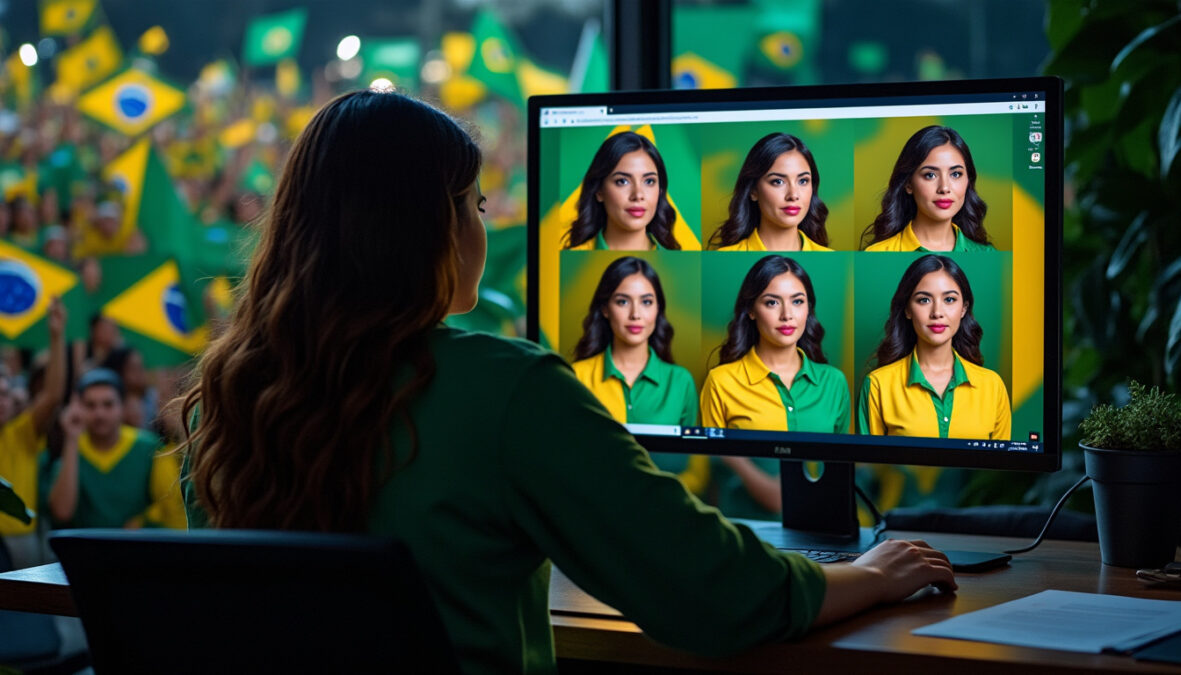
Just days before the second round of Brazil’s presidential election, a viral video appears to show a young blonde woman dancing alongside Flavio Bolsonaro and urging people to vote for him. The influencer, who is rapidly amassing hundreds of thousands of followers, is entirely fictional: the image of a conservative politician has been transformed using artificial intelligence. The case illustrates the risks of manipulation and identity theft at a time when social media has become a major battleground in the campaign.
On October 17, 2026, during a Flavio Bolsonaro rally, a clip begins to be widely shared on social media. It shows a young blonde woman, dressed in a revealing outfit, dancing and singing near the candidate. She appears to support his campaign and advocates conservative values on her Instagram account, while urging internet users to vote. Within a short time, her profile surpasses 500,000 followers.
As the October 25 runoff approaches, the appearance of this virtual activist initially seems like an effective publicity stunt. But fact-checks by Brazilian influencer Guga Figueiredo and Chilean outlet FastCheck reveal that the young woman, presented under the name “Julia Berlli Cortez,” does not exist. Her face and appearance were created using artificial intelligence tools.
A man transformed into a virtual influencer
The video is nevertheless based on real footage. The person dancing alongside Flavio Bolsonaro is indeed at the rally, but it is not a woman: it is conservative Congressman Nikolas Ferreira, a supporter of Flavio Bolsonaro and, before that, of his father Jair Bolsonaro. AI tools altered his appearance to portray him as a young blonde woman.
This transformation blurs the lines between an authentic scene and fabricated content. The rally did take place, and the congressman did attend, but the person seen by millions of internet users is a digital creation. This mixture of factual elements and visual manipulation makes the video all the more credible and makes it harder to identify as misleading content.
The case comes amid a growing trend in which AI-generated content is becoming more accessible and harder to detect. Safig has already examined the rise of online content that may have been produced by artificial intelligence, a development that could profoundly transform the way information circulates on the internet. Manipulated videos depicting Donald Trump and Volodymyr Zelensky in a fictional confrontation also illustrate how easily realistic images can bring events that never happened to life.
An election campaign shaped by a battle over images
The fake activist’s appearance comes amid a particularly tense campaign. Just days before the vote, the latest polls show left-wing President Lula and his conservative rival in a close race. Social media has become an essential space for reaching voters, but also a place where rumors, doctored images and artificially generated content spread rapidly.
The first-round results showed a notable gap between female and male voters. According to a poll by the Datafolha institute, Flavio Bolsonaro had a lower share of support among women than Lula: 35% compared with 46%. Among men, however, he was ahead, with 44% compared with 39%. In this context, the online presence of a young woman expressing support for the candidate can help create the impression that his campaign enjoys broader support among women.
HuffPost España notes that the absence of women at far-right rallies can affect the campaign’s image. Artificially adding female activists to videos could therefore serve to alter that perception, although the specific intention behind each post must be established on a case-by-case basis. The video of “Julia Cortez” thus depicts a crowd and support that do not reflect the reality of the person portrayed.
Multiple profiles and recycled identities
The first video is not the only one to feature this fictional character. FastCheck found other content in which “Julia Cortez” appears and answers questions about her voting choice. Meta has since deleted the original Instagram account, but other profiles featuring the same young blonde woman have also been created.
These accounts pose a particular challenge for platforms: an artificial identity can be replicated from one profile to another, while videos and messages continue to circulate after an account disappears. Deleting a page therefore does not guarantee that the content will stop spreading. The same images can be reposted, altered or reintroduced under another name, sometimes before fact-checks can reach the original audience.
Debates about platform moderation and responsibility take on greater importance when misleading content is disseminated on a large scale. Proposals to regulate social media more strictly, such as those advocating the regulation or even shutdown of Twitter, are part of this discussion about the effects of content circulation and the harm it can cause.
A political operation or a showcase for pornographic content?
The electoral dimension is not the only explanation being considered. According to HuffPost España, the bio of the Instagram account associated with “Julia Cortez” linked to a paid Telegram channel with more than 150,000 subscribers. The channel promoted pornographic content that was also generated using artificial intelligence.
This discovery suggests a possible commercial motive: the fake activist’s image may have been used to attract followers from social media to paid content. The political staging could therefore have served both to gain visibility and as a promotional tool. However, it does not, by itself, establish who created the accounts or whether the posts were primarily intended to influence the vote.
This distinction matters in a campaign where accusations of manipulation spread easily. Content can be used to attract traffic, generate revenue or draw attention without necessarily originating from a political organization. Conversely, the presence of a commercial interest does not rule out the possibility that a video could have a political effect, especially when it is presented as an authentic voter’s testimony.
Revelations about the use of artificial intelligence in the campaign
The case comes as revelations by Brazilian outlet The Intercept have shed light on a contract reportedly involving Flavio Bolsonaro and his party with Elytron, a US company specializing in cybersecurity. According to published reports, spending would exceed $140,000, and the AI system in question was intended, among other things, to collect data on a large scale and identify groups of voters.
The documents reportedly also mention methods such as spreading rumors and false information, creating fake accounts, and using infiltration and psychological warfare tactics to discredit opponents. These details have fueled questions about possible links between such practices and videos featuring fictional activists. However, no established connection has been made between the “Julia Cortez” account and the contract.
Flavio Bolsonaro’s campaign team and Elytron deny any involvement in illegal activities. They say no direct link has been demonstrated between their work and the fake influencer’s account. At this stage, it is therefore important to distinguish the reporting about the contract from speculation about the origins of the video.
Questions of accountability surrounding AI systems also concern models capable of producing text, images and videos from simple prompts. Discussions about the ethical responsibilities of large language models are a reminder that the issues go beyond the quality of the responses they generate: they also involve transparency, misuse and the effects of generated content in the public sphere.
Brazil, a testing ground for AI-generated election content
The fake “Julia Cortez” is not an isolated case in Brazil’s campaign. The newspaper Folha de São Paulo reported comments by Bruno Lewicki, OpenAI’s public policy lead for Latin America, who described Brazil as a possible case study in the use of artificial intelligence during elections.
Other artificial characters have also reached a wide audience. Among them is “Dona Maria,” an Afro-Brazilian retiree imagined by a rideshare driver and presented as a fierce critic of Lula’s Workers’ Party. Fake images showing an Afro-Brazilian woman worker removing graffiti hostile to Jair Bolsonaro from a São Paulo metro station have also circulated.
These examples draw on characters and situations that may seem familiar. They can give the impression that a political opinion is spontaneous, that an event was witnessed in person or that a social group broadly shares a particular position. When such portrayals are fabricated, they can help shape perceptions of a campaign without internet users immediately having the information they need to verify them.
Spotting manipulation in a stream of realistic images
The spread of increasingly realistic videos makes verification essential, especially when content is shared with strong emotional appeal or presented as decisive proof. It is useful to trace the source of a clip, compare the images with other footage of the same event and consult fact-checking outlets. In the case of “Julia Cortez,” research led to the real person whose appearance had been transformed.
Platforms must also contend with how quickly this content spreads. Warnings or reports may come after videos have already been viewed and reshared by a very large number of users. Discussions about social media regulation are thus connected to those about transparency requirements for AI tools, the speed of moderation and the protection of people whose image is used without their consent.
Controversial uses of AI are not limited to election periods. Debates about systems deployed by figures such as Elon Musk, particularly following comments that sparked strong reactions about the war in Gaza, show that design and moderation choices can also become matters of public concern. They reinforce the need to examine who controls these tools, what rules govern their operation and how the content they produce is disseminated.
A campaign in which disinformation is becoming a political issue
During the campaign, both sides filed lawsuits against their opponent, citing, among other things, abuses of power. In this atmosphere of confrontation, digital content can fuel accusations, deepen mistrust and shift the debate away from the candidates’ platforms and toward the authenticity of the images in circulation.
The case of the fictional activist highlights several risks at once: identity theft, the fabrication of political support, the monetization of artificial content and the difficulty of tracing it back to the people who produced it. It also serves as a reminder that a video can combine real and fictional elements, and that widespread online popularity is not proof of authenticity.
For democracies facing highly digitalized election campaigns, Brazil’s election offers a concrete glimpse of the challenges ahead. The spread of AI-generated content crosses national borders and may inspire new forms of political or commercial communication. Just months before France’s next presidential election, these practices are already prompting questions about campaign transparency, platform accountability and voters’ ability to identify manipulated images.


