
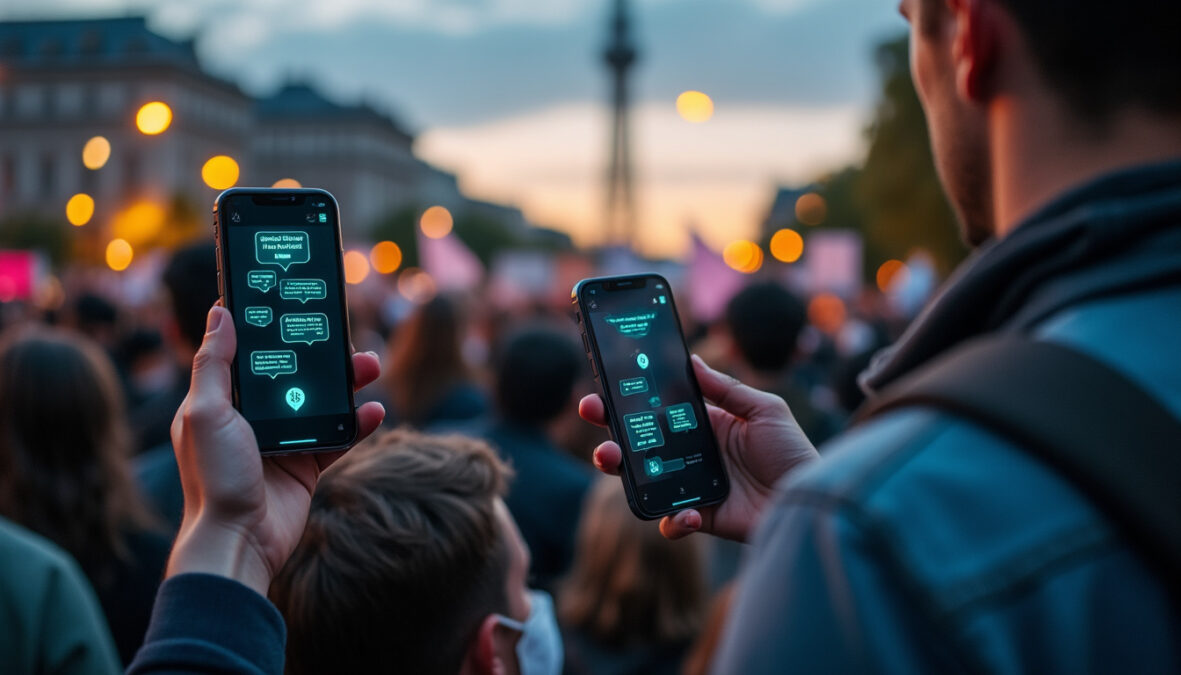
Bitchat is attracting attention as authorities consider restricting access to social media during certain demonstrations to prevent violence and looting. This messaging app, which relies on Bluetooth rather than the Internet or mobile networks, allows nearby phones to exchange messages and relay them from one device to another. Its rise is raising both practical questions about communication when networks are unavailable and issues concerning security and freedom of expression.
When mobile communications are disrupted or access to certain platforms is being considered as a preventive measure, demonstrators look for other ways to stay in touch. In this context, Bitchat is gaining visibility. The app offers messaging that can work without an Internet connection, which explains the interest it is generating among people taking part in gatherings.
The tool’s popularity has grown as discussions have circulated about possible restrictions targeting social media during demonstrations. Users are talking about it in videos and recommending that people install it in advance. The app has thus become one of the most downloaded in the country, according to information reported on October 31, 2026.
How does a messaging app work without an Internet connection?
Unlike conventional messaging services, Bitchat does not necessarily rely on mobile network or Wi-Fi access to transmit messages between nearby devices. It uses Bluetooth, a wireless communication technology built into most phones. Two devices with the app installed can exchange messages when they are within range of each other.
The stated range can reach around 300 meters under certain conditions. This distance is not guaranteed: it depends in particular on obstacles, the layout of the area and the characteristics of the devices. In dense urban settings, buildings or other sources of interference can reduce the effective range.
Phones can relay messages
The principle does not rely solely on direct communication between two people who are far apart. Devices participating in the network can act as relays: a message sent by one phone can pass through other compatible devices before reaching its recipient. This allows communication to extend beyond the Bluetooth range of a single device, when enough phones are present and available to relay messages.
This network therefore depends on proximity and the density of users. At a large gathering, the presence of many devices can help facilitate relays. Conversely, in a sparsely populated area, with phones far apart or significant obstacles, transmission may be more limited. Bitchat does not automatically replace a telecommunications infrastructure: its operation depends on nearby devices and communication conditions.
Why is the app attracting interest during demonstrations?
Social media and messaging apps play an important role in sharing information during gatherings: route changes, instructions, alerts or news about loved ones. If Internet access is disrupted, tools that rely on a conventional connection may become less accessible. A local communication app that works without the Internet can then appear to be a complementary way to communicate nearby.
Content shared online often highlights this possibility. Some users present Bitchat as an option to consider if SMS or Internet access stops working. These messages help raise awareness of the app, but they do not mean that it is guaranteed to work in every situation, or that it can replace emergency calls or public networks.
The discussion is part of a broader debate about measures being considered by authorities to limit violence and looting. Restricting access to social media, as well as using devices that could disrupt communications, raises questions about the effectiveness, proportionality and impact of such decisions. Decentralized communication tools then attract attention because they do not follow the same path as services that depend on the Internet.
An app worth exploring, with limitations to keep in mind
Bitchat’s operation may seem unusual to those who associate messaging with a permanent Internet connection. To better understand the features highlighted by the app, you can read this overview of Bitchat and how it works without an Internet connection.
Another explanation details the principle of communication between devices and how this local network works in this article about the network that communicates without the Internet. These overviews help put the app in context as a nearby communication tool, distinct from traditional platforms accessed via the Web.
As with any messaging app, users should also find out about privacy settings, the data processed and the terms of use. The fact that a service works without the Internet does not, on its own, mean that communications are anonymous or fully protected. It is also wise to verify information before passing it on, particularly in a tense situation where rumors can spread quickly.
Nearby communication and security issues
The development of solutions such as Bitchat highlights an important distinction: a decentralized local network does not have the same capabilities as a conventional mobile network. It can offer a way to communicate when usual connections are unavailable, but its coverage varies depending on the number of phones present and their ability to relay messages. It therefore guarantees neither uniform range nor consistent transmission.
In the context of a demonstration, the same tools can be used to share practical information, stay in touch with loved ones or send messages to a group. However, their use requires particular care when there is a risk of violence. The quality and verification of information, compliance with safety instructions and the protection of people remain essential, regardless of the means of communication used.
Finally, Bitchat’s rise reflects a shift in usage: as dependence on online services grows, some users are showing interest in apps that can work locally. Bluetooth technology and relaying between phones are at the heart of this proposition, while the network’s actual range depends on the environment and the participation of nearby devices.


