
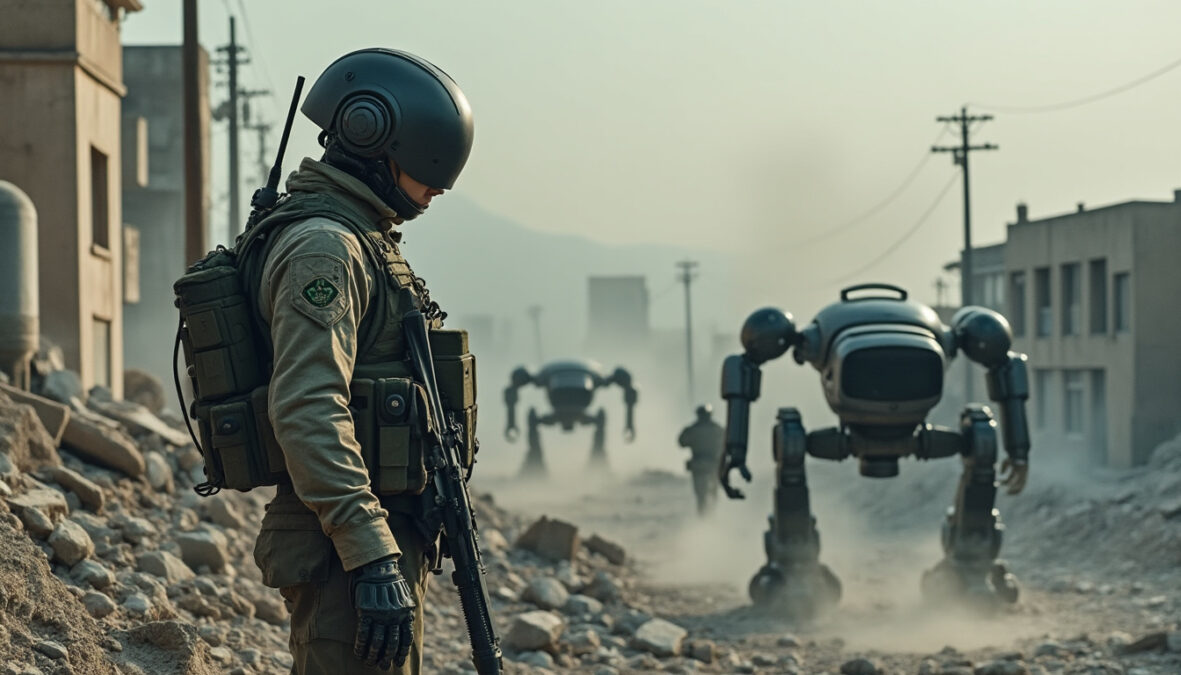
Ground robots, aerial drones and artificial intelligence systems are already changing the conduct of conflicts. Their ability to observe, transmit information and sometimes select targets accelerates operations, but raises a central question: what place is left for humans when military decisions are made by machines? From the battlefields of Ukraine to European debates on sovereignty and humanitarian law, this evolution affects the effectiveness of armed forces, the safety of populations and political accountability.
A rapid transformation in the conduct of conflicts
The robotization of warfare is no longer confined to speculative scenarios. Autonomous drones, uncrewed ground vehicles and tools for analysis assisted by artificial intelligence are already being used to monitor terrain, transport equipment or support military operations. By combining aerial and ground-based systems, some forces can now coordinate devices located far from their operators and operate in particularly dangerous areas.
The war in Ukraine illustrates this acceleration. Operations reported on the Donbas front have highlighted the coordinated use of aerial drones and ground robots, capable of being deployed behind enemy lines. This kind of maneuver would have seemed like science fiction just a few years ago. Above all, it shows that innovations spread at the pace of battlefield demands: armies experiment, adapt their equipment and quickly draw lessons from operations.
This evolution does not necessarily mean that soldiers will disappear. Rather, it changes how tasks and risks are distributed. Machines can identify a route, transmit images or transport payloads, while military personnel remain responsible for defining objectives, interpreting information and making decisions. But the more autonomous these systems become, the harder it is to draw the line between technical assistance and independent action.
From intelligence to action: the growing role of algorithms
AI software can process large volumes of images, messages and geographic data to identify items considered relevant. In a military context, this capability can help detect movements, set priorities or accelerate the preparation of an operation. It is presented as a way to reduce delays and support personnel faced with a volume of information that is difficult to analyze manually.
But an algorithmic recommendation is not a truth independent of its data. The quality of the results depends on the information provided, how up to date it is and how the system was designed. Incorrect or outdated data can lead to a person or building being wrongly identified as a target. And even when a tool provides an accurate analysis, it does not necessarily understand the human context, changes on the ground or the consequences of a strike.
These limitations take on particular importance when targeting systems reduce the time available for human verification. In recent conflicts, the use of software tools to identify and classify targets has raised concerns about how much room is really left for operators’ judgment. If validation becomes quick or routine, human oversight may remain in appearance while losing some of its practical significance.
Military autonomy raises ethical questions
Who decides when force is used?
The autonomy of a weapons system can refer to different things. A machine may follow a predefined route, detect objects or suggest targets without being authorized to fire. At a more advanced level, it could select and engage a target without immediate human intervention. These degrees of autonomy do not present the same risks: the ethical and legal problem becomes particularly acute when a system can decide to use lethal force.
The question, therefore, is not only whether a machine can perform a task accurately. It is also necessary to determine who sets the rules for its use, who oversees its decisions and who is answerable for the consequences. Responsibility may involve several actors: political leaders who authorize an operation, commanders who define its parameters, system designers and operators tasked with supervising it. Technical complexity must not make this chain of responsibility invisible.
The principles of international humanitarian law require, in particular, distinguishing combatants from civilians, ensuring attacks are proportionate and taking precautions to limit harm. These obligations require an assessment of the context, uncertainty and possible consequences. Yet AI does not make moral judgments in the human sense: it applies models and criteria defined in advance. Ensuring compliance with the law therefore remains a political and human responsibility.
Automated firing zones and the risk of error
The use of geographical areas in which systems are authorized to detect or engage targets raises further questions. An automated firing zone may be designed to address a specific military situation, but conditions on the ground change: civilians may move, a position may change its function or intelligence may become outdated. A decision based on outdated information can then have irreversible effects.
Speed is both one of the main advantages of these technologies and one of their vulnerabilities. Rapid analysis can help respond to a threat, but it can also shorten the time available to verify data, seek advice or call off a strike. The more automated operations become, the more essential it is to provide mechanisms for oversight, interruption and traceability.
Excessive trust in a system’s recommendations is also a risk. Even an experienced operator may be tempted to rely on a machine presented as faster or more objective. Yet an algorithm can reproduce biases, misinterpret a situation or be deceived by manipulated data. Cyberwarfare adds another dimension: networks, sensors and software can be attacked, jammed or falsified, with direct consequences for decisions made on the ground.
Conflicts are becoming hybrid and digitized
Advanced machines facing rudimentary means
Contemporary conflicts combine sophisticated technologies with means that are sometimes simple and inexpensive. A modified commercial device can be used to observe a position or guide an attack, while complex military systems provide surveillance and coordination. This combination explains why technological superiority alone does not guarantee control of the battlefield.
Drones are particularly representative of this hybridization. They can be used to gather intelligence, transmit images, disrupt communications or support an attack. Their cost, sometimes lower than that of the equipment they threaten, forces armies to rethink their defenses. It also leads to the rapid spread of expertise, as actors with limited resources can adapt readily available devices for military uses.
Digitization also changes how risk is perceived. When an operator controls a system remotely, they are less physically exposed than a soldier on the ground. This protection can save military lives, but it does not make the violence of conflict disappear. It can shift danger toward civilian populations and distance decision-makers from the real-world consequences of their choices.
The place of soldiers and civilians
Robots can be sent into contaminated areas, monitor dangerous routes or carry out certain transport missions. In this way, they can reduce soldiers’ exposure to immediate threats. However, this protection does not resolve the fundamental questions of war: the objectives being pursued, the proportionality of the means used, the harm caused to civilians and the conditions for a return to peace.
The gradual replacement of personnel with machines can also transform the relationship between society and conflict. If military personnel are less exposed, authorities may be less directly confronted with the human cost of operations. This does not automatically mean that war becomes easier to decide on, but it makes public debate about the thresholds for engagement and the consequences of automation necessary.
The human role is therefore not limited to pressing a button before a strike. It includes assessing the circumstances, the ability to doubt, consideration of civilians and judgment about whether the action itself is warranted. A machine can perform a task at great speed; on its own, it cannot determine whether continuing an operation truly serves a legitimate political objective.
France and Europe face the technological race
Sovereignty and strategic dependence
The race for military technologies is dominated by powers with substantial financial resources and powerful technology sectors. The United States is investing heavily in AI and autonomous systems. China is also pursuing the development of these capabilities, in a context often seen as less constrained by the same ethical and regulatory debates. Russia, for its part, relies on its own military priorities and a different approach to regulation.
For France and Europe, the challenge is twofold. They must develop capabilities suited to the needs of their armed forces, while also avoiding complete dependence on technologies designed elsewhere. This military sovereignty concerns the equipment, software, data, components and expertise needed to develop them further. Dependence on foreign systems can limit freedom of action or expose sensitive information.
European research and experimentation are underway, but they must contend with more fragmented budgets, demanding regulatory frameworks and sometimes complex industrial cooperation. These constraints are not only obstacles: they can also help establish safeguards and ensure that military development respects democratic values. The challenge is to prevent ethical requirements from resulting in a technological lag that would reduce Europe’s ability to make its own decisions.
Innovating without abandoning the principles of oversight
A European strategy could aim to develop high-performance systems while maintaining meaningful human control over lethal decisions. This requires clearly defining what “human control” means in relation to the functions involved and the operational context. Genuine oversight requires operators to have understandable information, sufficient time to act and a real ability to suspend or modify the system’s operation.
It also involves assessing weapons before deployment, checking their behavior in a range of situations and documenting decisions made with the help of their recommendations. Audit and traceability mechanisms can help explain how a system contributed to an operation. They do not replace human responsibility, but they make it harder for that responsibility to be diluted behind an interface or an algorithm.
International discussions on autonomous weapons systems focus precisely on how to limit risks and safeguard humanitarian law. They sometimes pit calls for a general ban against the pursuit of rules governing their use. Whatever framework is adopted, the challenge remains to reconcile shared commitments with divergent military interests and an accelerating technological race.
Understanding the effects of artificial intelligence beyond the military sphere
Debates about autonomous weapons are part of a broader discussion about the capabilities and limitations of artificial intelligence. Its development affects work, the economy, information and social relations, while raising questions about human control over systems. In this regard, the analysis of Geoffrey Hinton’s warning about the evolution of artificial intelligence sheds light on broader concerns about the role these technologies might play in human decision-making.
In the military domain, these questions take on particular urgency, because the consequences can be immediate and irreversible. Technology can enhance detection and action capabilities, but it eliminates neither uncertainty nor the need for judgment. The faster and more complex systems become, the more important it is to understand their limitations, retain the ability to control them and determine unambiguously who is accountable for their use.
The question of war without soldiers is therefore not simply about physically replacing combatants with robots. It concerns how societies choose to wage war, the degree of autonomy granted to machines and the responsibility of those who design, authorize and use them. The place of humans will depend as much on political and legal choices as on the technical performance of the systems deployed.


