
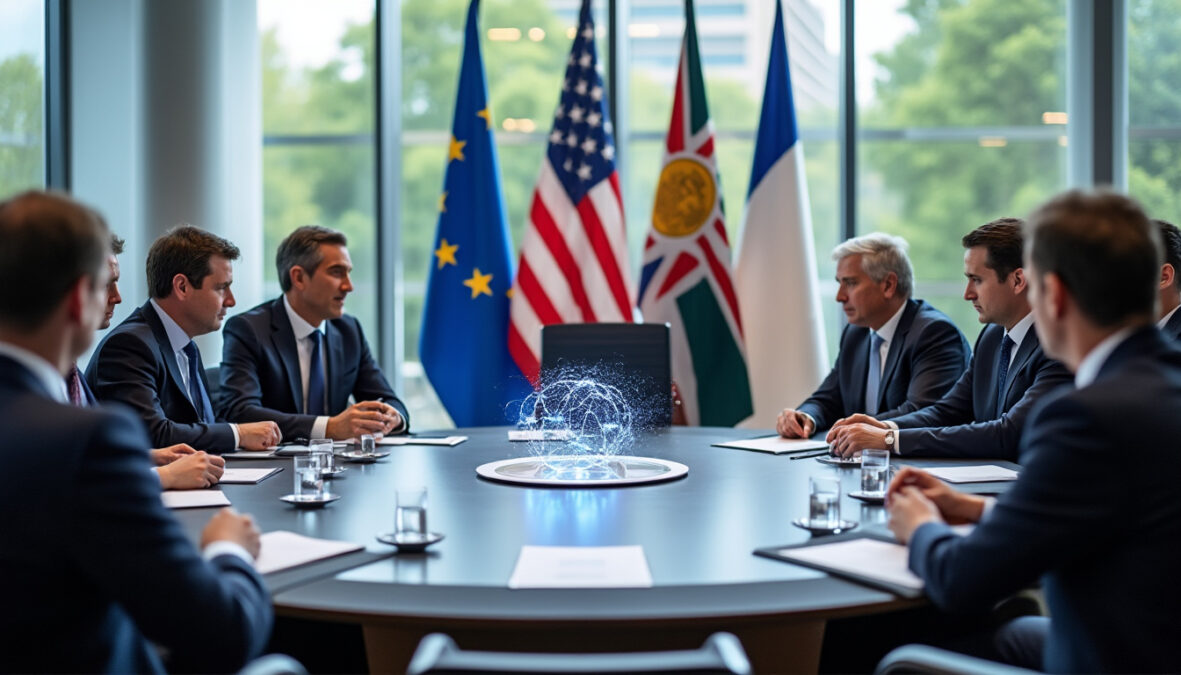
In the face of the rapid rise of artificial intelligence, Norway, Canada, Finland, and other countries advocate for common rules and international oversight. This diplomatic initiative is taking shape without the support of the United States, which currently rejects a binding global framework, even as its companies maintain a dominant position in the sector.
Artificial Intelligence: A Western Coalition Seeks Common Rules, Without the United States
An Exchange Between Leaders Originating a Diplomatic Initiative
The project began with an informal conversation between Norwegian Prime Minister Jonas Gahr Store and his Canadian counterpart, Mark Carney. The two leaders were regularly exchanging ideas when Store asked him if Canada would agree to join a group of Western countries looking to reflect on new international rules for artificial intelligence. According to the Norwegian leader, the Canadian response arrived within minutes: Ottawa was ready to participate.
This membership is part of a broader diplomatic momentum. Managing risks associated with AI was also on the agenda of a meeting between Mark Carney and French President Emmanuel Macron, held on September 20 in Saint Pierre and Miquelon. Following that, Canada asked the United Nations Security Council to examine the security issues related to this technology.
Days later, Jonas Gahr Store and Finnish President Alexander Stubb issued a joint statement signed by 22 countries. They call for strengthening international oversight and remind that artificial intelligence must remain under human leadership, supervision, and control. Their proposal includes the creation of a global monitoring mechanism for developments in AI.
Common Rules for a Borderless Technology
For the involved governments, the effects of artificial intelligence now transcend national borders. AI systems can be developed in one country, used in another, and have consequences on a global scale. This interdependence fuels the idea that a limited response based on national legislation might not be sufficient to prevent the most dangerous uses.
The approach evokes—albeit with context-specific differences—the international efforts made after World War II to reduce risks associated with nuclear weapons. The analogy emphasizes the ambition to build shared principles around a strategic technology. However, it does not imply that the two situations are identical: AI is a versatile technology, developed and deployed by public and private actors across many sectors.
The risks and governance issues thus vary depending on the applications. In the health sector, for example, artificial intelligence can support research and medical practices while raising questions about reliability and human control, as explored in this article on AI in medicine, between potential and vigilance.
Concerns also pertain to the uses of AI for producing or modifying images and content. The potential transformations of image professions, from models to graphic designers, illustrate the economic and professional ramifications of these tools, as described in this report dedicated to the recreation of faces and the evolution of creative professions.
Washington Reluctant to a Binding International Framework
A Leading Power Opposed to Global Rules
The main difficulty for proponents of common governance lies in the position of the United States. The country is home to several of the largest companies in the sector and has a central ecosystem for research and development of advanced models. Artificial intelligence has also become a growth driver and a major valuation factor for large American tech companies.
Despite this influence, Washington is not very supportive of creating a binding international framework. Jonas Gahr Store described a contrast between governments willing to take collective responsibility and those prioritizing strategic competition. He notably criticized the notion that the priority should be to outpace China rather than negotiate common safeguards.
During his address to the United Nations General Assembly on September 22, Donald Trump rejected the idea of an international framework aimed at regulating artificial intelligence. This opposition complicates discussions: the United States is among the main powers designing the most advanced models and has a significant influence over their global dissemination.
China constitutes another major player whose absence would pose problems. Experts believe that an agreement negotiated without the two major AI powers could remain largely symbolic. James Lewis, a former U.S. State Department official who worked on cybersecurity under the Obama administration, points out that it would be challenging to limit the consequences of military or dangerous uses if the primary producers of this technology are not involved in the negotiations.
This challenge also concerns the balance of power between countries using AI tools and countries hosting the most influential companies and laboratories. The most active governments in calling for regulation are often those dependent on technologies developed elsewhere. A coalition without the main research hubs could thus help establish principles but struggle to enforce them on the actors shaping the sector.
The Economic and Financial Stakes of Regulation
The debate on AI rules goes beyond the diplomatic framework, as regulatory choices can affect innovation, competition, and markets. Financial institutions are also questioning the risks and transformations related to automation and new artificial intelligence tools, as shown in this article about how Wall Street perceives AI as a new challenge.
For states, the challenge lies in defining guarantees that limit risky uses without hindering applications deemed beneficial. An international standard could encompass transparency, security assessments, developer accountability, or the deployment conditions of certain systems. The question remains regarding who would be tasked with ensuring compliance with these rules and what means would be available in case of non-compliance.
Tech Companies Also Call for Shared Governance
OpenAI and Anthropic Advocate for International Coordination
Calls for better coordination do not come solely from governments. Some companies behind the most advanced AI models also support the idea that governance should not be left solely to tech companies. On September 23, Sam Altman, CEO of OpenAI, advocated before the UN for broader participation in the decisions that determine the future of artificial intelligence.
He argued that if AI is to be democratic, the most important decisions cannot be made solely by private labs concentrated in the San Francisco area. This position highlights a central question: how to involve governments, independent experts, companies, and citizens in the rule-making process without entrusting all decision-making power to the actors developing the systems?
Dario Amodei, head of Anthropic, also submitted proposals related to AI safety to the UN Security Council. Among the suggestions is an international ban on certain uses that could facilitate the development of biological weapons. Such a proposal illustrates the desire to define precise limits for applications deemed particularly sensitive.
The uses of artificial intelligence also raise questions about individual rights and democratic control. In Europe, an initiative presented as giving citizens unprecedented and anonymous power over the management of AI shows that the debate also revolves around the public’s role in the governance of these tools: European citizens and their power over artificial intelligence.
An Idea of a Regulatory Body Already Discussed in the Sector
The creation of a structure to monitor the risks associated with AI had already been suggested prior to the current calls for an international coalition. In July, Demis Hassabis, then former CEO and now Chairman of Google DeepMind, proposed the idea of an organization funded by industry companies. Its board would include independent specialists and representatives from the AI ecosystem.
The proposed model drew inspiration from Finra, an American organization that performs certain regulatory functions in the financial domain. The project garnered interest in some economic circles, but it was later sidelined after opposition from several prominent tech figures, including Mark Zuckerberg, Jensen Huang, and Elon Musk, directed at Donald Trump.
This experience highlights the discrepancies within the sector itself. Some companies see coordination of safety and legitimacy guarantees as beneficial; others fear that external control would limit their maneuverability. The debate thus centers as much on the content of the standards as on the identity of the institutions that will develop and enforce them.
A Coalition Against Security Risks and Malicious Uses
AI Security at the Heart of International Discussions
The Canadian request to the UN Security Council reflects the desire to include artificial intelligence in international discussions on security. Governments are particularly concerned about the possibility that advanced systems might facilitate malicious operations, enhance military capabilities, or make certain sensitive knowledge more accessible.
The risks are not limited to military applications. AI tools can also be associated with the creation of misleading content, violations of privacy, or forms of violence targeting individuals. The current news surrounding an incident involving a Molotov cocktail attack against Sam Altman’s home serves as a reminder—without establishing a direct link between an act and regulatory debates—that industry leaders can also be exposed to threats: the case related to the attack targeting the home of the OpenAI leader.
For proponents of a common framework, the question then is to distinguish the risks that can be framed by national rules from those that require cooperation between states. Digital systems circulate rapidly, and models can be reused in different contexts. International oversight could facilitate information exchange, tracking of technical advancements, and identification of practices posing cross-border dangers.
The Participation of Major Powers, a Decisive Issue
The coalition led by Norway, Canada, Finland, and their partners can help structure the debate and bring forth common principles. However, the effectiveness of any agreement would largely depend on the involvement of the countries that develop and deploy a significant portion of artificial intelligence systems. The absence of the United States and China would limit the scope of any measure targeting the main players in the sector.
Standards developed without these powers could nonetheless influence the practices of other countries and the expectations of international organizations. They could also serve as a foundation for subsequent discussions, clarifying the desired objectives and the required monitoring mechanisms. The question remains whether these rules would be voluntary, integrated into national legislations, or associated with more formal international commitments.
For now, diplomatic efforts are multiplying, companies are presenting their own proposals, and governments are seeking to define their role in overseeing AI. The debate, long concentrated within technical and economic circles, is now moving to the forefront of discussions among leaders and within international institutions.


