
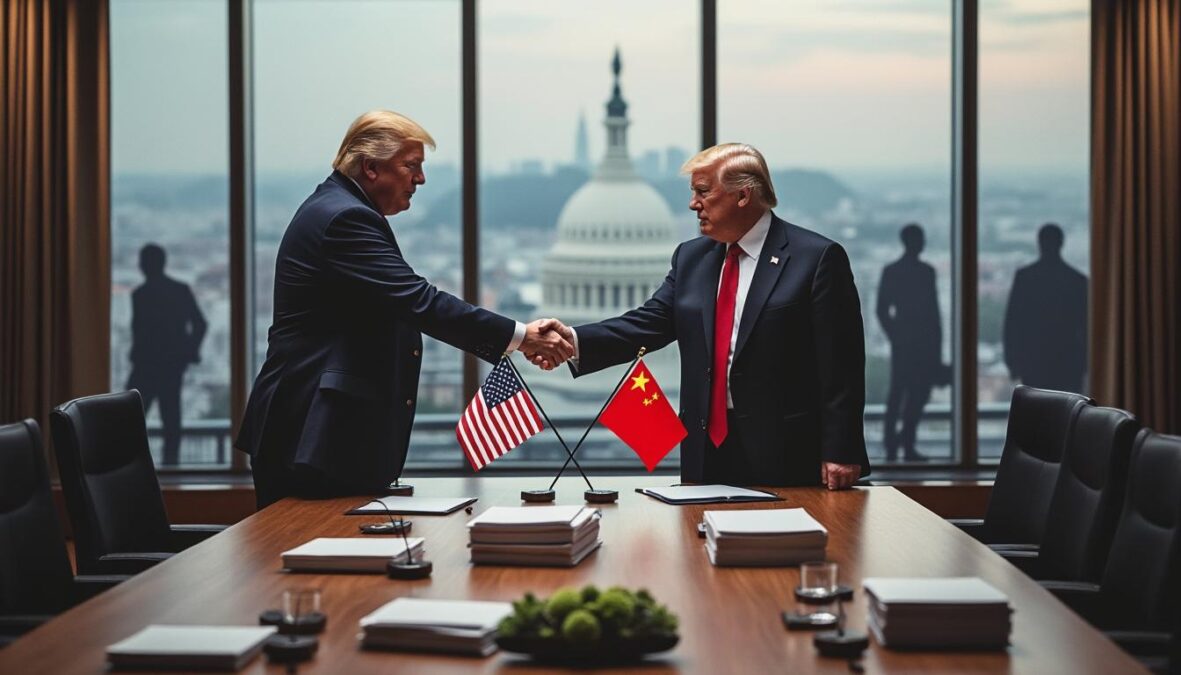
In a context of strained trade relations between the United States and China, President Donald Trump has recently undertaken efforts to reduce tensions with the Asian giant. This rapprochement, however, faces new challenges that could significantly influence exchanges between the two powers. This text will explore the different dynamics at play, the actions taken by Trump, and the potential obstacles that arise.
Trump de-escalates trade tensions with Beijing
During a summit in Beijing, Donald Trump stated that the United States and China are increasingly realizing profitable business together. Elected on the promise to correct the trade imbalance between the two countries, Trump claimed that trade relations are improving, particularly with announcements such as China’s intention to import more American products like soybeans and beef. The discussions at the summit emphasized the need to maintain a growing economic stability, which could translate into the establishment of a Trade Council to promote ongoing dialogue on economic issues.
A prolonged trade truce
The trade truce, which was established last October, seems to be on track to be extended. This initiative could allow both countries to ease tensions arising from high tariffs and concerns related to emerging technologies, including artificial intelligence. Trump and his advisers highlight the idea that this common commitment is essential not only to strengthen the economic resilience of the United States but also to ensure a favorable framework for future agreements.
New challenges on the horizon
Despite an atmosphere of cooperation, several persistent challenges threaten to undermine this recent harmony. For example, while Trump claims to be optimistic about increasing trade, statistics reveal a worrisome decline in American exports to China, with nearly $50 billion less in goods compared to the previous year. This drop is partly explained by the cessation of Chinese soybean purchases during last year’s trade war. This raises concerns about the effectiveness of the trade reforms undertaken by the Trump administration.
The impact of geopolitical tensions
Relations between the United States and China are also affected by geopolitical tensions related to broader issues, such as China’s role in the global supply chain. As American companies redirect their supply chains to other countries like Vietnam and India, the United States’ dependence on Chinese imports has significantly decreased. Imports from Taiwan now exceed those from China, a sign of shifting trade dynamics.
Divergent strategies of Washington and Beijing
The approaches of the United States and China regarding global competitiveness are also proving to be very different. While Trump emphasizes maintaining America’s lead in artificial intelligence and views trade balance as a key issue, Xi Jinping and his administration adopt a vision that incorporates realities such as climate change and global energy challenges. This divergence of strategy could exacerbate tensions as the two countries navigate an increasingly complex economic and political landscape.
Persistent structural tensions
Varied issues continue to arise, such as China’s dominance in the rare earths sector and crucial technologies. The Trump administration is trying to supplement this shortfall through national partnerships for the development of rare earth resources, but the path remains long and challenging. Furthermore, ongoing trade tensions, exacerbated by the war in Iran and new regulations on sensitive technologies, pose significant obstacles to a complete restoration of relations.
An uncertain future
As events unfold rapidly, both nations must navigate through significant challenges. A new intergovernmental trade body, proposed by the United States, could facilitate trade exchanges without jeopardizing national security. But its success will depend on both parties’ willingness to engage in constructive dialogue while facing complex economic and geopolitical realities. Upcoming developments, including final decisions on issues such as chip control and agricultural exports, will be decisive. The outcomes of this dynamic will have implications for the trajectory of trade relations for many years to come.


