
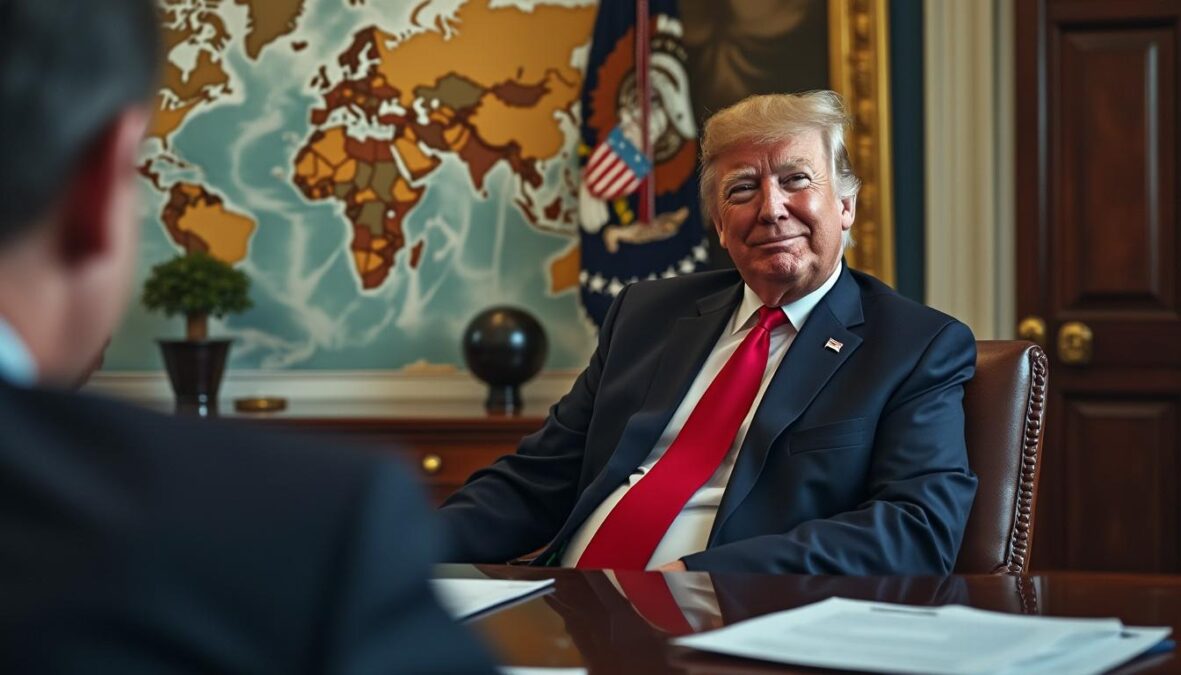
The American president, Donald Trump, recently expressed his optimism regarding the tense situation with Iran, stating that the conflict could be “almost over.” These remarks were reported by Maria Bartiromo, host of Fox Business, after an interview conducted at the White House. This perspective raises questions about the evolution of relations between the United States and Iran, as ceasefire negotiations are expected in the coming days.
Trump’s Optimistic Statements
During his interview with Bartiromo, Trump stated: “I think it’s almost over… I consider it very close to the end.” This optimistic tone from the American president is not new, as he has regularly asserted that the United States’ objectives, particularly limiting Tehran’s nuclear and military capabilities, have been achieved. However, Iran has largely contested these claims, making accusations against the United States.
Upcoming Negotiations
Trump also indicated that he expected ceasefire negotiations between the United States and Iran to resume quickly, in the near future, following a weekend of fruitless talks in Pakistan. Indeed, a fragile ceasefire has been agreed upon, extended until April 21, and last night, this agreement seemed to hold. Active diplomatic efforts are therefore expected in the coming days.
A Naval Blockade and a Context of Concern
Despite this apparent optimism, the situation remains tense. In parallel to the talks, Trump ordered a naval blockade against Iran. This blockade, initiated this week, raises concerns about a potential escalation of tensions. Indeed, the conflict has already reached its sixth consecutive week without a clear resolution in sight, awakening fears of a deterioration of the situation on the ground.
Discussions Between Israel and Lebanon
A positive element within this climate of tension is the holding of historic discussions between Israel and Lebanon, taking place in Washington and marking the first since 1993. This development enriches the dialogue in the region, even as Iran has expressed its desire to include Lebanon in any future ceasefire agreement. This context could provide new perspectives for de-escalation in the Middle East, which is essential given the current uncertainties.
Reactions and Reflections
The international community is closely monitoring these recent developments, as the ramifications of a prolonged conflict could have consequences well beyond regional borders. While the Trump administration seems confident about resolving the conflict, voices are rising to remind that the realities on the ground often echo more complex challenges. Recent reports of hostilities and human casualties highlight the fragility of this situation.
With a ceasefire ongoing and negotiations taking shape, the future of peace in the region seems European, but remains subterranean. Ongoing discussions and noticeable military actions shape a climate where Trump’s optimism could face a more obstinate reality.
For more information on the situation, one can refer to several related articles addressing American involvement in the region and the international dynamics at play, such as the conflict in Iran, reflecting persistent tensions.
Other articles also highlight recent events, such as the postponement of Trump’s ultimatum to Iran and security discussions surrounding the Strait of Hormuz, thereby addressing crucial issues for global stability.
These developments and the dynamics in Washington must be followed closely, as the international community hopes for a peaceful resolution to this prolonged conflict. The situation, however, remains fluid and complex, filled with challenges to overcome.


