
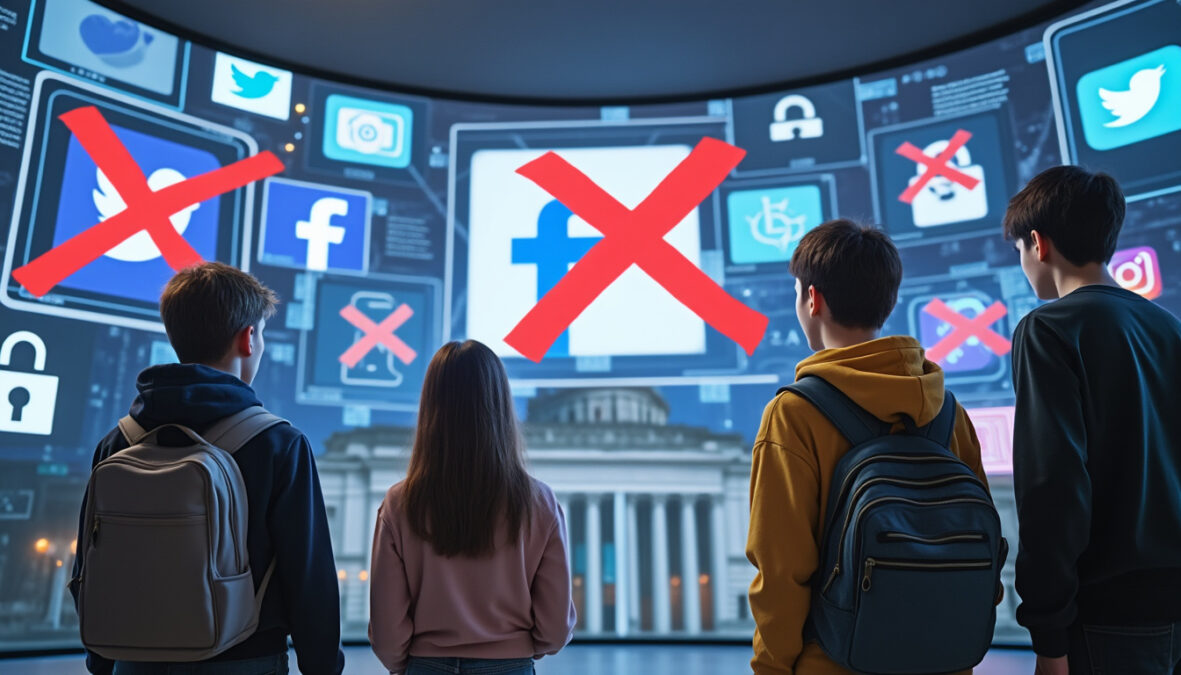
The deputy minister Laure Miller has proposed a bill prohibiting social media for youths under 15 years old, which will be voted on this Tuesday after discussions in a mixed parliamentary committee. This measure aims to put an end to the unregulated use of platforms by minors, in response to growing concerns about the harmful effects on their mental health. What impact will this ban have on the different platforms and when will it be implemented? This article particularly addresses these questions.
Social media ban: which platforms are affected?
The bill presented by Laure Miller applies to all social media platforms, without distinction. This means that giants like Facebook, Instagram, Snapchat, TikTok, and Twitter will be strictly prohibited for users under 15 years old. Only a few exceptions are considered, such as access to online encyclopedias and educational projects with a positive aim.
The measure aims to protect young people from the risks associated with excessive social media use, such as cyberbullying, addiction, as well as sleep and concentration disorders. In fact, statistics show that nearly 67% of young people aged 6 to 10 use these platforms, despite the theoretical ban on accessing them before the age of 13.
When will the measure come into effect?
The government expresses its desire to implement this ban as soon as the school year begins, in September. This implementation will also coincide with another measure, that banning the use of mobile phones in high school. Regarding the legislative process, the text will need to be voted on by both assemblies, which seems to be a formality, given the consensus observed during discussions in the committee. Only France Insoumise voted against it.
The stakes of this legislation
The question of the application and enforcement of this measure also raises concerns. Indeed, in a context where many teenagers manage to bypass security systems, such as facial recognition software, the need for a more rigorous verification mechanism arises. The European Commission opts for a gradual access of minors to social media, recommending a ban for those under 13 years old, thus leaving it to EU countries to implement additional restrictions.
This subject raises many debates not only at the national level but also at the European scale. Countries like Italy, Germany, and Spain are considering similar legislations, thus seeking to protect youth from the dangers of social media. This echoes broader concerns regarding the impact on the well-being of young people, a public health issue acknowledged by many experts.
For more information on the harmful effects of social media on our well-being, you can consult this global report. Likewise, exploring the challenges that this ban represents for Europe, this other article can be consulted: a challenge for Europe.


