Automated trains, maintenance that can anticipate breakdowns, passenger-adapted announcements and facial recognition payments: artificial intelligence is already transforming many aspects of rail transport. Trials and deployments are progressing around the world, but at different rates, amid promises of economic gains, regulatory constraints and questions of public acceptance.
Rail remains a highly capital-intensive activity. Building and modernizing tracks, purchasing trains, maintaining them and managing daily operations all represent significant costs for operators. An increase in passenger numbers is not always enough to ease this pressure on costs. In this context, digital tools and artificial intelligence are emerging as ways to improve network efficiency and service quality.
Their applications go far beyond the striking image of a driverless train. They also include early fault detection, driving optimization, passenger assistance at stations and streamlining access to transport. According to an estimate by the consulting firm BCG reported by AFP, AI could enable the global rail sector to reduce its costs by $36 billion to $79 billion.
Automating train operation and enhancing rail traffic safety
Autonomous rail vehicles are one of the most visible applications of this transformation. Presented at the InnoTrans trade fair in Berlin, an experimental Deutsche Bahn train, named Automated Train, is designed to run without a driver between a depot and a station. Its maximum speed is 40 km/h. LiDARs, ultrasonic sensors and infrared cameras enable it to detect obstacles and, if necessary, trigger braking.
The project is part of a broader effort to modernize German infrastructure. The Ministry of Economic Affairs has provided €42 million in support for the program, as part of planned investments to renew the network. Automation is intended in particular to make some operations run more smoothly and reduce the workload associated with repetitive tasks. The Spanish startup Ostirion has presented a system that uses AI to assist drivers in their work.
Networks are already testing forms of automated operation
In Russia, passenger trains on the Moscow Central Circle are operated remotely, with a supervising driver on board. The system is designed to detect a pedestrian up to 600 meters away and respond in 0.3 seconds. The operator plans to expand autonomous operation across its entire network by 2029.
These systems do not mean that human presence will disappear immediately. Trials and initial services often rely on supervision, while perception and decision-making systems need to be assessed in a range of situations. Safety, equipment reliability and the ability to respond to unexpected events are crucial before any widespread rollout.
The social implications are also significant. In Germany, the GDL train drivers’ union is closely monitoring automated train projects and is concerned that efficiency gains could be used to justify job cuts. Rail’s technological evolution therefore also depends on dialogue with the employees concerned and on how new functions are incorporated into their jobs.
Anticipating breakdowns through predictive maintenance
Less striking than an autonomous train, predictive maintenance is a major area of application. Sensors and analysis systems monitor the condition of trains and network equipment to identify anomalies before they cause a breakdown or service suspension. By anticipating maintenance work, operators can better schedule workshop operations and reduce service interruptions.
In Japan, AI-enabled cameras inspect certain train and infrastructure components, including overhead lines, on the JR East line. Automated image analysis can flag a potential defect and help teams focus their inspections. In a sector where maintenance operations require substantial resources, detecting an anomaly earlier can reduce intervention times and costs.
In France, rail applications of AI include maintenance and train operation. The growing number of onboard sensors provides more data on train condition and makes it easier to monitor their operation. When a breakdown occurs despite preventive measures, diagnostic support tools can suggest several possible repairs within seconds.
These recommendations can draw on the train’s service history, built up over several years, as well as technical documents and maintenance reports. Possible scenarios are ranked by likelihood to help teams guide their investigations. AI does not replace technicians’ expertise: it brings together and organizes information that can speed up the identification of a problem.
Reducing energy consumption and improving punctuality
Artificial intelligence also plays a role in the day-to-day operation of trains. Eco-driving tools provide drivers with real-time guidance to adjust their speed and anticipate gradients or stops. The aim is to limit energy-intensive acceleration and braking while complying with operating constraints and schedules.
For SNCF’s TGV trains, this type of assistance is associated with an estimated 8% to 10% reduction in electricity consumption. This is significant for a major rail operator whose trains account for a substantial share of energy use. Optimization can also contribute to smoother driving and passenger comfort, provided the recommendations remain compatible with safety and operational requirements.
In South Korea, on the Daegu Metro, a system analyzes drivers’ operation in real time and compares it with a benchmark for optimal driving. It can then offer personalized guidance. Analysis of driving practices is thus used to identify areas for improvement and tailor training, with punctuality and onboard comfort among the intended outcomes.
Adapting information and assistance for passengers
Digital transformation is also changing the station experience. In Japan, on the Meitetsu network, some voice announcements are generated by AI, particularly at unstaffed stations. Smart cameras can identify situations in which a passenger appears to need help. A language generation system can then provide the passenger with guidance and alert emergency services.
This approach, sometimes described as a form of “benevolent surveillance”, illustrates the dual function of these technologies: improving assistance while analyzing images captured in public places. Their deployment therefore raises questions about data collection, retention, surveillance practices and informing the people concerned.
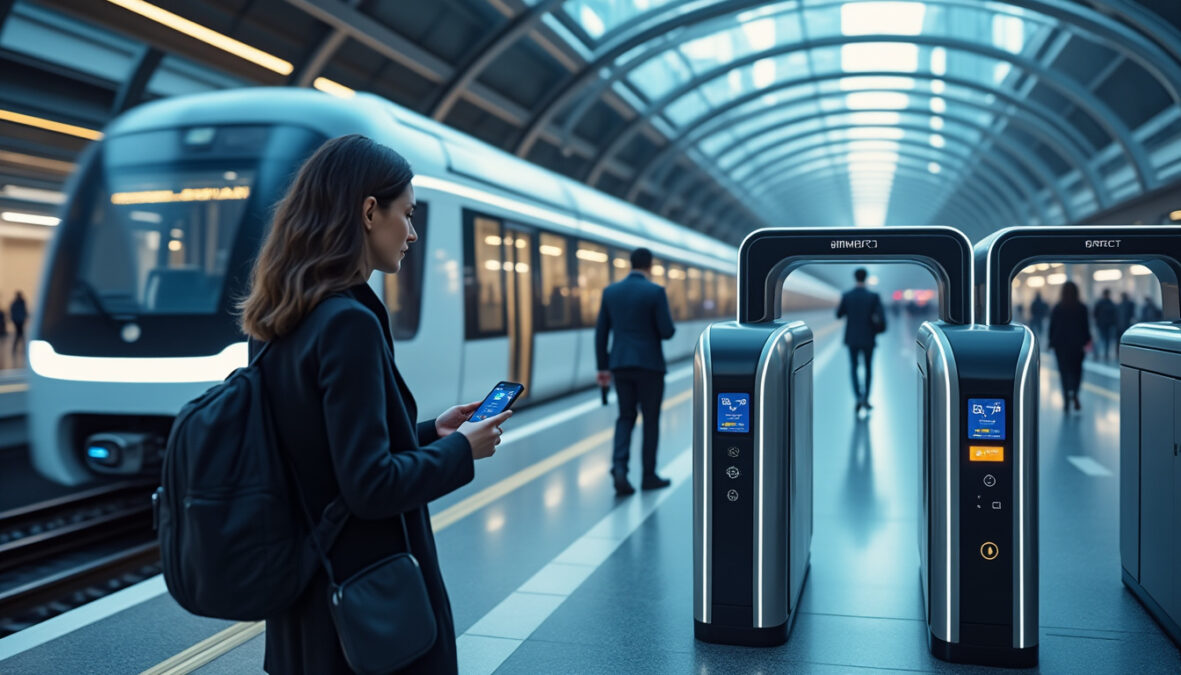
Digital tools can also make access to transport faster. In Russia, the Face Pay service lets passengers pay and pass through access gates on the Moscow network using facial recognition. It is available at 240 stations and has around 200,000 registered users. In China, facial recognition has been used since 2017 for boarding some high-speed trains and on several metro networks.
In Stockholm, AI-linked cameras have been installed to identify behavior that could signal a dangerous situation in stations. According to a Hub Institute study for SNCF Voyageurs, the system is said to have helped save 39 lives in three years. These uses highlight the potential for early detection, but also underscore the need to clearly define the purposes, responsibilities and limits of surveillance.
Very different levels of deployment across regions
AI applications in rail are not progressing at the same pace everywhere. Several projects in Asia demonstrate uses that are already integrated into operations, maintenance or passenger assistance. In Europe, many initiatives remain at the trial stage or face greater difficulty moving to large-scale operation.
This difference is not explained by budgets alone. Rules on personal data, safety requirements, ethical concerns and labor relations all affect project timelines. In Europe, facial recognition is tightly regulated under data protection rules and the AI Act. Some biometric uses are prohibited or subject to significant restrictions.
Before adopting a system developed in another country, operators must therefore assess its level of maturity and acceptability in their own context. Image blurring, data anonymization and limiting the information collected are among the proposed ways to better protect privacy. The challenge is to determine which functions can genuinely provide benefits without creating disproportionate risks.
Significant investment, gains to be measured
The economic potential of AI is attracting operators as several countries embark on major rail renewal programs. In Germany and France, modernization needs involve tracks, equipment and trains. Savings that could be achieved through predictive maintenance, automation or energy optimization may help cover some of these costs, but their scale depends on the conditions under which they are deployed.
Results need to be assessed beyond financial gains alone. Service punctuality, the number of breakdowns prevented, train downtime, energy consumption and the quality of passenger information are also important indicators. A tool that performs well in a trial may need to be adapted before it can be used across an entire network, where equipment, traffic volumes and constraints vary.
In France, SNCF says it has deployed 120 AI-related use cases. The most advanced examples include rolling stock maintenance and driving assistance. Their development draws on growing amounts of data collected by trains, track equipment and operational tools, as well as the expertise of staff who interpret the systems’ results.