
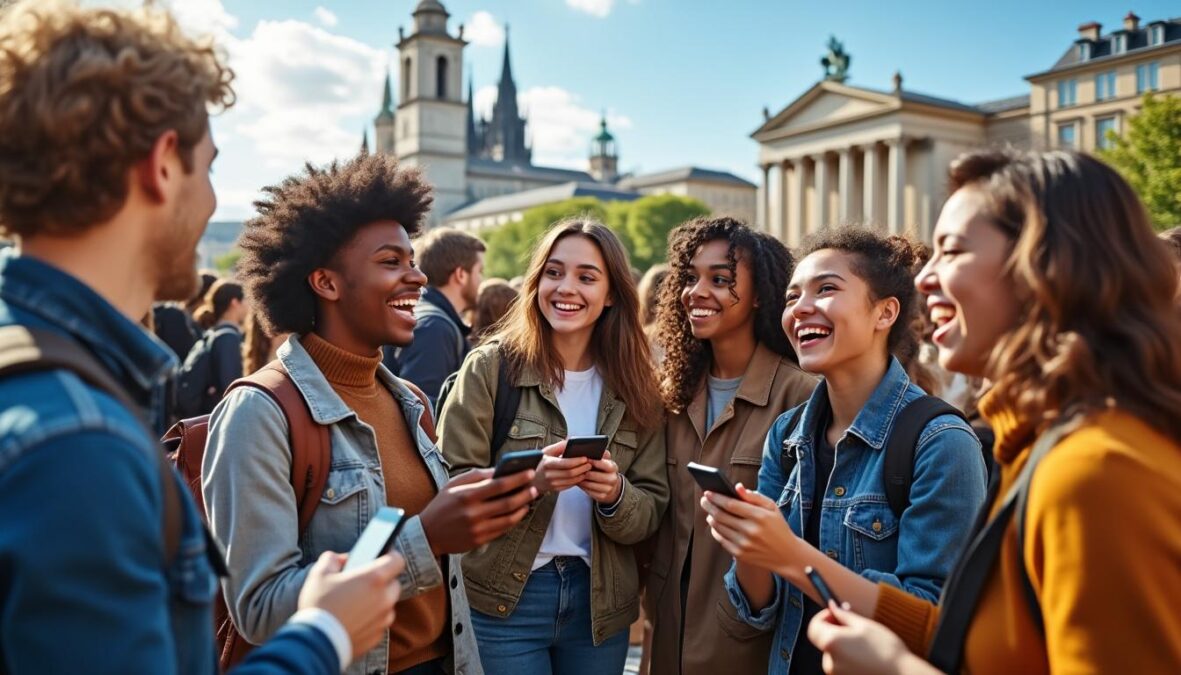
As European governments consider various regulations on young people’s access to social media, voices are rising to oppose a general ban. European youth asserts that they must be included in the debate on an issue that has a major impact on their social and educational lives. Young people advocate for solutions that enhance online safety while preserving their freedom to access these platforms.
A debate on the online safety of young people
Discussions around banning social media for under-16s are fueled by concerns about the safety of young people. Proponents of these measures argue that they are necessary to protect this age group from potential dangers they may encounter online. However, the young people themselves decry their exclusion from debates that directly concern them, emphasizing that these restrictions do not truly address their needs.
Young people mobilized to defend their digital space
In France, Ireland, and the Netherlands, youth movements such as Ctrl+Alt+Reclaim have formed to express their opposition to these proposed bans. Thomas Yaqoubi Reboul and Noe Hamon, members of this collective, insist that social media has become essential tools for socializing, learning, and participating in public life. They have thus proposed amendments to the bill aimed at regulating platforms rather than restricting access to them.
A collective voice in the media
Young people have also sought to make their voices heard through op-eds published in major newspapers like Le Monde, to publicly debate the potential consequences of such restrictions. They have organized meetings with other young people across the country to better understand their concerns regarding these measures.
An alarming perspective on bans
When young people became aware of the possible implications of these bans, their reaction was one of deep concern. Many initially thought these measures would be beneficial but soon realized the ramifications they would have on their access to platforms like Roblox or TikTok. These digital spaces, according to Hamon, are vital not only for socializing but also for personal creation and development.
Pressure on young people to gain safety
Young people are aware of the risks associated with social media, but they do not believe it is necessary to restrict their access. On the contrary, they argue that social media is among the few fully accessible public spaces, allowing them to learn how to interact responsibly. Youth movements in Europe recommend better enforcement of existing regulations rather than implementing blanket bans based on age.
A call for education and regulation
Lauren Bond, 19 years old and a board member of the Organising Bureau of European School Student Unions, emphasizes the importance of tailored digital education. She insists that initiatives have already been put in place at her school to teach young people how to navigate the digital world. However, this education is not uniform across Europe; therefore, it is crucial to develop programs on digital citizenship in all schools.
Diverse experiences across countries
Niels Zagema, representing Dutch youth, also advocates for a gradual regulation of access to social media. He reports that the majority of young people he consulted oppose bans, although they recognize the need to better control their online behaviors. He proposes phased exposure methods, where the use of technologies is introduced gradually depending on age.
Social media as windows to the world
Aisling Maloney, from Ireland, shares her personal experience: for her, social media has been a valuable link to the outside world, allowing her to explore interests otherwise inaccessible. She argues that all young people should have the opportunity to use these platforms in an informed and safe manner. Maloney calls for a dialogue between young people and policymakers so that the true impacts of such restrictions are understood.
Towards more humane regulation
Young people advocate for solutions that will make platforms safer without depriving them of their means of expression and exploration. They suggest that features designed to protect users, such as time limits, should be better highlighted. Additionally, new legislations like the Digital Fairness Act (DFA) could limit potential paths of addiction and manipulation on social media.
The reality is that European youth are not asking for a ban on their digital space but rather a thoughtful approach that combines strict regulation and education, thus allowing for the construction of a safer online future while respecting their rights and needs.


