
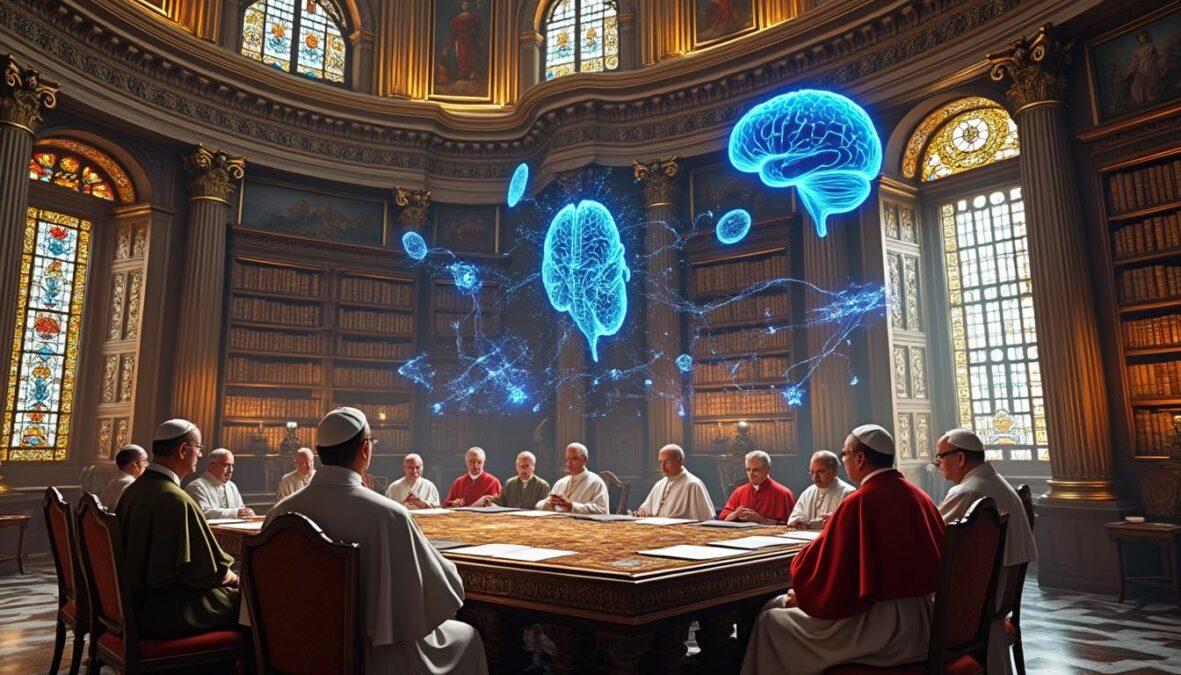
The encyclical “Magnifica humanitas” by Pope Leon XIV, published on May 25, 2025, marks a significant step in the exploration of human dignity in the age of artificial intelligence (AI). It is part of a historical reflection initiated by his predecessors, notably Pope Francis, on the necessity to align technological advancements with fundamental human values. Through this encyclical, Leon XIV seeks to establish ethical foundations for the use of AI and to address the contemporary challenges that society faces in light of this digital revolution.
A Papal Legacy in the Face of AI Challenges
Pope Francis’s reflection on AI began in 2020, when he issued a “Call from Rome for an Ethics of Artificial Intelligence.” This document brought together prominent figures in technology and globalization to advocate for the idea that digital advancements should serve to improve human conditions rather than replace them. The concept of “algor-ethical,” introduced by Franciscan Father Paolo Benanti, highlights the importance of integrating human values into technological development from the outset.
The Call from Rome and Its Ethical Implications
During the landmark event of 2020 at the Vatican City, the alliance formed around this call established ethical imperatives for creating responsible AI. This ethical framework laid the groundwork for collaboration among religious institutions, businesses, and government agencies. It permeated Pope Francis’s thought and influenced Leon XIV’s encyclical, rendering their position credible in the face of technological advancements.
AI and Human Dignity
In the current context, Leon XIV emphasizes that the question of human dignity is paramount. His message for the World Peace Day in January 2024 was dedicated to AI, asserting that the voice of all stakeholders, particularly those of the most marginalized, must be heard in discussions about regulating this technology. It is a call for inclusive dialogue, a theme closely linked to the idea that every human being deserves to have their opinion and well-being considered in technological decisions.
Leon XIV’s Intervention at the G7
In 2024, Pope Francis became the first pontiff to intervene before a G7, after which he continued to advocate for meaningful human control over technological choices. His statements reminded that AI deployments should not condemn humanity to a role of observer, but rather enable it to maintain control over its own reality. Leon XIV inherited this message and amplified it, warning that AI systems could surpass human control, raising crucial moral dilemmas.
The Vatican’s Doctrinal Texts on AI
From the outset of his pontificate, Leon XIV continued to enrich the Church’s social doctrine with texts addressing the relationships between artificial intelligence and human intelligence. Initiated in 2025, the decree of the Pontifical Commission prohibits algorithms that promote social inequalities or violate human dignity. This critical position reminds us that machines, however advanced, should not be confused with forms of autonomous intelligence.
A Message on Ethics and Humanity
In this context, the Pope also emphasized the necessity of a public interest platform regarding AI, before reminding that every decision in technological design must reflect a vision of humanity, thus inviting developers to adopt a stance of moral discernment. Leon XIV also insisted that the real challenge lies in preserving reality in the face of the increasing virtualization of our lives.
A Warning Against Reality Simulation
In a speech given in 2026 in Yaoundé, the Pope engaged in a deeper reflection on the consequences of AI, identifying a critical risk where reality could gradually be replaced by simulations. This warning, which evokes a civilizational shift, sheds light on the ethical implications of AI on younger generations and their development. Leon XIV thus emphasizes the shared responsibility among designers, users, and decision-makers to steer technological futures toward authentic service to humanity.
The Future of AI Through the Lens of Social Doctrine
As society enters a new era of undeniable innovations, the encyclical “Magnifica humanitas” centralizes the idea that the teachings of the popes must go beyond words. They must serve as a guide for a digital ethics that preserves individual dignity and encourages responsible technological development. This historical return of the papacy to questions of AI marks a commitment to responding directly to the upheavals of modern times while safeguarding fundamental human values.


