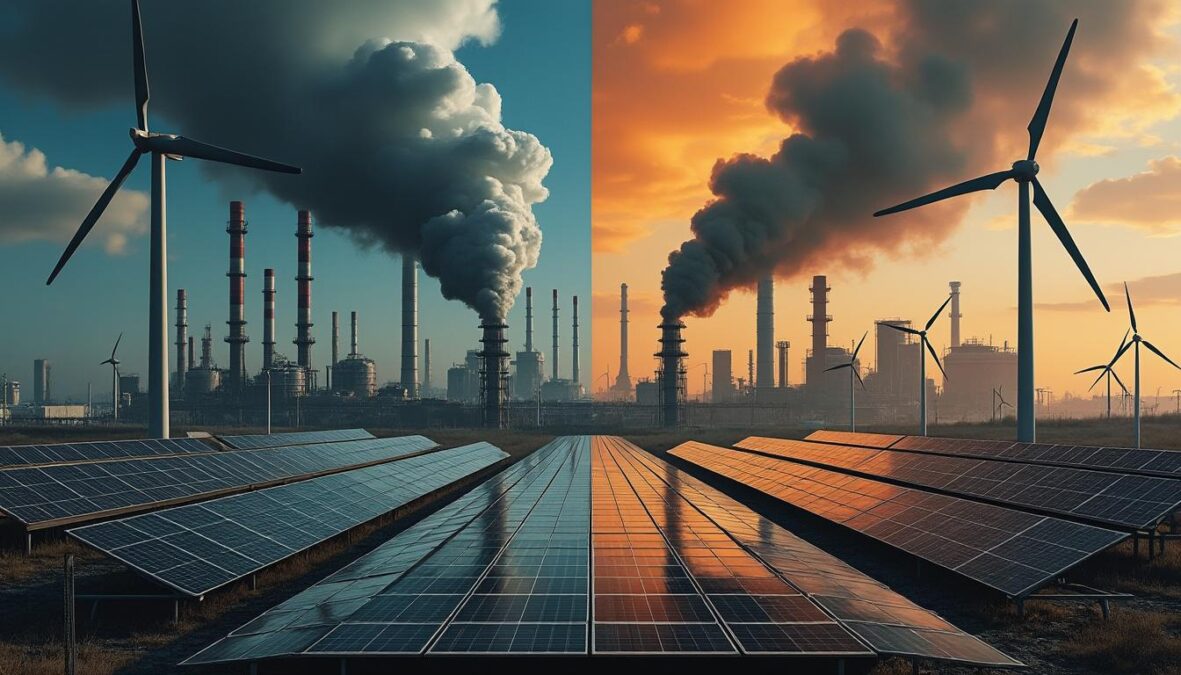
Since the election of Donald Trump, the energy policy of the United States has undergone a major turnaround. The president has firmly opposed the transition to renewable energies, and this stance has serious consequences, particularly in the context of the conflict with Iran. This text explores the effects of Trump’s policy on the United States, putting them in a position of weakness in the face of the volatility of fossil fuels and the global energy market.
Disdain for renewable energies
Trump’s disdain for renewable energies is evident, with provocative statements and concrete actions aimed at hindering their development. In Scotland, he called wind farms a “scam,” encouraging European countries to abandon their green ambitions. At the World Economic Forum in Davos, he reiterated claims that China was exploiting wind turbines, while omitting to mention that it has the largest wind farm in the world.
This rejection of energy alternatives has been exacerbated by the Trump administration’s decision to withdraw from global climate agreements and to cut subsidies for clean energies in states deemed “politically unreliable.” This short-term strategy could prove disastrous, especially as American energy infrastructures are strained by international conflicts.
Impact of the conflict with Iran on energy
The war against Iran has brutally highlighted the vulnerability of the United States to fluctuations in fossil fuel prices. Geopolitical tensions, particularly around the Strait of Hormuz, have caused a spike in crude oil prices, exceeding 100 dollars a barrel. This strait is a key route for oil transport, representing one-fifth of global oil supplies.
Despite a slight increase in domestic production, fluctuations in the global market continue to exert pressure on gasoline prices in the United States. The cost has risen to about 4 dollars per gallon, while Trump recently boasted about lower prices. The current situation thus prevents American consumers from benefiting from the advantages of an energetic transition toward more sustainable solutions.
Consequences for American consumers
American households are already feeling the negative effects of this policy on their budget. The rising energy tariffs weigh heavily on consumers, who are now seeking alternatives like electric vehicles. Analysts also warn that oil prices will not necessarily return to normal levels after hostilities end, highlighting the administration’s lack of response to the challenges posed by dependence on fossil fuels.
Calls for investment in green energies
In light of the current volatility, energy experts and environmental advocates are calling for a reassessment of investment priorities. Renewable energies, such as wind and solar power, are not affected by geopolitical conflicts and could provide a sustainable solution to energy challenges. The example of Spain, which has managed to maintain affordable energy bills through investment in renewables, serves as inspiration for the United States.
António Guterres, UN Secretary-General, reminds us that “there are no price spikes for sunshine and no embargoes on wind,” thus underscoring the exclusivity and stability that these energy sources can offer compared to fossil fuels. This reality highlights the growing gap between global climate ambitions and the energy policies of a country that, under Trump, has hesitated to embrace change.