
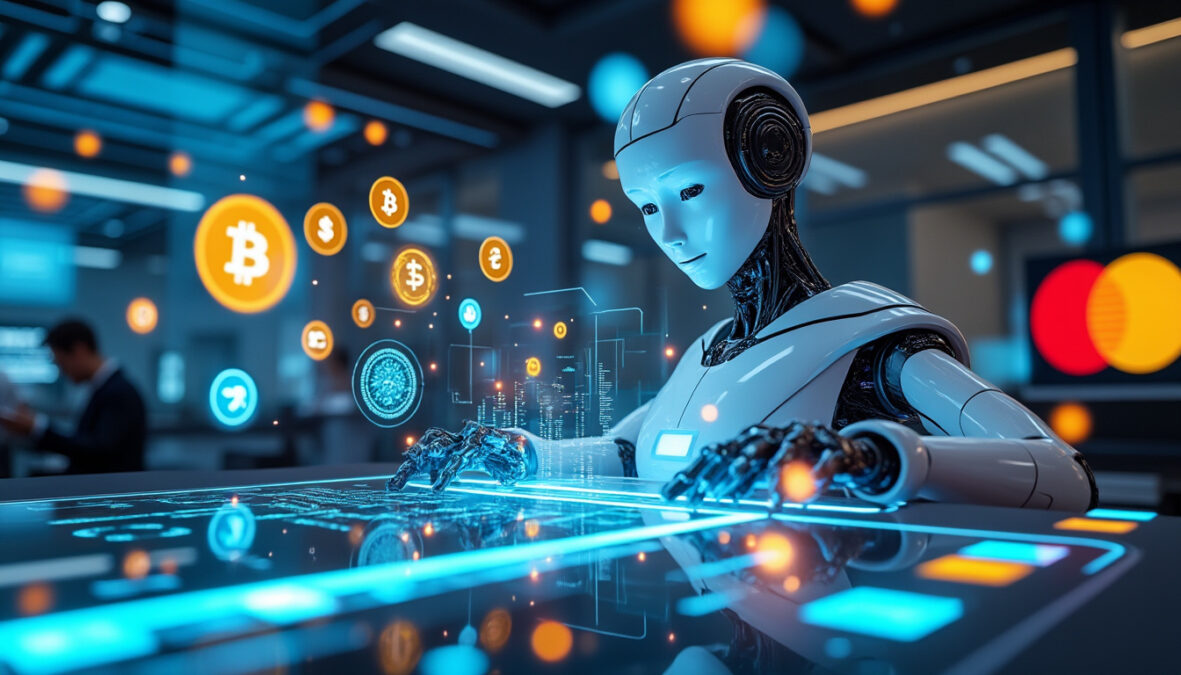
In a world of constantly evolving technology, Mastercard positions itself at the forefront by offering a revolutionary automated transaction system. This new protocol, called Agent Pay for Machine (AP4M), seeks to enable artificial intelligences to manage payments among themselves, without human intervention. An advancement that promises to redefine online commerce and expand the capabilities of businesses through autonomous machines.
The functioning of AP4M
The AP4M protocol was designed to facilitate transactions between artificial intelligence agents. By allowing these software programs to initiate and execute autonomous payments, Mastercard paves the way for a new era of digital commerce. This operational model means that the needs expressed by users would be instantly translated into series of purchases, carried out by AI agents. These transactions, quickly executed and continuously, would lead to frequent microtransactions, transforming our consumption habits.
Implications for businesses
With the rise of this new payment system, Mastercard envisions a future where businesses can create digital services that AI agents can automatically purchase and use. This autonomous capability could radically transform the overall business landscape. Not only small businesses, but also large corporations would be able to become major players in the digital space, responding more efficiently to user demands.
A future without human intervention
Mastercard’s vision is clear: to create an environment where artificial intelligences take on complex payment processes without requiring human intervention. This automation could lead to a paradigm shift in online commerce, making transactions faster and more efficient. In other words, it would be possible for AIs to execute entire chains of financial operations, representing an unprecedented technological advancement.
Concrete use cases
Mastercard has already begun to illustrate practical examples of this future. Take the example of a florist who would ask an AI to design their website. In this scenario, the AI could also manage payments for hosting, the domain, and even the integration of marketing tools. This demonstrates how autonomous machines could handle the entire commercial process, from creation to transaction, thus highlighting the potential for complete automation.
Ethical and economic challenges
Despite the undeniable advantages of this technology, its emergence also raises ethical and economic questions. The possibility of machines managing our money without human oversight could concern some users. Moreover, the question of the impact on employment is crucial, as millions of positions could be affected by increasing automation. For more information, refer to this article on jobs at risk due to artificial intelligence: Five million jobs at risk in France.
The necessity of digital education
As this technology evolves, it is imperative that professionals and students become familiar with the capabilities of artificial intelligence. Understanding the tools and capabilities offered by AI is crucial to adapting to these changes. To learn more about why every student must master these skills, check out this article: Why every student must absolutely master AI.
Towards an innovative transformation of communities
This transition towards automated transactions could also play a crucial role in transforming communities. AI can offer innovative solutions to improve public services and resource management. To explore how AI is transforming communities, check out this article: AI and the innovative transformation of communities.
Partial conclusion on business performance
Ultimately, the implementation of artificial intelligence in financial transactions represents a fascinating opportunity for businesses. By allowing machines to optimize their performance, businesses can enhance their operational efficiency. For further insights on how AI boosts business performance, check out this article: When artificial intelligence boosts business performance.


