
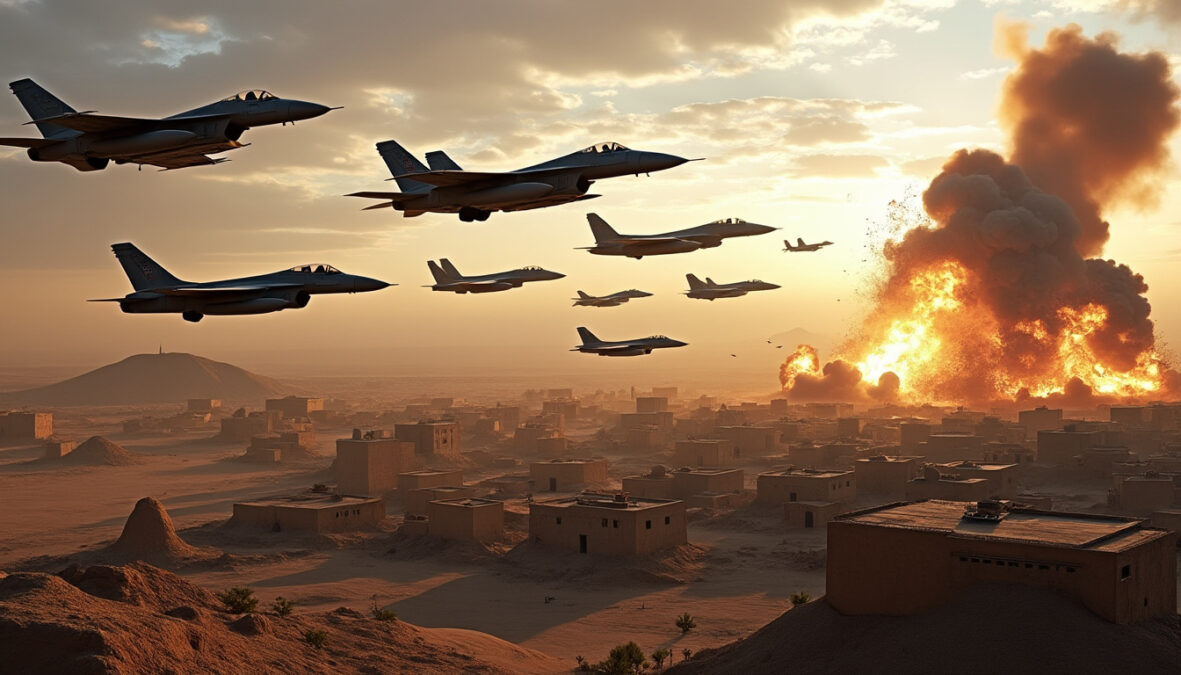
On June 9, the U.S. Central Command, known as Centcom, announced airstrikes in Iran in response to the attack on an American helicopter. This decision follows escalating tensions in the region, heightened by the destruction of an Apache helicopter, prompting the U.S. president to promise an urgent and proportionate response to this aggression.
Conflict Background
For several months, relations between the United States and Iran have been marked by heightened tensions. Several incidents and clashes have occurred, including U.S. strikes near the Strait of Hormuz and Iranian reprisals. The situation was further intensified by the announcement of a temporary ceasefire in early April, which was quickly broken by hostile activities from both sides.
Recent Events
On June 8, an Apache helicopter from the U.S. armed forces was shot down over the Strait of Hormuz, triggering an immediate reaction from Washington. President Donald Trump announced on his social media platform Truth Social that the pilots survived the incident, but emphasized the importance of a U.S. response to this Iranian aggression. According to him, “the United States must, imperatively, respond to this attack,” asserting that Iran must be held accountable for its actions.
U.S. Strikes in Self-Defense
The Central Command carried out the strikes at the order of the commander-in-chief, stating that they were acting in self-defense. The operations began at 5 PM local time, targeting specific facilities in Iran believed to be linked to the attack on the helicopter. These actions are part of a strategy to demonstrate strength and security for U.S. troops deployed in the region.
International Reactions
In response to the strikes, Iranian Foreign Minister Abbas Araghchi downplayed the incident, stating that foreign forces in the region were “constantly exposed to risks” due to their own mistakes. Araghchi suggested that the best solution to reduce these risks would be the withdrawal of U.S. forces from the area. This position reflects the complexity of geopolitical issues in the Middle East, where every military gesture is scrutinized and leads to potential escalations.
A Failed Diplomacy
Despite rising tensions, President Trump had previously mentioned the possibility of a diplomatic agreement to end hostilities in Iran, talking about a timeframe of “two to three days” to reach a peaceful solution. However, with the outbreak of violence, peace prospects seem to be fading as U.S. strikes intensify. The current chapter of U.S.-Iran relations appears more as a showdown than as a constructive negotiation, exacerbating an already tense climate in the region.
Economic and Military Stakes
The strikes by U.S. forces occur within a context of economic instability due to sanctions and military measures taken by both countries. While Iran is facing severe sanctions, U.S. actions continue to have repercussions on the markets, plunging U.S. stocks into a sea of intense volatility. Economic concerns are widely reported and fueled by expert analyses closely following these events. The overall dynamics highlight the importance of a cautious approach in managing this crisis.
For more analyses on the geopolitical situation, visit this article on the Iran-U.S. confrontation, or explore other aspects such as the economic context described here.


