
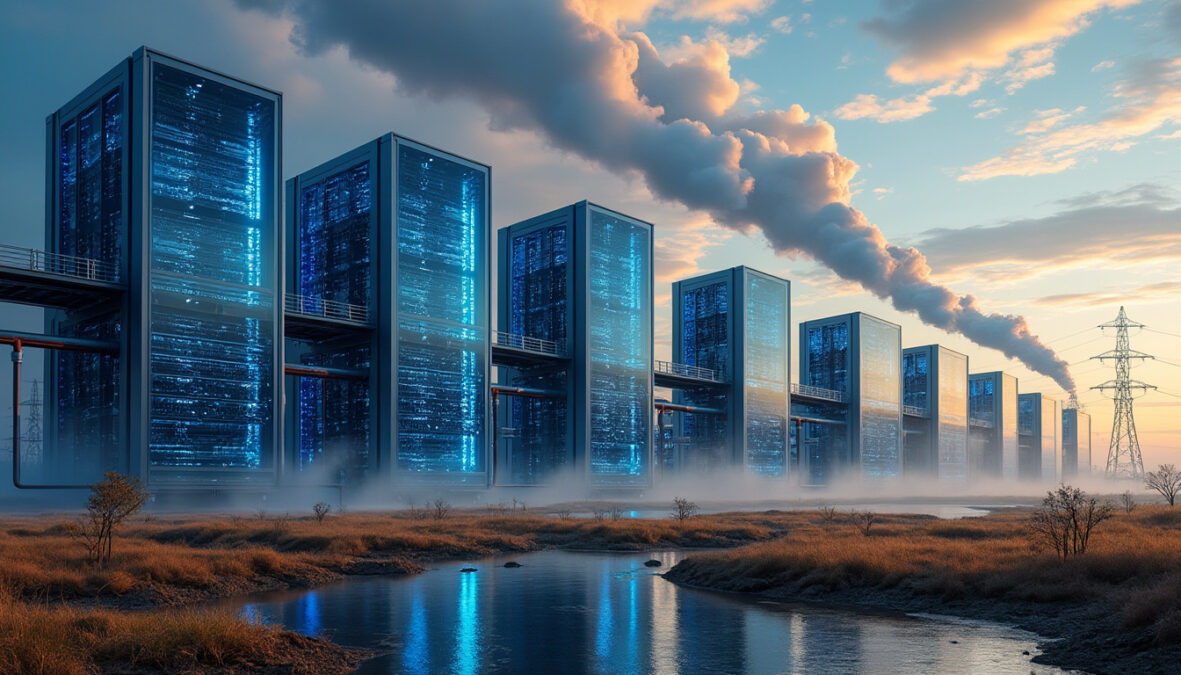
According to a study presented by the Green IT association at Produrable Paris 2026, the environmental footprint of artificial intelligence could worsen significantly by 2030. Greenhouse gas emissions associated with global AI infrastructure could rise from 99 to 636 million tonnes of CO₂ equivalent, while impacts on water, natural resources and health would also remain significant. The report calls for better regulation of AI use and the development of more resource-efficient models.
The rapid growth of artificial intelligence is accompanied by increased demand for servers, computing power and electricity. At the Produrable Paris 2026 trade show, Green IT published a study comparing the environmental and health impacts of AI infrastructure worldwide in 2025 and projecting them to 2030. Its projections describe a marked increase in several forms of ecological pressure, not just carbon emissions.
The authors estimate that, if current trends continue, annual greenhouse gas emissions linked to global AI could increase around sevenfold in five years. This change would take place amid the accelerated deployment of data centers and the growing power of computing equipment. Green IT warns that the consequences could affect both ecosystems and populations.
An assessment that goes beyond carbon emissions alone
The report examines four major types of impact. The first concerns global warming, driven in particular by the manufacture of servers and the electricity they consume during operation. The second relates to the eutrophication of aquatic environments, a phenomenon that can disrupt ecosystems and contribute to oxygen depletion.
The other two categories studied are the depletion of abiotic resources — particularly mineral, metal and fossil resources — and fine-particle emissions. The latter are a significant public health concern: in France, they are associated with tens of thousands of premature deaths each year. The report estimates that particulate pollution linked to AI could increase further by 2030.
For these different indicators, the study attributes a significant share of the pressures measured worldwide to AI. It estimates in particular that AI’s contribution to global warming would rise from 35% in 2025 to 36% in 2030, and that its share of eutrophication would increase from 23% to 25%. For the depletion of natural resources, the figure given remains close to 19% over the period. These assessments are a reminder that AI’s footprint cannot be reduced to the electricity it consumes or its CO₂ emissions.
This range of impacts invites us to examine the entire digital life cycle: material extraction, component manufacturing, equipment transport, data center operation and end of life. The effects can vary considerably between stages. For example, hardware production can weigh heavily on resource depletion, while the electricity used during operation can become the main driver of several other impacts.
Why could the footprint increase so rapidly?
Green IT’s projection is based in particular on the growth of the global fleet of servers dedicated to artificial intelligence. The study estimates that around 13 million servers will be in operation in 2025, compared with nearly 25 million in 2030. This increase would be accompanied by more powerful equipment and a substantial expansion of the floor space needed to house it.
Graphics processing units, or GPUs, are at the heart of this development. They perform the calculations required to train and run many models. According to the report, their number could double, while the average power draw of each GPU would increase from around 700 watts to nearly 2,000 watts. The combination of a larger fleet and more energy-intensive equipment would therefore contribute to growing electricity needs.
The development of new data centers also creates a need for buildings, cooling equipment and energy connections. Green IT projects a sixfold increase in the floor space occupied by this infrastructure. This expansion raises questions about land artificialization, water availability and how electricity is allocated between digital uses and other activities.
Increased use can also cancel out some of the efficiency gains achieved through more capable equipment. When a technology becomes less expensive or easier to use, it may be used more often and for a wider range of tasks: this is the rebound effect. This mechanism, often discussed in relation to digital technology, is explained in more detail in this article on how to avoid the trap of the rebound effect associated with artificial intelligence.
Greenhouse gas emissions set to rise sharply
The report estimates that annual greenhouse gas emissions attributable to global AI could rise from 99 million tonnes of CO₂ equivalent in 2025 to 636 million in 2030. The authors compare this projected level to around 1.4 times the European Union’s sustainable annual budget. This term refers to the amount of impact an individual can generate in a year without exceeding the ecological limits used in the study.
On a per-person basis, AI’s footprint in 2030 would represent around 16% of this sustainable annual budget. This estimate does not cover all digital uses: other equipment and online services would also draw on the ecological budget. Green IT estimates that the digital sector as a whole could use a much larger share.
These figures are projections, not a definitive account of a future situation. They depend on assumptions about the number of servers, their performance, lifespan and utilization rate, as well as the composition of the electricity mix. However, they underscore the importance of tracking the development of infrastructure and not measuring progress solely by model performance or cost of use.
AI’s energy needs are already prompting questions about the resources required to power it. To explore this issue further, an article examines the energy impact of our growing dependence on artificial intelligence. Data center electricity demand can also compete with the needs of other sectors, including those that themselves need to decarbonize.
Manufacturing and electricity: two decisive stages
Impacts are not distributed evenly across the equipment life cycle. Server manufacturing uses metals, minerals and fossil resources. For some indicators, this stage could account for up to 45% of the associated impact, particularly in terms of resource depletion. The extraction and processing of materials take place before the machines even begin to handle queries.
Once the servers are installed, the generation of the electricity they need to operate becomes a decisive factor. According to the study, it could account for up to 96% of certain impacts associated with equipment use. The choice of energy supply is therefore essential: lower-carbon electricity reduces part of the footprint, without eliminating pressures related to manufacturing, land use, water or material resources.
Greening the electricity supply and resource efficiency must therefore be considered together. Powering more data centers with decarbonized sources can limit emissions associated with their operation, but electricity remains a resource that must be allocated. If total demand grows too quickly, using it for AI infrastructure could delay or complicate other energy transition needs.
What the Green IT study measures
To produce its estimates, Green IT focuses on the physical infrastructure dedicated to artificial intelligence: servers, equipment racks and data center floor space. The report does not distinguish between systems according to their function — generative, predictive or agentic AI — and therefore does not claim to provide a separate assessment for each category of algorithm.
The analysis covers several server categories, from entry-level and mid-range equipment to the most powerful machines. It takes into account different stages of their life cycle, from manufacturing and distribution to use and end of life. This approach brings to light impacts that are often far removed from the end user, such as material extraction and infrastructure construction.
The methodology nevertheless requires assumptions about the server fleet and how it will evolve. The results should therefore be read as an estimate of the impacts associated with physical infrastructure, within the scope defined by the study. They do not constitute a comprehensive measurement of all uses, nor a direct comparison of every AI model available.
Questioning use and developing more resource-efficient models
Green IT invites individuals and organizations to consider whether each use is necessary. When a task can be completed easily without AI, choosing that option can avoid additional resource consumption. When artificial intelligence provides real value, the report recommends prioritizing resource-efficient models where possible, choosing models suited to the task rather than automatically opting for the most powerful systems.
This consideration also extends to how tools are offered and integrated into services. The automatic inclusion of AI features can lead to their use in situations where they are not essential. More resource-efficient design choices, clear information about the systems being used and an assessment of their actual usefulness can help limit unnecessary use.
Public discussions about AI range from its expected benefits to the risks it raises. To find your bearings in these discussions, some topics are covered in this guide to key questions to know when discussing artificial intelligence. The ecological dimension deserves a central place alongside economic, social and democratic issues.
Policy levers proposed for public authorities
Green IT believes that individual decisions alone cannot change this trajectory. The association is calling on public authorities to establish an AI resource-efficiency plan to better regulate use and incentives to deploy this technology across all sectors. The aim would be to focus attention on actual needs rather than simply on the availability of new tools.
Among the proposals is the creation of a labeling system to clearly identify AI systems. Accessible information could help users understand when a technology is involved and better assess the resources it uses. The association also recommends supporting a resource-efficient and responsible AI sector, based on lighter models for everyday tasks.
The report also proposes making eco-design mandatory for AI systems hosted in France. This approach could incorporate criteria relating to resource consumption, equipment lifespan and model efficiency. Another recommendation is to tax data centers dedicated to AI when they run on fossil fuels, in order to reduce the advantage of highly emissions-intensive solutions.
These issues form part of broader discussions about the digital transition and technological solutions presented as environmentally beneficial. One article, in particular, proposes taking a closer look at the promises of artificial intelligence for the climate future, taking into account both its potential applications and its material costs.
Bringing digital innovation and the ecological transition together
Finding answers also depends on dialogue between businesses, local authorities, digital specialists and environmental stakeholders. Events dedicated to greentech offer an opportunity to test proposed solutions against the practical constraints of implementation, particularly in terms of energy, resources and governance. The report on the October 2024 Meet-up Greentech illustrates these discussions about technology and transition initiatives.
For organizations, the challenge is to assess the benefits of an AI system against the resources it uses, then choose a solution that is proportionate to the need. This can involve reducing unnecessary queries, selecting less resource-intensive models, extending hardware lifespan and gaining a better understanding of the source of the electricity consumed.
Green IT’s projections thus highlight a key question for the coming years: how can useful applications be developed without allowing the infrastructure that supports them to grow without limit? The answer will depend in particular on technical choices, user practices, corporate strategies and the rules adopted by public authorities.


