
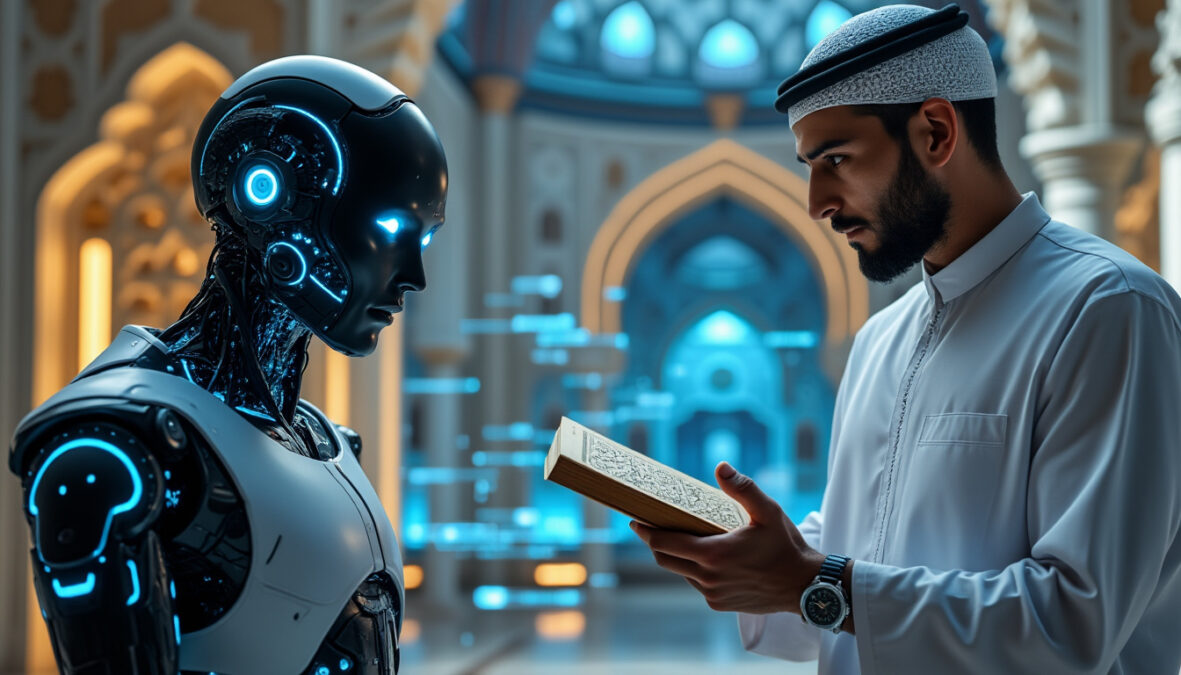
In a world in full transformation, artificial intelligence (AI) reveals itself as a powerful tool capable of reexamining deeply rooted concepts, notably the foundations of modern Islam. Through detailed analyses, AI allows for the exploration of sacred texts, belief systems, and traditional interpretations while opening new perspectives on faith and spirituality. This article examines how the convergence between AI and religious heritage can spark crucial debates on rationality, transgression, and the plurality of spiritual paths.
A new paradigm for religious rationality
The rise of artificial intelligence calls into question established doctrines and conservative religious orthodoxies. These institutions have long compartmentalized faith, often confiscating reason in favor of rigid interpretations. However, AI, armed with its analytical and comparative abilities, disrupts these certainties. It can sift through vast textual corpuses, detect recurrences, and uncover contradictions that challenge traditional readings. This cognitive shock between the reason deployed by AI and religious dogmas raises fundamental questions about faith.
Questioning traditional narratives
Artificial intelligence tools are not limited to extracting information; they also provide the opportunity to question narratives and interpretations that have long escaped scrutiny. By confronting various religious readings, AI can illuminate ambiguities and evolutions in the Islamic discourse throughout history. This ability to connect varied interpretative traditions paves the way for a more nuanced and pluralistic understanding, encouraging the faithful to explore their faith in a less doctrinal manner. The questioning of these narratives could then be perceived not as a transgression but as a necessary act of introspection.
A space for post-dogmatic spirituality
With the emergence of a rationality capable of dialoguing with the sacred, new voices, such as that of Abdellatif Laroui, urge us to consider a post-dogmatic spirituality. This vision is liberated from the constraints of religious institutions, promoting responsibility and openness to diverse paths of meaning. Artificial intelligence, through its analyses, can thus help explore this spirituality without rigid dogmas, making the religious experience more personal and accessible. This new space for reflection invites believers to question the foundations of their faith and embrace a plurality of perspectives.
The challenges of AI in the religious context
However, this modern exegesis does not come without challenges. Religious institutions are often reluctant in the face of the power of AI, which could upend the very bases of their authority. The difficulty lies in reconciling technology and tradition while addressing the needs of a rapidly evolving world. The question remains: how will established structures adapt to this new environment, and how far are they willing to go to maintain their relevance in the face of the rise of AI?
A weaver between traditions and innovations
This dynamic also offers fertile ground for in-depth research on the implications of artificial intelligence in religious practices. Studies reveal that certain professions will be particularly affected by the rise of this technology, highlighting the need for reflection on the future of employment and ethical missions within the framework of AI. Institutions can then, alongside emerging technologies, envision a future where faith and reason do not oppose each other but nourish one another.


