
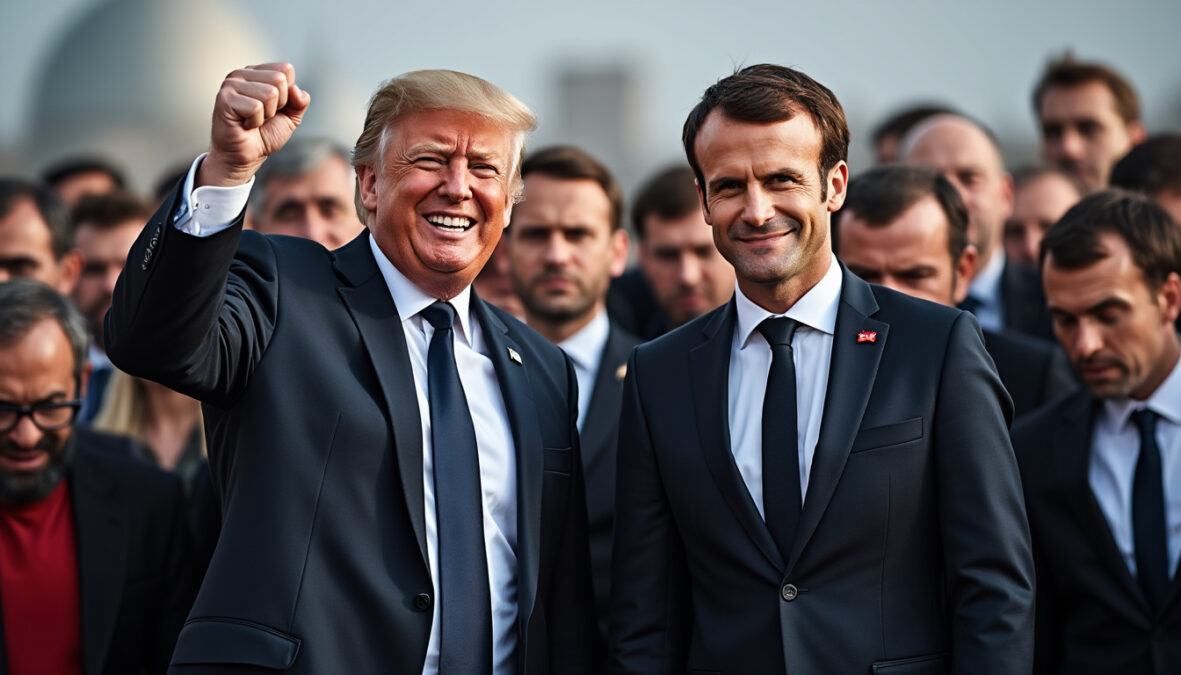
The recent agreement between the United States and Iran has sparked a series of reactions that illustrate the complex dynamics at play on the international stage. While the agreement is seen as a triumph for Washington, it has also left some of its adversaries in a difficult position. American president Donald Trump expressed his joy at this outcome, while Emmanuel Macron congratulated the parties involved. In the following lines, we will take a closer look at the reactions that followed this landmark event.
Trump Celebrates the Agreement
After the announcement of the finalization of an agreement between his administration and Iran, President Trump did not hesitate to express his satisfaction. On his social media platform, he indicated that many presidents had tried unsuccessfully to initiate peace with Tehran, and that he was the first to succeed. His assertion of being an effective diplomat capable of introducing peace in the region was appreciated by supporters while attracting criticism.
Trump also took the opportunity to compare this agreement with that of his predecessor, Barack Obama. He labeled the previous agreement as a “catastrophe,” arguing that the agreement he had finalized would ensure that Iran could not acquire nuclear weapons, a promise which, according to him, demonstrates his skill as a world leader.
Reactions in Iran
While Trump reveled in his diplomatic victory, Iranian leaders celebrated what they called an imposed victory over their American and Zionist adversaries. In a statement to state television, they claimed that Iran’s divine will had forced its enemies to accept defeat. However, this self-aggrandizing narrative raises questions about the reality of the ongoing negotiations, which do not yet seem to be fully finalized.
Silence and Tensions in Israel
Israel’s reaction was notably more nuanced. Prime Minister Benyamin Netanyahu, who observed the agreement with a critical eye, emphasized in a statement that Israeli military efforts had been crucial in preventing a nuclear destruction by Iran. His initial silence suggests frustrations that could influence relations between Washington and Jerusalem in the future.
Although some members of his government expressed sharp criticisms, such as the Minister of National Security, who stated that this agreement did not commit them, this underscores a possibility of divergent alignments among traditional partners.
Macron and European Diplomacy
In Europe, Emmanuel Macron reacted positively by calling for a robust ceasefire in Lebanon as part of this new agreement. He also emphasized the importance of reopening the Strait of Hormuz, a strategic area often associated with tensions in the Middle East. Macron, who was leading the discussions at the G7 summit, sought to take the reins on the subject as Europeans were not directly involved in the negotiations.
The E4 countries, comprising the United Kingdom, France, Germany, and Italy, expressed their willingness for renewed cooperation with Iran, while remaining cautious regarding the nuclear issue, reflecting an evolving European diplomacy.
A Changing Geopolitical Landscape
As the parties acclimate to this new reality, the American-Iranian agreement appears to have redrawn the lines of power in the Middle East. The tensions that had prevailed between Washington and Tehran could ease, but they leave behind a landscape of uncertainty and distrust. The statements from Trump and Macron, along with the responses from Tehran and Israel, indicate that while the agreement is a step forward, it may not yet be a path to lasting peace.
The balance of alliances and antagonisms in the Middle East is in perpetual flux. In the meantime, international observers are waiting to see how this agreement will be implemented and whether it will lead to substantial progress in regulating regional tensions. For more details, you can consult articles on these events on contemporary history websites as well as on news platforms.


