
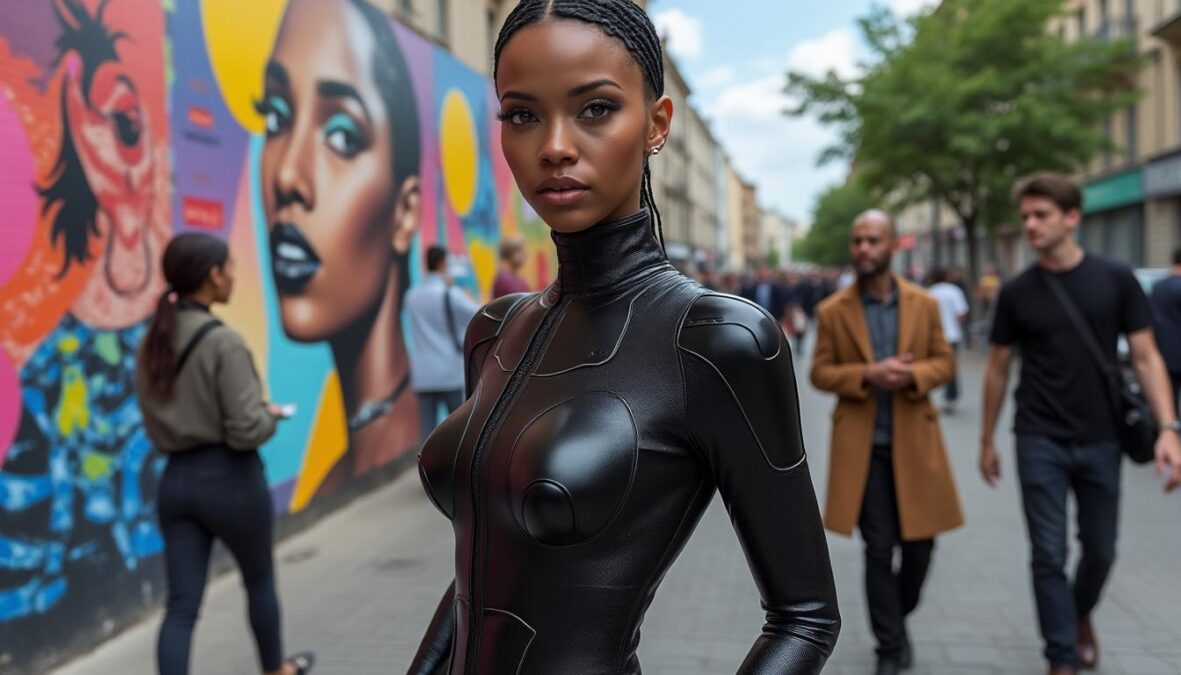
The virtual singer Lolita Cercel has taken the music scene in Romania by storm, garnering widespread success and attracting media attention. However, behind this fame lies a deep and complex debate about anti-Roma racism and cultural appropriation. Her rise highlights the challenges faced by Roma artists, exacerbating tensions within an already marginalized community.
A meteoric popularity
Lolita Cercel has become a true phenomenon in the Romanian music landscape. Her captivating videos, accompanied by emotionally charged choruses, have quickly amassed millions of views. The media shows increasing interest in her, lining up interviews and flattering comments. This success is unexpected, especially in a country where the Roma community continues to face systemic discrimination.
Roma artists facing cultural appropriation
While the character of Lolita receives warm public reception, many Roma artists feel a deep injustice. Bianca Mihai, a 25-year-old Roma singer, expresses her dismay over this comparison. For her, it is “unfair” to see her hard work overshadowed by an AI-generated creation. Her experience highlights a feeling of collapse for artists who, despite their talent, struggle to carve out a space in a music world that is often reluctant to welcome them.
A battered cultural heritage
Bianca’s concerns do not stop there. She also denounces the commercialization of elements of Roma culture, revealing an exploitation that feels painful to her. “It’s all well and good to borrow elements of Roma culture without truly appreciating them,” she admits, attesting to a struggle against the stereotypes and superficial representations that persist in the music industry.
Reactions to latent racism
The success of Lolita has also sparked concern among Roma activists. Bogdan Burdusel, a respected activist, sees this creation as a manifestation of the latent racism that permeates Romanian society. “People love Roma culture, but not Roma,” he states, highlighting the dichotomy that exists between an appreciation of culture and the acceptance of the people from whom it originates. This harsh observation brings to light a reality often ignored: the success of an artificial representation attracts crowds, while Roma artists are often rendered invisible.
The creator behind Lolita
The designer behind the character of Lolita, who prefers to remain anonymous, expresses an intention not to offend but to capture “the reality of millions of people living in the Balkans.” However, his choice to draw from traditionally Roma sounds shows that he is using a heritage while remaining outside the consequences of this appropriation. He expresses surprise at the character’s virality, happy to perceive that his work “resonates” with so many people.
An industry in question
In light of these events, Grigore Burloiu, a lecturer in interactive technologies, offers a reflection on how the music industry has paved the way for such success. According to him, AI is effective in identifying what the public wants to hear, relying on known formulas that are in reality not very innovative. This observation raises questions about the future of human artists and the place they occupy in an increasingly virtual-dominated music landscape.
The struggle of a generation of artists
Finally, the impact of Lolita Cercel‘s rise on her human counterparts is undeniable. This phenomenon symbolizes a struggle beyond mere competition: it questions the very foundations of the music scene in Romania. Artists like Bianca Mihai feel a deep despair about their future in an industry that seems to prefer fictional manifestations over authentic talents, as she expresses while juggling a full-time job and her musical dream.


