
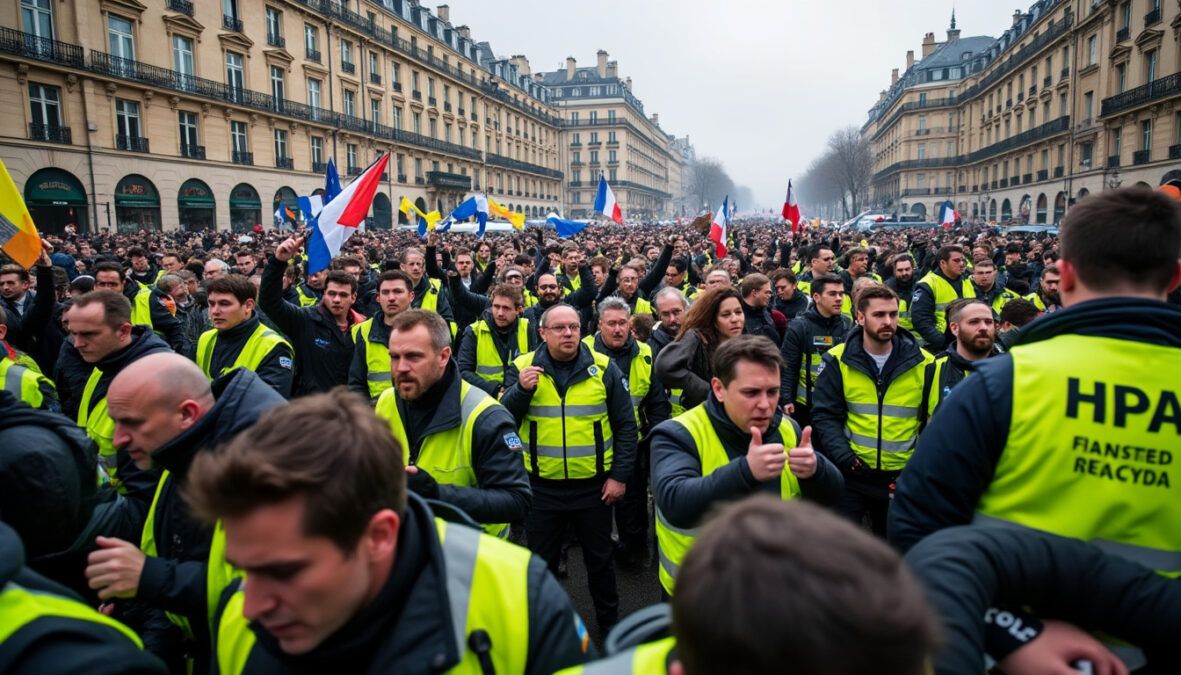
For several weeks, calls for a national mobilization in France, linked to the Yellow Vests movement, have resurfaced. Scheduled for October 17, 2026, this initiative is already causing significant concern within the government, which fears public order disturbances. Social media platforms, particularly TikTok, Facebook, and Instagram, play a key role in spreading these calls, rekindling memories of a time when this movement had profoundly impacted the French socio-political landscape.
A mobilization launched on social media
Messages and videos calling for a return to the upheavals of the Yellow Vests are widely circulating on social platforms. These contents invite citizens to once again wear their yellow vests, a symbol of a social struggle that began eight years ago. The emergence of discussion groups, such as the Telegram channel “GJ2026”, which presents itself as a peaceful and civic movement, reflects this desire to gather individuals around a fight led without political recovery.
Increased vigilance from the authorities
In light of this situation, the government is adopting a posture of particular vigilance. Territorial intelligence services are closely monitoring any gathering, whether planned or unexpected, that claims to be part of the Yellow Vests. It is worth noting that like the early days of the movement in 2018, many previous gatherings also took place without prior declaration, leaving some uncertainty for the authorities.
A response to the economic crisis
The rise in fuel prices, combined with the increase in electricity and food costs, fuels popular discontent. The calls for mobilization on October 17 seem to be a direct response to this economic crisis that many French people are facing. Although no structured national organization or leader has emerged to coordinate these efforts, citizens are spontaneously coming together, sharing messages virally on social networks.
Fears of confrontations
Some voices are being raised among former participants in the movement, expressing their reluctance to participate in new demonstrations, out of fear of confrontations or because they must consider the financial impact of a day of mobilizations. In this context, the memory of the excesses that occurred during previous protests remains ingrained in people’s minds. The fear of a new escalation of violence does not favor massive support.
A loaded history and lessons to be learned
On November 17, 2018, more than 282,000 demonstrators marched across France. This first major mobilization was largely underestimated at the time; hence the current difficulty for the government to anticipate the scale of the forthcoming mobilization. The reminder of this historical moment echoes skepticism; thus, October 17, 2026, is marked and closely monitored by the authorities, fearing that the momentum of mobilization may take a similar turn.
An uncertain future
As discussions continue around the modalities of this mobilization, the government is trying to downplay the fears, believing that the current context will differ from that of 2018. However, the possibility of a significant return of the Yellow Vests cannot be ruled out. The date of October 17 thus looms as a decisive moment, the consequences of which could potentially alter the social and political climate in France in the coming months.
To delve deeper into the subject, it is also interesting to note the measures taken by the government in the area of online surveillance, aimed at anticipating social movements and understanding the dynamics of citizen demands. More information on this topic can be found in the following article: Online Search Surveillance.


