
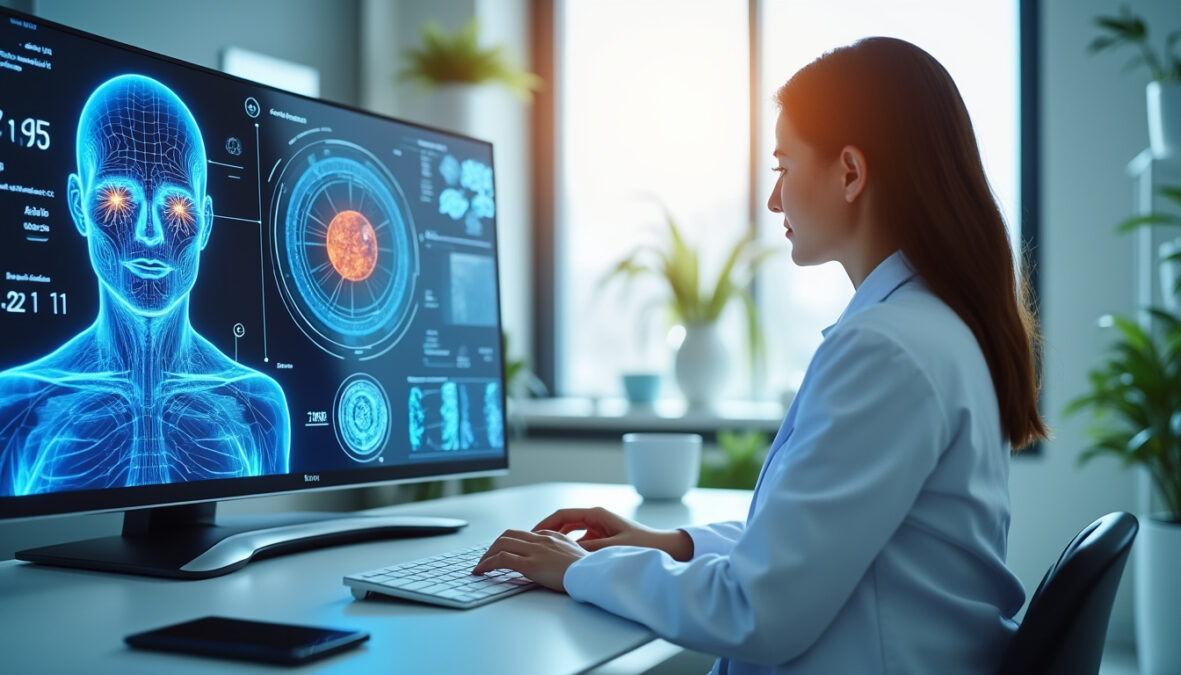
The digital revolution is increasingly making its way into the medical field, and Spain is at the forefront of this transformation, particularly in dermatology. Thanks to technological innovations such as artificial intelligence (AI), the company Legit.Health is redefining diagnostic methods, making the process both faster and more accurate. This article explores how this Spanish technology is transforming the dermatology landscape and improving the experience for both patients and healthcare professionals.
Dermatological issues are often difficult to diagnose due to the variability of symptoms and diagnoses. Following a personal journey marked by difficulties in obtaining a correct diagnosis, Andy Aguilar, co-founder of Legit.Health, decided to develop a system that uses AI to provide assistance in this specialty. By integrating precise clinical data and image analyses, this technology becomes an essential ally for dermatologists.
An approach driven by personal experience
The creation of Legit.Health did not stem from a mere market analysis, but originates from the experience lived by Andy Aguilar. Convinced that many patients share her struggle for a fair dermatological diagnosis, she set up a solution that not only supports diagnosis but also enhances case management. This willingness to understand the real needs of patients and doctors has allowed Legit.Health to develop a high-value tool.
The simplified and efficient functioning of the system
Unlike other technologies that require expensive and complex equipment, Legit.Health operates with devices already present in healthcare facilities. By integrating the software with the electronic medical record, it optimizes the professionals’ working time. With a simple smartphone, a dermatologist can photograph a lesion and obtain valuable clinical information in just a few seconds.
Differential diagnosis and severity measurement
The system offers a hierarchical differential diagnosis based on a wide range of clinical data. Instead of providing a categorical verdict, it presents probabilities associated with various possible diagnoses and allows the doctor to visualize the criteria that led to this conclusion. This approach ensures transparency and explainability, which are essential in the medical field.
Additionally, the tool objectively measures the severity of symptoms, such as erythema or pustules, and assigns scores based on models already used in dermatology. This not only allows tracking a patient’s progress over time but also enables comparison of results among different professionals in the field.
Tangible results in medical practice
The data collected by Legit.Health shows that the use of AI increases diagnostic accuracy by between 15 and 21 points, depending on the context. In primary care, a study has demonstrated a notable improvement of nearly 18 points, making the diagnosis more reliable and relevant. This means that fewer patients are directed to specialized consultations, optimizing both the time of doctors and the resources of hospitals.
Special attention for darker skin
A major challenge that remains in the dermatological field is how artificial intelligence addresses different skin types. Legit.Health specializes in the classification of skin conditions on darker skin, which have often been underrepresented in traditional studies. The analyses conducted reveal an increase in diagnostic accuracy of nearly 23.3 points for these skin types.
Challenges and the future of AI in dermatology
Despite the advances made, some challenges persist. One of the main obstacles is the reluctance of some doctors to adopt diagnoses provided by a system they cannot easily understand. Legit.Health addresses this concern by delivering clear and explainable results, thereby avoiding doubts about their validity. By strengthening the trust of healthcare professionals, the company stands out as a change agent in dermatological diagnosis.
Future prospects and international expansion
Legit.Health already benefits from the CE marking as a medical device, allowing it to be deployed across the European Union. The company is now looking beyond its borders, with the ambition of obtaining FDA approval in the United States. The intention is to lay the groundwork for a successful expansion, enabling this technology to improve dermatological diagnoses worldwide.


