
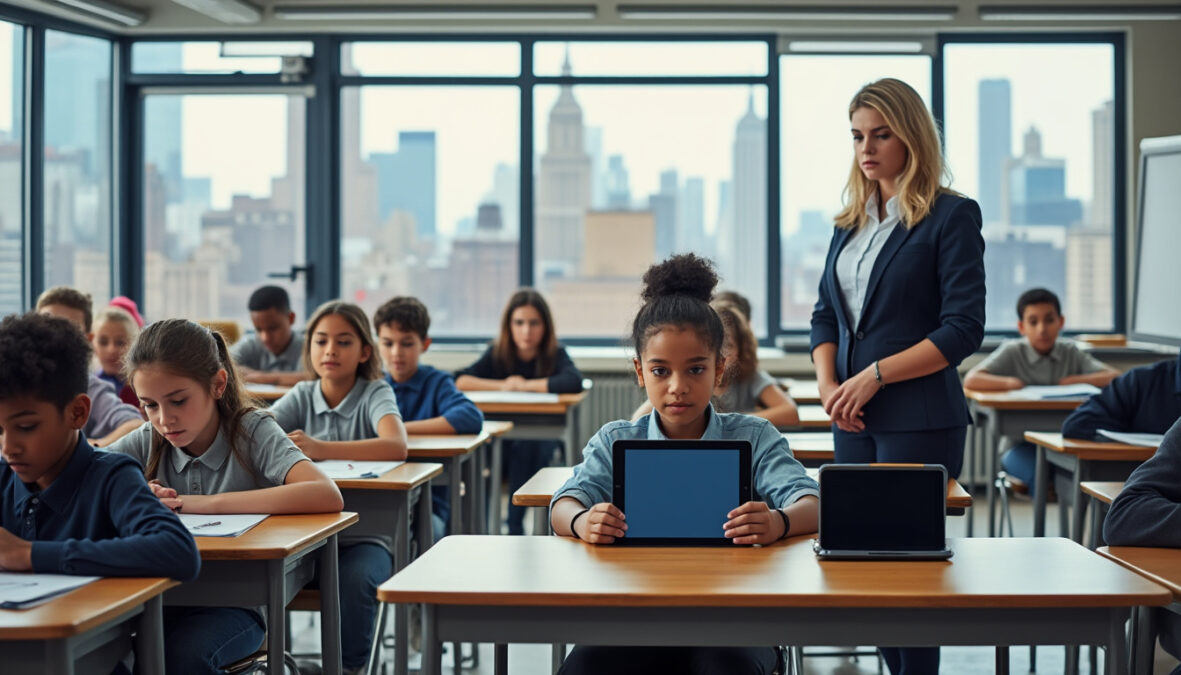
The Mayor of New York, Zohran Mamdani, recently announced a major decision regarding the use of artificial intelligence in the city’s public schools. Thus, for the 2026-2027 school year, the use of AI will be strictly prohibited for all students from kindergarten to the ninth grade. This initiative aims to protect the development of young people alongside their peers and teachers while emphasizing the importance of traditional teaching.
A significant ban
In a proactive approach, the city of New York has established a one-year moratorium on the use of generative artificial intelligence for young students. This moratorium applies to all students from kindergarten to ninth grade, thus affecting nearly 600,000 public school students. This radical decision follows criticism from parents, teachers, and educational experts, who believe that AI in the education of young children cannot replace human teaching.
Context and motivations for the decision
This decision was announced after a previous document published in March 2026, which was deemed insufficiently binding, sparked a backlash among education stakeholders. Indeed, this first document allowed the use of AI for activities such as research and creative projects, which did not sit well with parents and teachers concerned about the quality of education. The New York Chancellor, Kamar Samuels, then acknowledged that the authorities had “missed the boat” in terms of communication on the subject.
Conditions for the use of artificial intelligence for high school students
Starting from high school, which begins in ninth grade, the use of AI will not be completely banned but will be regulated. Only “limited experiments” with artificial intelligence will be allowed in a small number of classes. High school students will also benefit from two annual modules dedicated to critical thinking regarding AI. The goal is to familiarize them with this technology while protecting their intellectual and social development during their early school years.
The role of teachers and parents
Teachers, on their part, will be allowed to use artificial intelligence to prepare their lessons and carry out administrative tasks. This shows a willingness to enable education professionals to leverage this technology without imposing it on students. The city hall also emphasized the importance of the human relationship in the educational process: “Children need teachers and human contact to learn and grow,” said Mamdani.
Evaluating the impact of the moratorium
As part of this initiative, a working group composed of students, teachers, parents, and experts will meet throughout the school year to evaluate the impact of the ban. This will allow for feedback on this decision and possible adjustments based on precise assessments of academic results and student engagement. Close monitoring seems essential in a context where New York’s technological directions are closely followed across the country.
A movement that resonates with other opinions
This decision from New York comes in a broader context where various voices are raised against the unregulated integration of technology in education. For instance, a recent article discusses opposition to a total ban on social media, while another reveals concerns about in-person exams to curb AI-related cheating. These debates highlight the importance of finding a balance between technological innovation and conscious and responsible teaching methodology.
For more information on youth facing technology restrictions, check out this article link or the one on the impact of AI on in-person exams link. As for the influence of AI in higher education, find detailed analyses here.


