
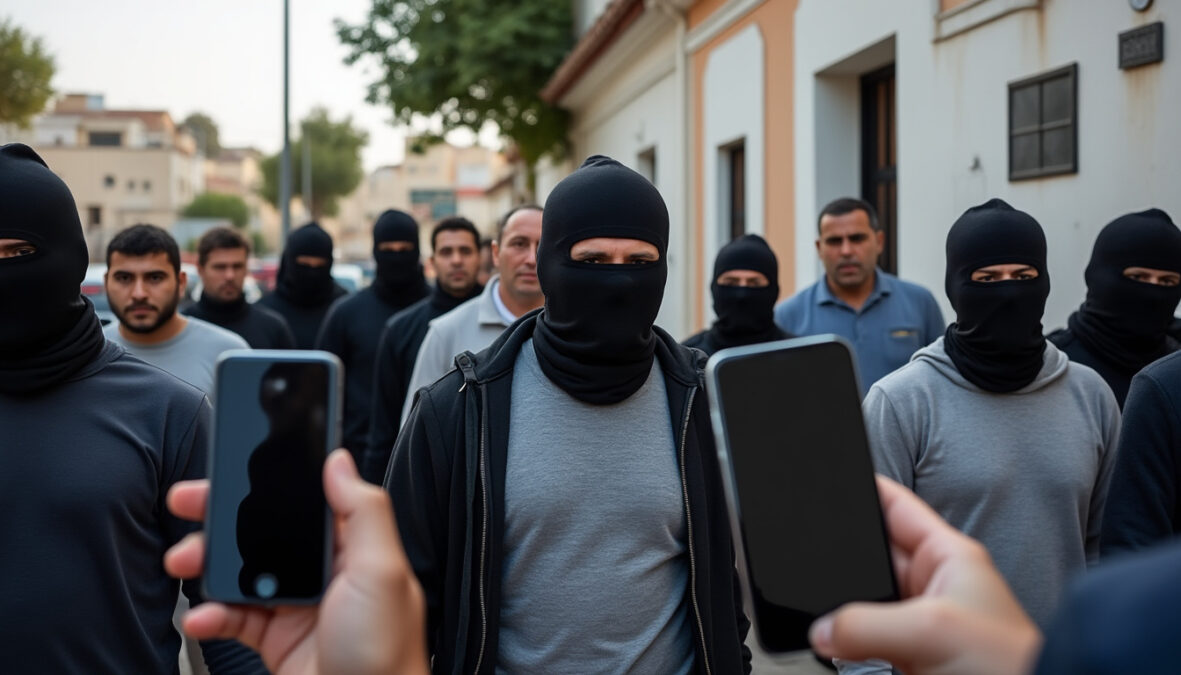
The arrest in Oran of 61 Moroccan nationals, including a former member of the Royal Moroccan Army, has sparked numerous reactions online. Three days after the operation was announced, the information released by the Algerian police remains limited. This lack of detail, combined with the circulation of images presented as having been fabricated using artificial intelligence, is fueling speculation and reigniting tensions between internet users in the two countries.
An operation described as the dismantling of a criminal group
According to the Algerian police, the arrests led to the dismantling of an international criminal group allegedly linked to 61 Moroccan citizens. The authorities say the operation was carried out before the individuals concerned could commit acts likely to threaten security and public order. At this stage, however, they have not made public any further details about the precise nature of the acts they are accused of.
The alleged presence of a former member of the Royal Moroccan Army among those arrested was also mentioned in reports about the case. This detail, particularly sensitive given the strained relations between Algiers and Rabat, quickly drew attention on social media. However, no detailed explanation has been provided about the role attributed to the former soldier or the evidence that may have led to his arrest.
Police describe a route, but provide few details about the investigation
The account provided by the Algerian authorities describes a route that allegedly passed through Tunisia. The Moroccan nationals are then said to have entered Algeria irregularly, following trails in the El Kala region, near the border, before reaching Oran. The information made public does not specify the dates of this journey, the precise means by which the border was crossed, or the circumstances in which the individuals were identified.
At the time of the arrests, the police reportedly seized Moroccan passports, as well as significant sums in dirhams and euros. The official statement does not specify the amount of cash, its presumed origin, or its intended destination. In the absence of these details, it remains difficult to understand publicly what physical evidence is being considered as part of the investigation.
A video showing the arrests was broadcast on Algerian national television on Sunday evening. Since then, no further substantial information has been announced. The scarcity of official communications contrasts with the speed of the comments and interpretations circulating online.
Lack of information fuels online speculation
On social media, the initial reactions focused as much on the reported events as on the lack of detail. Some internet users questioned the account presented by the Algerian authorities, while others circulated interpretations that went beyond the confirmed information. This dynamic is blurring the distinction between officially announced details, hypotheses, and unverified content.
An Algerian observer describes the situation as a form of “media self-intoxication” on both sides of the border. According to this view, narratives and reactions reinforce one another without necessarily being supported by new, verifiable information. The observer also believes that the Algerian authorities may not release any further information about the case, despite accusations of staging made by some Moroccan internet users.
Disputed images attributed to artificial intelligence
The circulation of images presented as generated or modified using artificial intelligence has added another layer of confusion. In a context where information remains scarce, visual content may be shared as if it directly documented the operation, even though its origin or authenticity has not been clearly established. Its circulation intensifies emotional reactions and makes fact-checking more difficult.
The existence of such content does not, in itself, confirm or refute the official statements about the arrests. It does, however, underscore the importance of distinguishing authenticated images from composites, illustrations, and creations generated by digital tools. Until the circumstances of the operation are documented in greater detail, claims circulated on platforms should be treated with caution.
Accusations of staging and the responses to them are unfolding in a climate where every new post may be interpreted through the lens of political tensions between the two countries. Online exchanges then sometimes focus less on the available evidence than on the trust placed in sources and the intentions attributed to the authorities.
Calls for greater transparency
A specialist in Moroccan politics views these reactions as a new provocation, the effects of which are being felt mainly on social media. The specialist would like to see a statement from Morocco’s Ministry of Foreign Affairs calling for clarification about the investigation and greater transparency in the release of information.
This request reflects the questions that remain about the case: the specific acts attributed to those arrested, the evidence that led to their detention, and the legal proceedings being considered. For now, the Algerian authorities have provided a general account of the operation without publicly detailing these aspects.
Moroccan authorities, contacted by RFI, had not responded to requests for comment at the time of reporting. With no official comment from Rabat and no further details from Algiers, discussions continue to develop mainly on the basis of statements already released and content shared on social media.
A case being followed amid strained relations
The arrest of Moroccan citizens on Algerian territory takes on particular significance because of the political context between the two countries. In this setting, a police operation can quickly be seen as an issue extending beyond the judicial sphere alone. Messages circulating online reflect this sensitivity, but do not in themselves confirm the accusations or hypotheses being discussed.
For now, verifiable information is limited to the announcement of the arrest of the 61 nationals, the Algerian authorities’ description of their presumed route, the seizure of passports and money, and the broadcast of a video on national television. The missing details leave many questions unanswered, while disputed images and competing interpretations continue to fuel online exchanges.


