
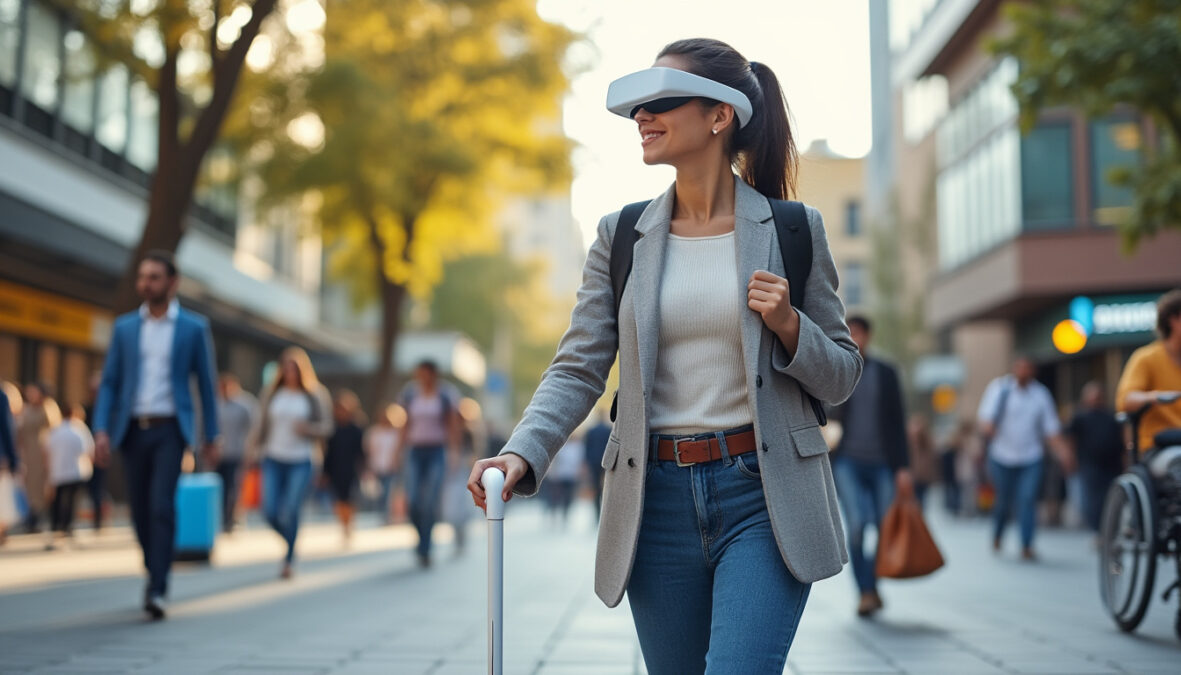
In a constantly evolving world, artificial intelligence (AI) and innovative technologies play a crucial role in transforming the daily lives of visually impaired individuals. Thanks to tools like smart connected glasses, these individuals gain autonomy and improved quality of life. This technological revolution helps overcome daily challenges such as navigating public spaces, reading texts, or even interacting in social environments.
Innovative tools for regained autonomy
Connected glasses represent one of the major advancements for people with visual impairments. Equipped with miniature cameras and artificial intelligence, they describe the environment in real-time. For example, Anaïs Badot, a high school graduate, had the opportunity to test this tool for the first time. Her enthusiasm is palpable: she talks about the possibility of reading a menu in a restaurant without needing help from third parties. Thanks to environmental analysis, these glasses can also assist with navigation in unfamiliar places.
Freedom of action and safety
Another appreciated innovation is the autonomy provided by voice control. The glasses connect via Bluetooth to a smartphone, allowing users to keep their hands free while moving around. This feature is particularly important, as visually impaired people often face safety issues when handling their phones in the street. Sylvie Degrelle, head of communication for the Braille League, highlights this potentially aggravated danger, making the technology of the glasses even more essential.
The impact on social life
Participating in social events or conferences becomes less intimidating thanks to technological advances. Situations where exchanging ideas and interactions take place are now more accessible. The glasses offer the possibility to follow conversations and read texts that enhance the social experience. Such accessibility opens the door to more opportunities for visually impaired individuals, allowing them to actively engage in discussions and meetings.
The future of artificial intelligence for the visually impaired
With promises of continuous improvements, the future looks bright for the use of artificial intelligence in service of visually impaired individuals. Research continues to progress, and increasingly sophisticated solutions are coming to market. Those who have already tried these technologies, like Jérôme, emphasize the importance of having free hands for smooth navigation in the environment. The idea that these tools could evolve to read expiration dates or provide even more detailed descriptions of environments is exhilarating.
In summary, the combination of artificial intelligence and innovative technologies appears to be an essential key to improving the daily lives of visually impaired individuals, offering them not only necessary autonomy but also an opportunity to fully interact with the world around them. To learn more about this technological revolution, check out this article on a Lyon-based start-up that is changing the game: SAFIG.


