
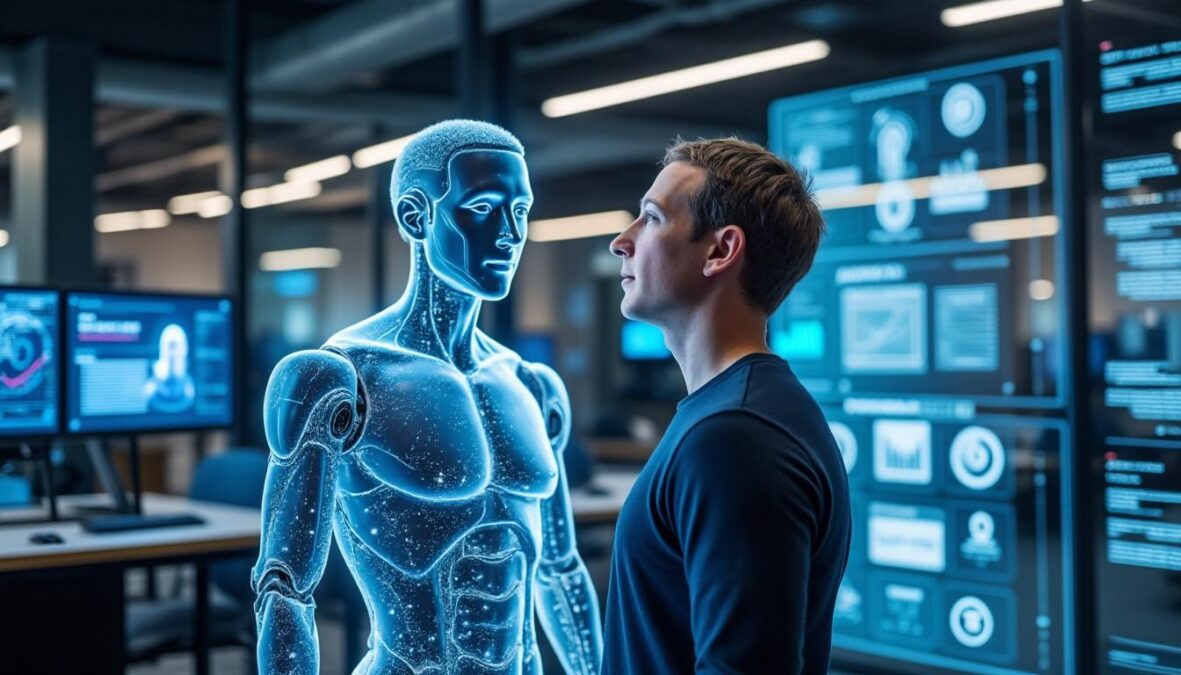
Meta, the organization behind Facebook and Whatsapp, is embarking on a bold initiative by developing an artificial intelligence designed to imitate the style, manners, and ideas of Mark Zuckerberg. This innovation aims to transform internal communication, making the CEO more accessible to employees through real-time interaction. In this context, questions arise regarding the impact of this AI on the structure of the company, particularly during restructuring periods.
An AI in the image of a modern boss
Mark Zuckerberg is personally involved in the development of this artificial intelligence. With the aim of creating a model capable of reproducing his mannerisms and his thoughts on the company’s strategy, he actively participates in its training and testing. This AI is designed to answer employees’ questions at any time, without having to go through the lengthy process of a traditional appointment. Thus, the interactions are expected to allow an unprecedented closeness between employees and their boss.
A new internal communication tool
With this initiative, Meta aims to create an environment where every employee can receive real-time feedback on their work. This project seeks not only to optimize communication within the company but also to strengthen the bond between Mark Zuckerberg and the teams. Employees will have the opportunity to ask questions about their projects, seek advice, or get opinions on their performances, all through an animated AI interface that will replicate their CEO’s behavior.
Photorealistic 3D characters to enhance interaction
Powered by artificial intelligence, the project also includes the creation of photorealistic 3D characters with which employees can interact. These characters, while innovative, raise questions about their real-world application. Will it be possible to truly converse with a holographic projection of Mark Zuckerberg? If that is the goal, it remains to be seen whether these projections can offer responses as relevant and human as a direct exchange with the boss.
The risks and stakes of this project
However, the creation of this AI does not come without risks. The possibility that the artificial intelligence expresses opinions divergent from those of Mark Zuckerberg raises serious questions. What is the legal weight of statements made by the AI? What will happen if it promises raises or days off? Air Canada’s recent experience highlights the dangers associated with automated interaction, where a chatbot made erroneous promises, leading to legal consequences for the company.
Repercussions in a restructuring context
This announcement comes as Meta prepares to reduce its workforce and has announced the elimination of around 8,000 jobs. The social climate within the company is already tense, raising questions about the acceptance and success of this initiative. In its desire to enhance the efficiency of its management, Meta is also seeking to recoup its investments in key areas such as artificial intelligence. The question of the future of middle management and decision-making thus becomes crucial.
Towards an automation of professional interactions?
Looking ahead, it is entirely possible to envision that employees receive instructions directly from the virtual Mark Zuckerberg. This perspective raises questions about accountability in the event of unfortunate decisions and challenges traditional command structures. Thus, the implications of this AI on management and the organization of the company could be more extensive than anticipated.
As Meta invests heavily in artificial intelligence to position itself in a fierce competition, it seems that the stakes of communication and human interaction are at the heart of this transformation. For more information on the issues related to technology, you can read articles on the impact of AI in companies or on how artificial intelligence boosts employee well-being.


