
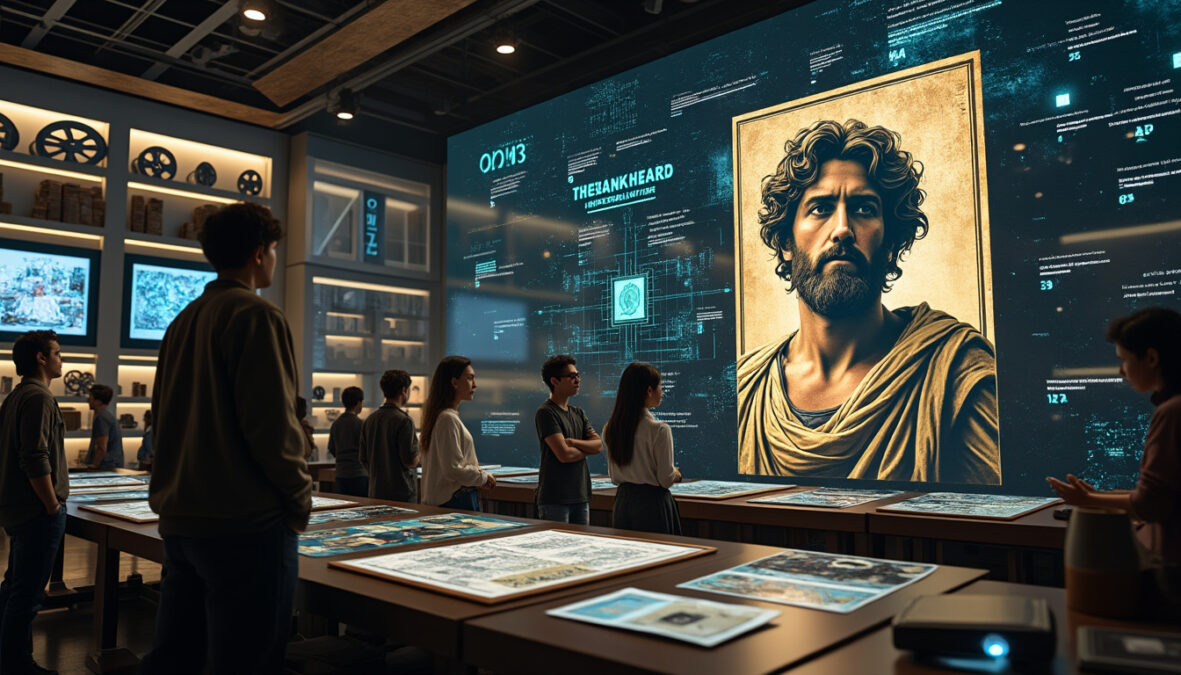
In the heart of Europe’s flagship innovation event, VivaTech, in Paris, a revolutionary cinematic work emerges: “Oedipus King of IA”. Co-directed with artificial intelligence and running for 65 minutes, this unique film draws inspiration from a Greek tragedy while addressing contemporary concerns surrounding advanced technologies. Stéphane Lévy, son of Maurice Lévy, not only conceived this bold project but also took care to integrate essential elements under human supervision, proving that human creativity can ally with the power of AI.
An unprecedented collaboration with artificial intelligence
“Oedipus King of IA” stands out as it was co-created with artificial intelligence, offering an innovative perspective on cinematic production. Stéphane Lévy, who leads the ArtMajeur platform, invested two years of work outside his professional obligations to finalize this work. He succeeded in using AI not just as a tool but as a creative partner, thus allowing for a rare artistic freedom. “I wanted to make a film with total independence, which is an absolute luxury. And AI made that possible,” he states.
A poignant story with modern echoes
The narrative of “Oedipus King of IA” takes place in the near future in Hong Kong. The main character, Oedipus, is the leader of the imagined AIonAI company, a global giant in artificial intelligence. As a series of strange disappearances and enigmatic crystals disturb the city, Oedipus must face the consequences of his technology. The storytelling, imbued with timeless tragedy, raises questions about human responsibility and the potentially dangerous effects of AI, resonating with themes from Sophocles’ classic work.
An intriguing visual aspect
Visually, the film presents a unique aesthetic identity, born from thoughtful creative choices. The characters appear in a world oscillating between living paintings and cardboard sets, an intention to integrate an artistic dimension. Although AI generated each visual element of the film, the result retains a unique authenticity, though the features of the characters sometimes render them somewhat artificial. This highlights the current limitations of technology in creation, while showcasing the statistical brutality of AI:
“I directly took the gamble of signing a probabilistic film. And I wanted to play with the statistical brutality and intelligence of artificial intelligence and create something that is contrasted,” explains the project’s initiator. This approach allowed for the creation of a film that is both aesthetic and experimental, while betting on a balance between human vision and AI capabilities.
A prophetic message about AI
Through this creation, Stéphane Lévy reflects on the implications and consequences of an artificial intelligence that could escape all control. The reflection on technique is marked by dialogues borrowed from the original tragedy, questioning modern perceptions in the face of a powerful tool. With themes of blindness and the quest for truth, “Oedipus King of IA” is poised to become a prophetic work, echoing our contemporary world where technology evolves at a breakneck pace. The name of the fictional company embodied by Oedipus, inspired by Aiôn, the deity of eternity, reinforces this dimension of reflection on the permanence and reach of AI in our lives.
The creation experience: between surprises and expectations
The collaboration with AI has brought its share of surprises, both in the creative process and the final result. Stéphane Lévy admits that every viewing of his work pushes him to see aspects he would like to improve: “I stopped watching this film, because I know that with each viewing, I will see things I will want to redo.” This highlights the dynamic nature of the work, where the impact of technology on artistic realization raises questions about the future of cinema and its relationship with artificial intelligence.
Beyond the film itself, Lévy’s experience also raises the question of the future of AI in artistic production. A future that remains filled with uncertainties but invites a deep reflection on the role of humans in a constantly evolving technological world. AI is a “tool”, but what is its true potential when human creators use it to explore artistic realms? This film, at a crossroads, promises to ignite the debate on this bold collaboration between humans and AI.


