
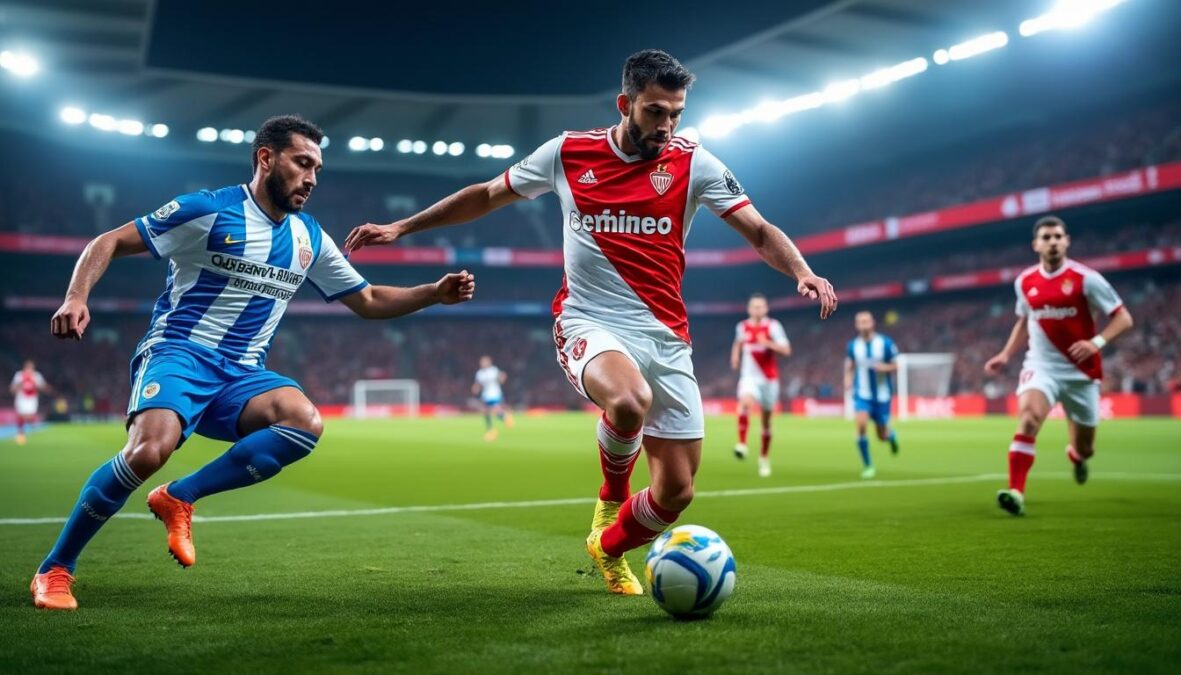
During the last confrontation between Olympique de Marseille (OM) and AS Monaco, a thorough analysis reveals how the Monégasques managed to outsmart the renowned solid defense of OM. Despite a first period rather well-mastered by Habib Beye and his players, Monaco exploited crucial gaps in Marseille’s defensive organization, leading to a 2-1 victory. This article will focus on the different strategies implemented by Monaco to penetrate the Marseille block, as well as the key moments that led to the decline of the Phocaean defense.
A reorganized but vulnerable Marseille block
Even before the kickoff, Olympique de Marseille took to the field with notable absences, prompting Habib Beye to revise his defensive structure. By choosing a 5-4-1 system, OM seemed determined to prioritize strength and balance within their lines, a choice understandable given their recent defensive performance in Ligue 1. During the first hour of play, this configuration worked well, showing signs of a cohesive and compact defense.
Monaco’s tactical adjustments
In response to the Marseille strategy, AS Monaco successfully adapted their offensive approach. Rather than blindly rushing into attack, they opted for a clever positioning of their key players, utilizing creators such as Golovine, Coulibaly, and Akliouche, who often saturated the creative zones. This positioning automatically forced OM to react, but the Monégasques brilliantly exploited the spaces left open, particularly between the Marseille central defenders.
An impressive first hour for OM
Despite the pressure from Monaco, OM managed to limit the opponents’ shots and handle depth intelligently. With well-orchestrated pressing, they forced Monaco into ball retention, preventing numerous opportunities. This discipline off the ball was a strong point for the Marseillais, who even managed to launch a few counterattacks, as evidenced by the first offensive transition initiated by Timber at the start of the match.
The turning point of the match
Everything changed in the first quarter of the second half. While OM seemed solid, their structure began to crack. Leaving many spaces for Monaco, particularly outside the box, allowed Akliouche to find himself in a favorable position. This lack of aggressiveness in the pressing was crucial. OM players, notably Pierre-Emile Höjbjerg and Amine Gouiri, failed to follow the movements of the Monégasque attackers, leaving the field clear for Golovine’s first goal.
Exploitation of Marseille’s weaknesses
Monaco clearly understood that the Marseille defense had shortcomings, especially during transitions. The quick combinations between the Monégasque midfielders managed to unbalance a block that, although well-organized, lacked energy and intensity when it came to reacting to a loss of possession. This lack of commitment in interventions allowed Monaco to create a favorable situation, where they doubled their lead thanks to a superb collective action.
Lessons to be learned for OM
The two goals conceded by OM highlight the need to improve their reactivity and defensive organization. Habib Beye, although he established a tactical structure that seemed effective at the beginning of the match, will need to take these shortcomings into account for upcoming matches. The balance between a solid defense and an effective attack remains a challenge to be met for the OM coach. The work of training and awareness on the field will be essential to avoid experiencing such setbacks in the future.
An uncertain future for OM
After this defeat, OM will need to dive back into hard work to fine-tune their tactics and adjust their systems. The road is fraught with obstacles, but with a return to the field and appropriate readjustments, the Marseillais can still hope to right the ship in the competition. Continuity of effort is crucial to avoid being mired in difficulties, while nurturing the burning desire to reclaim their place at the top. For further analyses on football and team performances, feel free to check out the latest studies on the impact of technology in sports, or the dynamics of clubs in Ligue 1.


