
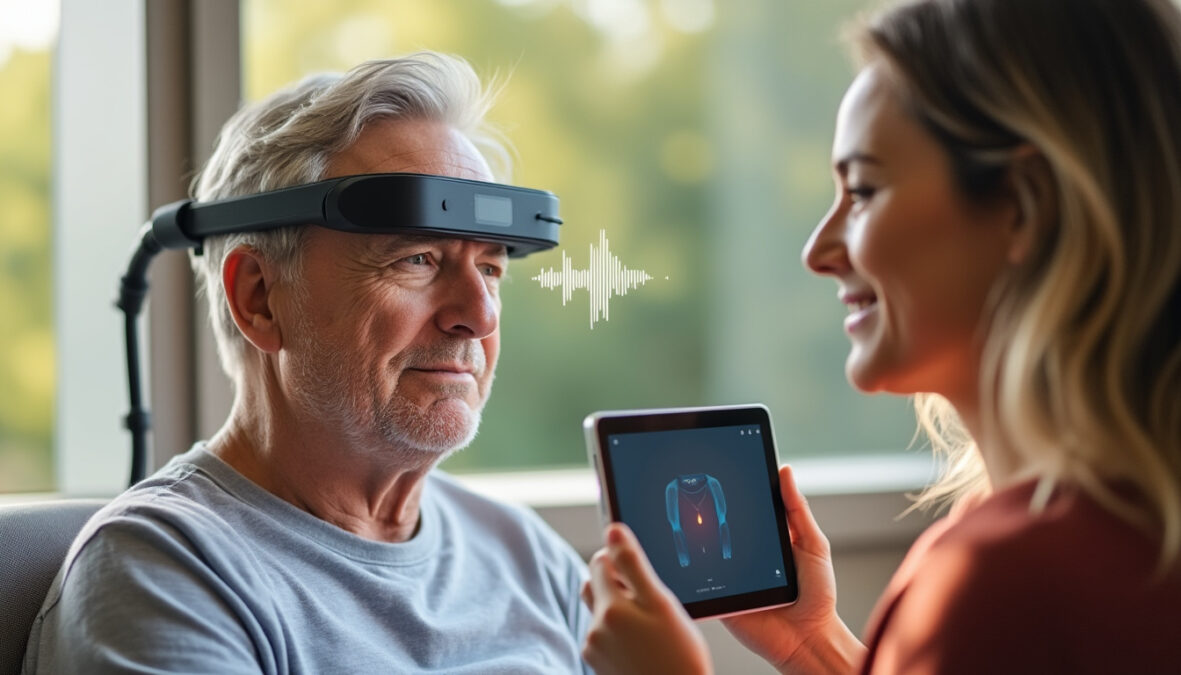
An artificial intelligence developed by start-up Kyutai could help people with amyotrophic lateral sclerosis communicate with a voice similar to their own, even after losing the ability to speak. Called Invincible Voice, the project has notably enabled Olivier Goy, who has ALS, to speak again in his own voice and take part in more spontaneous conversations.
ALS, also known as amyotrophic lateral sclerosis, is a neurodegenerative disease that causes progressive muscle paralysis. As it progresses, it can affect the muscles needed for breathing, swallowing and speech. For people who lose the ability to speak, assistive communication tools are an essential way to stay in touch with those around them.
The Invincible Voice project is exploring a new approach: using artificial intelligence to recreate a person’s voice from a recording made before they lose the ability to speak. The tool also aims to make conversations flow more easily by suggesting context-appropriate responses rather than simply speaking text prepared in advance.
A personal voice instead of a standard synthetic voice
When speaking becomes difficult or impossible, people can turn to computer devices. These systems allow them to compose a message and then have it spoken by a computer-generated voice. Although synthetic voices have become more natural, they do not necessarily reproduce the person’s vocal characteristics: their timbre, intonation and usual way of expressing themselves.
With Invincible Voice, the goal is to reproduce a voice connected to the user’s identity. In Olivier Goy’s case, the AI draws on a voice recording made in 2019. This clip serves as a reference for generating speech that retains a familiar sound. Olivier Goy described the experience as a significant milestone: after regaining the ability to communicate by computer, being able to do so in his own voice represents, in his view, an important difference.
From prepared messages to real-time dialogue
Traditional solutions often require users to type in advance what they want to say. This preparation can slow down exchanges and make it harder to take part in a fast-moving conversation. It can be particularly difficult to respond spontaneously to a question, react to a comment or follow several people speaking.
The technology developed by Kyutai aims to make these exchanges flow more smoothly. It can transcribe the conversation, analyze its content and present suggested responses based on the context. The person can then choose a suggestion or use it as a starting point to formulate their own message. The AI must therefore do more than produce a voice; it must also support the pace of the dialogue.
These suggestions are intended to help users respond as a discussion unfolds. They can reduce the time needed to compose a reply, without taking away the person’s choice about what they want to express. Being able to edit or select suggestions remains central to ensuring that the tool supports communication without speaking on the user’s behalf.
A project born from a collaboration between an association and an AI laboratory
Invincible Voice is the result of a joint effort between Les Invincibles, an association supporting people affected by ALS, and Kyutai. Olivier Goy, who also has ALS, co-founded the association. The project was presented in January 2026 and draws on the experience of people directly confronted with the communication difficulties associated with the disease.
Kyutai is a European non-profit artificial intelligence research laboratory, founded in 2023 by CMA CGM, Iliad Group and Schmidt Sciences. It says it operates according to the principles of open science: the laboratory’s work and advances can be shared and reused by other researchers or professionals, particularly in research and medicine.
This approach is important for a technology that is still experimental. Sharing the work may allow other teams to study and evaluate it, and explore new applications. However, this does not mean that the tool is already available as a widely applicable medical solution: its operation and uses still need to be developed and assessed.
Assistive technologies that have evolved over time
Using a computer to communicate despite paralysis is not new. Physicist Stephen Hawking, who also had ALS, used a computer system with a robotic voice from 1985 onward. A sensor placed near his cheek muscle allowed him to select characters on a screen, after which software converted the text into speech.
This type of device demonstrated that a person who has lost the ability to speak could continue to communicate their ideas using an adapted interface. Today’s tools build on this history while harnessing new capabilities in language processing and voice generation. They aim to improve both voice personalization and the speed of exchanges.
Before trying Invincible Voice, Olivier Goy had already used a synthetic voice. Even when it reproduced some human intonations, having to prepare his responses in advance was a constraint. The assistance offered by artificial intelligence aims to partly overcome this limitation by combining voice reproduction with conversational support.
Personalizing the assistant using the user’s data
To suggest responses suited to an individual, the system needs information about how they express themselves and the context of their conversations. The patient may be asked to provide details about their life, personality, usual tone and relationships. Access to conversation history can also help the software better understand the topics and phrasing that are familiar to them.
This personalization raises important questions about personal data. The information used may be sensitive because it relates to the user’s private life, communication habits and relationships. The decision to share it with the software belongs to the patient, and the collection of this information must be approached carefully, particularly when using a tool that is still under development.
Invincible Voice must also be controllable by people whose motor abilities are very limited. An eye-tracking interface makes it possible to interact with the screen without using the hands. This eye control can provide access to the software’s functions for people who have lost the use of their arms, provided the device is suited to their needs and abilities.
A voice sample to record before losing the ability to speak
Recreating a personal voice depends on having a reference recording. The Invincible Voice website therefore invites people who may lose the ability to speak to submit a voice sample of about ten seconds. The Kyutai team can keep this clip as a resource in case the person is no longer able to speak later on.
This approach aims to preserve the vocal characteristics unique to each person before the disease takes them away. It can be considered before speech is lost, but submitting a sample does not in itself guarantee immediate access to a finished solution. The technology is still at an early stage, and its capabilities are still being explored.
For people with ALS, losing the ability to speak can profoundly change their interactions with loved ones and healthcare professionals. Assistive communication tools allow them to continue expressing their needs, opinions and emotions. By seeking to combine a personalized voice, contextual analysis and eye control, Invincible Voice is exploring a form of assistance designed around dialogue and each user’s individuality.


