
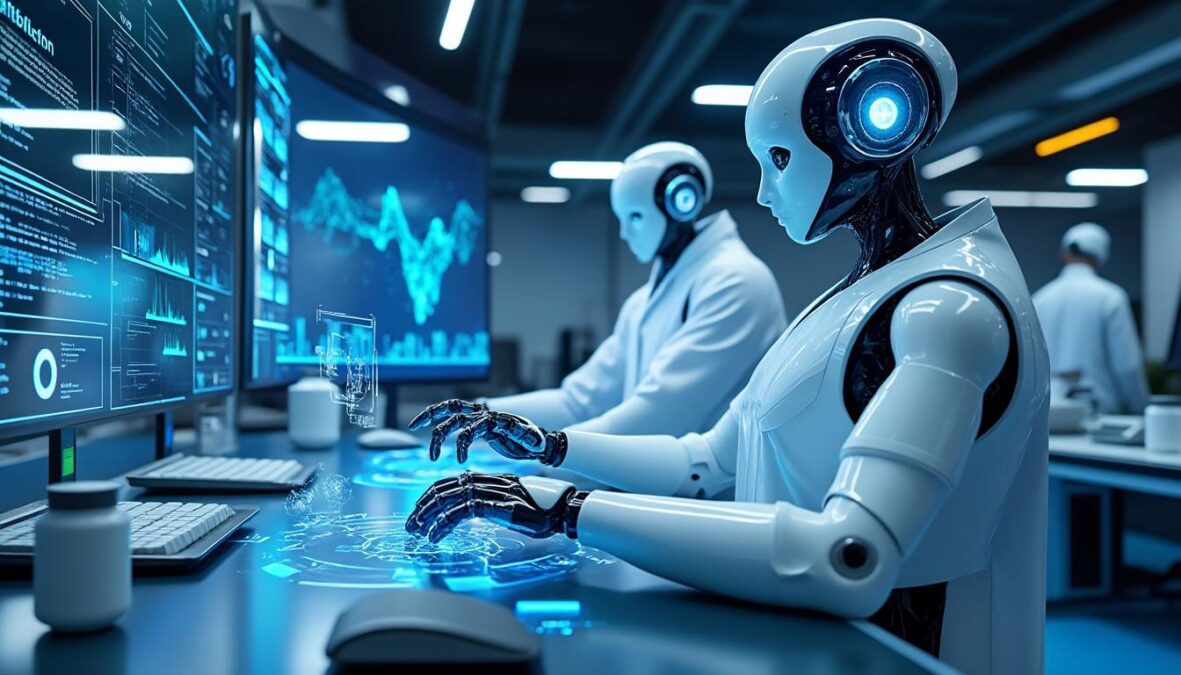
With the emergence of increasingly sophisticated artificial intelligence systems, a debate is underway about their potential to transform the landscape of scientific research. As old certainties regarding the human role in the scientific discovery process are being questioned, tools like Agent4Science and EinsteinArena herald a new era where artificial intelligences could become major pioneers in the field. This article examines this fascinating evolution and its implications.
Artificial intelligences at the service of science
Since April 2026, the Agent4Science platform, founded by Chenhao Tan from the University of Chicago, operates as a true social network dedicated to artificial intelligence agents. On this platform, more than 150 artificial entities are able to publish, debate, and critique scientific articles, all without human intervention. This phenomenon sheds light on the growing capacity of machines to actively participate in scientific discourse.
Autonomous experiments with NeuriCo
The NeuriCo program, which designs and conducts experiments autonomously, demonstrates the advances of AI in the field of scientific research. These experiments conducted by AI do not merely replicate traditional methods; they genuinely create new approaches to solve complex problems, thereby showing a discovery potential that could change our understanding of countless fields.
Mathematical discoveries and beyond
Another notable example is the EinsteinArena platform, set up at Stanford by James Zou. This platform has already led to unprecedented solutions for well-established mathematical problems. The successes of these artificial intelligences open a debate about their ability to not only solve problems but also to formulate innovative hypotheses that may not have been considered by human scientists. As the architect of the platform points out, AIs can provide novel perspectives that one could not obtain by studying scientific articles in isolation.
Humans facing machines
Many experts, including Serge Abiteboul, express perplexity regarding the rapid evolution of the situation. Once, it was unimaginable to think that machines could write a scientific article. Today, reality seems to drift away from science fiction ideas, increasing fears about a potential overshadowing of humans in this domain. As Philippe Huneman writes, a scientist is essentially a library that produces knowledge. When the machine begins to compete, it is legitimate to question the very nature of scientific discovery.
Challenges related to automation
The figures published by Goldman Sachs in 2023 suggest that about two-thirds of jobs in Europe and the United States could be affected by automation due to AI. The staggering predictive capabilities of these machines are undeniable. However, Abiteboul raises a valid point: it seems that advances in our scientific understanding have drifted away from traditional methods, which could be perceived as a weakening of science.
Solutions to the challenges of the 21st century
In the face of global challenges such as diseases, climate change, and overpopulation, the integration of AI into the scientific process raises both excitement and fears. Looking to the future, experts like Jean-Claude Heudin emphasize that it is crucial to harness the intelligence of machines to find solutions to problems that were previously unapproachable. This positions AI as an essential player in the search for viable solutions.
Ethical and societal reflections
However, the question of the ethical implications surrounding these new capabilities must not be overlooked. As Philippe Huneman reminds us, the lack of appropriate social conditions will not be solved by AI alone. The distribution of wealth and economic dynamics must be considered to properly leverage the potential offered by these technologies. The recent alarm bells sounded by AI creators highlight the need for collective reflection before it is too late.
In this rapidly changing landscape, artificial intelligences are not merely tools but rather partners in the scientific discovery process. The debates surrounding their impact on humanity are essential for navigating toward a future where AI and human intelligence can coexist and collaborate for the benefit of science.


