
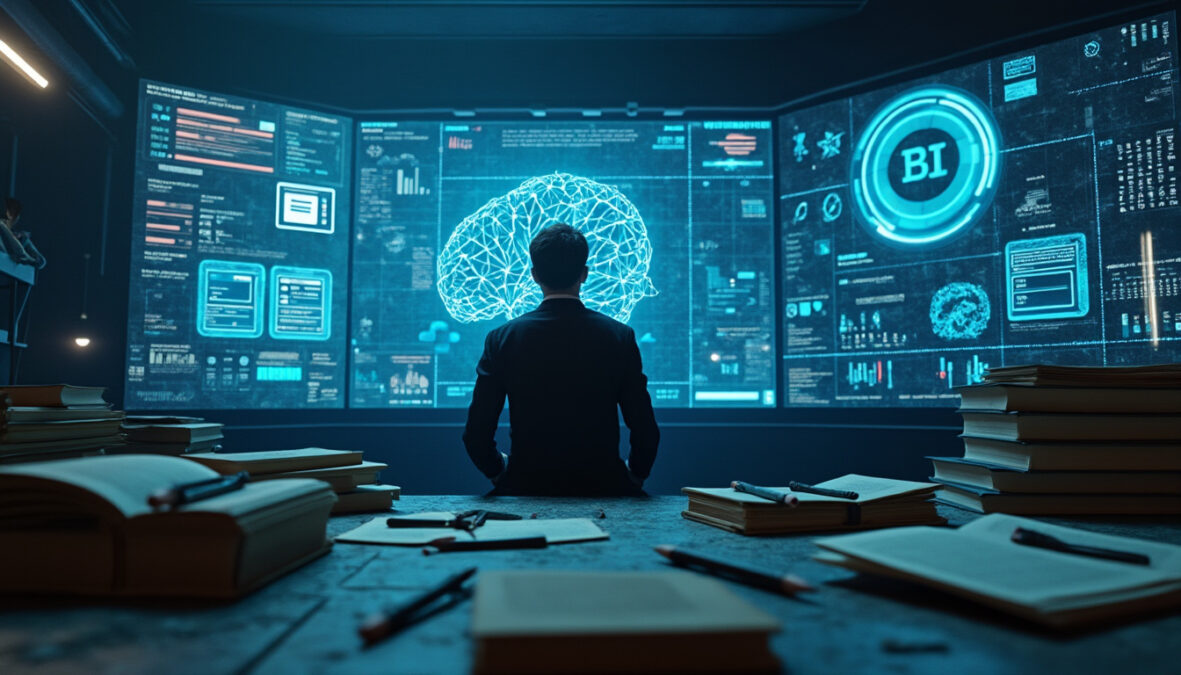
At the dawn of a new technological era, the rise of artificial intelligence raises crucial questions about our relationship with learning. As AIs become increasingly proficient in tasks such as reading, summarizing, and even writing content, the question arises as to whether traditional human learning will become obsolete. This article explores the implications of this evolution: could an increased dependence on machines lead to a decrease in our ability to learn, think, and adapt?
The capabilities delegated to artificial intelligences
Recent advances in the field of artificial intelligences allow for the delegation of various cognitive tasks to machines. From translating texts to summing up information, these tools manipulate vast amounts of data and perform functions that previously required significant human effort. By making ourselves dependent on these technologies, we may see them as tools that facilitate our daily lives, but also as potentially dangerous substitutes for our own thinking.
A true paradise or an intellectual hell?
The debate rages on about the psychological impact of this transformation. On one hand, the increased efficiency provided by AIs could pave the way for a more free world where access to knowledge is simplified. On the other hand, this dependence on AI could lead us to a form of intellectual atony. The risks of seeing our curiosity and motivation diminish in the face of technology that does everything for us should not be underestimated.
The consequences of the technologization of thought
Diverse studies, including one conducted by the Massachusetts Institute of Technology (MIT), show that the use of AI, such as ChatGPT, could lead to a decrease in neural connectivity. The less we engage our brain to perform cognitive tasks, the less we cultivate our ability to think critically. Being able to assimilate knowledge can quickly turn into a reflex more connected to instantaneity than to deep and sustainable learning.
A growing digital amnesia
A term emerges, that of digital amnesia, describing the tendency to forget information that one could quickly retrieve online. This form of forgetting goes hand in hand with overestimating our knowledge after a simple search on data evaluation engines. While technology facilitates access to knowledge, it could also reduce our capacity to retain and assimilate information.
A threat to intellectual curiosity
Curiosity is intrinsically linked to our humanity. The reality is that learning often requires effort, and it is in this challenge that the pleasure of discovery often hides. If we have the option to take a cable car instead of climbing a mountain, it is very likely that we will choose the easier path. A prolonged dependency on AI might thus annihilate our taste for intellectual ascent as well as our desire to know the world in a deep and meaningful way.
The values of human experience
In the quest for ubiquitous digital knowledge, we lose sight of the importance of lived experiences. Learning should not only consist of accumulating abstract information but also of having experiences that enrich our understanding and change us forever. Knowledge, when linked to a physical and emotional experience, becomes a more powerful tool than mere data from a database.
The limits of intellectual augmentation
The dream of augmenting human beings through technology is based on the premise that our intelligence and capabilities must be optimized at all costs. However, these limits might actually define who we are. Living with uncertainties and facing challenges are integral parts of human existence. Wisdom, often acquired through struggle and suffering, far outweighs merely processing data without a true experience.
The social impact of technological decisions
As technologies continue to advance, the values of human interactions must remain at the heart of our concerns. Solutions to societal crises requiring interdisciplinary approaches reflect this necessity. Human reflection, which includes elements of emotional, ethical, and instinctual order, should not be neglected in favor of a strictly quantifiable vision of the world.
Ultimately, the question remains: is humanity at risk of losing its critical sense and capacity for learning in the face of the rise of artificial intelligence? The future could hold a world where AI is both a tool and a challenge for our personal and collective evolution.


