
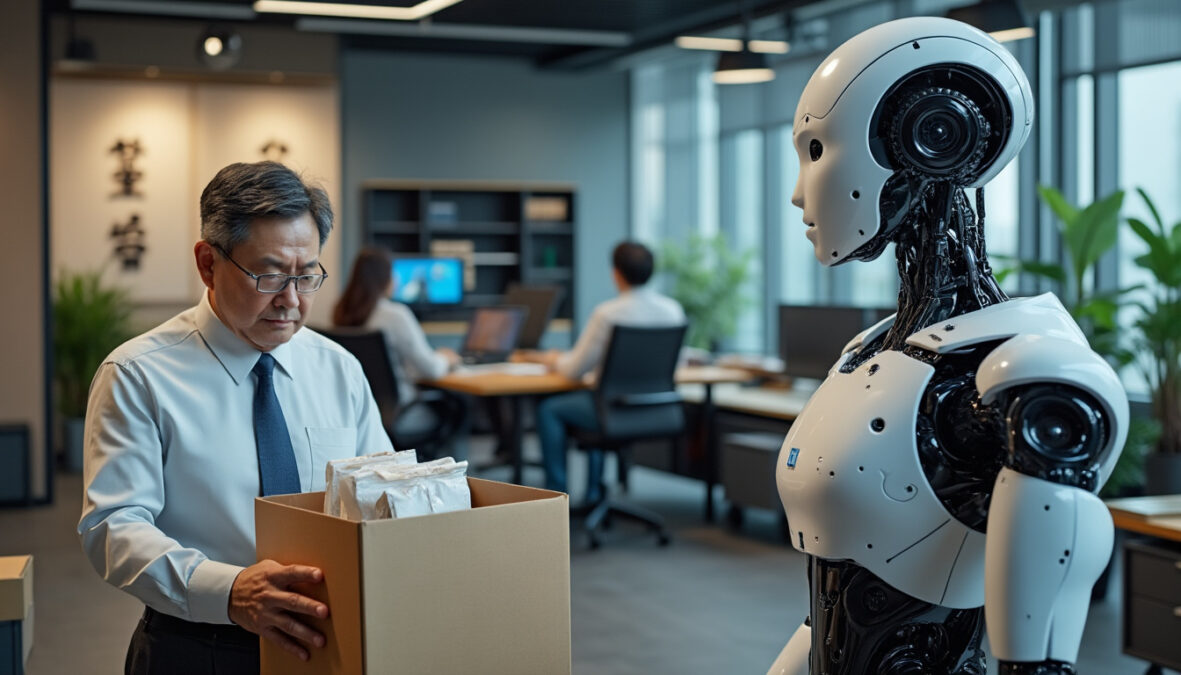
Artificial intelligence (AI) raises many questions about its impact on the job market. An incident that occurred within a Chinese company has highlighted the delicate issue of replacing a worker with AI. Following this situation, the company was sanctioned for having made this replacement in an abusive manner, leading to a court decision that questions the limits of technological use in the field of employment.
Context of the Incident
In Hangzhou, a city near Shanghai, a company decided to replace one of its employees with artificial intelligence. This employee was responsible for checking the quality of the responses generated by AI systems meant for customer service. He ensured that these solutions were error-free and respected users’ privacy. However, in 2025, he was informed that his position would be eliminated in favor of technology, while being forced to accept a 40% salary reduction to continue working. These decisions caused his outrage.
A Legal Response to an Unfair Dismissal
Refusing to accept these new working conditions, the employee filed a lawsuit against his company, labeling it as an unfair dismissal. The decision of the “intermediate people’s court” of Hangzhou, which ruled in favor of the plaintiff, highlighted the responsibility of companies to be accountable when they use AI to replace workers. The court stipulated that the company had deliberately chosen to opt for AI, without valid justifications related to external economic circumstances.
Arguments for the Company’s Defense
In its defense, the company claimed that a “substantial change in economic circumstances” justified this decision. However, the court pointed out that such an argument is generally reserved for situations where a company faces unforeseen external constraints, which did not seem to be the case here. The decision thus implied that this shift towards an AI-based work model was a deliberate managerial decision.
Financial Consequences for the Company
Following this judgment, the company was ordered to pay its former employee 260,000 yuan, equivalent to about 33,100 euros. This decision sends a strong message about the ethical issues surrounding the integration of AI into the workplace and underscores the importance of protecting workers’ rights in the face of automation.
The Debate on the Impact of AI on Employment
Incidents like this fuel the debate surrounding the impact of artificial intelligence on employment. While some studies predict that AI could replace one in two jobs, others argue that it could also generate new professional opportunities. In France, reports indicate that AI could indeed contribute to job creation, whereas in China, some companies appear to adopt a less favorable approach towards employees.
Due to the constant advancements in AI, it is essential to define an appropriate legislative framework that would balance technological innovation and employee protection. The case of this Chinese company illustrates well the challenges faced by modern societies regarding social responsibility and ethics in the application of new technologies. This dilemma raises the question: how far can companies go in automation without violating workers’ rights?
To learn more about these issues related to artificial intelligence and its integration into the labor market, explore relevant articles such as those discussing the evolution of Siri by Apple, methods for detecting altered images using AI, or the importance of mastering AI in education.


